
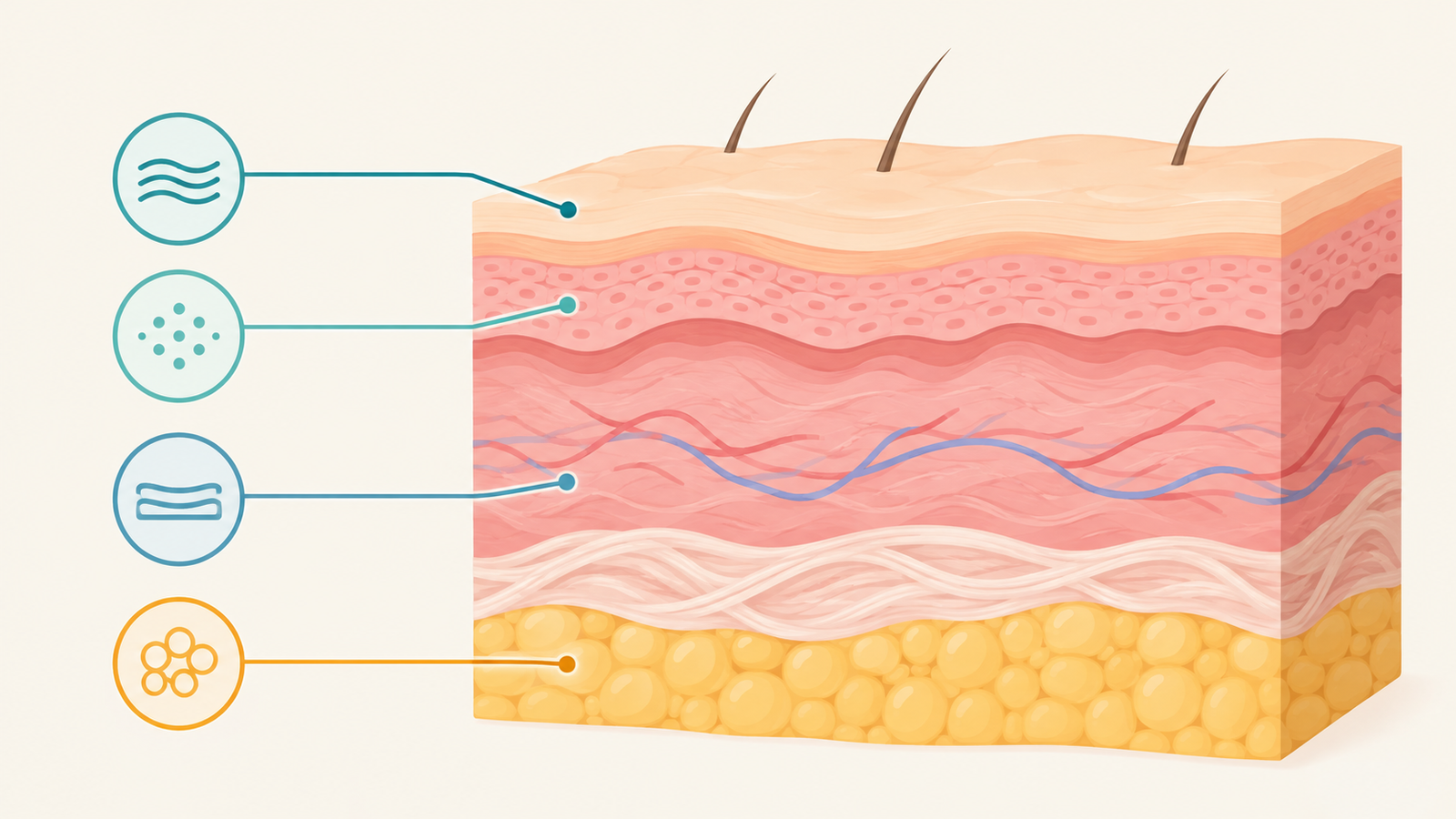
Sagging skin isn’t just about having “too much” skin – it’s the combined result of weakened collagen, a loosened support layer beneath the surface, and shifting fat pads. Non-surgical skin tightening works by targeting these specific layers directly, without a single incision, which is exactly why choosing the right technology for the right depth matters so much.
Non-surgical skin tightening works by delivering controlled energy or mechanical action to specific layers beneath the skin, triggering the body’s own collagen-rebuilding response without surgery. Some technologies use focused heat to tighten the deep support layer that surgeons work with during a facelift; others target only the mid-layer of skin while deliberately avoiding the fat layer beneath; and some physically remove tiny amounts of excess skin to close the gap mechanically. The right approach depends on how much laxity is present, the treatment area, and how much facial fat volume still needs to be preserved.
Key Takeaways
- Skin sagging comes from several things happening together – weakened collagen, a loosened support layer, and shifting fat pads – which is why non-surgical tightening isn’t a single technique but a group of different approaches.
- Different technologies are engineered to reach different depths, from the deep support layer used in surgical facelifts to the mid-layer of skin just beneath the surface.
- Going too deep with the wrong technology, especially in thinner or more volume-depleted faces, can unintentionally reduce facial fat and create a hollow rather than lifted appearance.
- Some newer approaches specifically avoid the fat layer altogether, making them a safer choice when preserving facial volume is a priority.
- Combining more than one approach across different depths, in a planned sequence, generally produces more noticeable and complete results than relying on a single technology alone.
Introduction
Non-surgical skin tightening is often marketed as one single category of treatment, but the technologies behind it work in genuinely different ways and reach genuinely different depths beneath the skin. Some rely on heat, some on mechanical tissue removal, and some on biological stimulation through injections. This article breaks down what’s actually happening beneath the surface during non-surgical skin tightening, what separates one approach from another, and how a treatment plan is actually put together.
What’s Actually Happening Beneath Sagging Skin?
Skin sagging isn’t caused by one single change – it’s the result of several structural layers breaking down at the same time. The skin’s collagen framework, which gives it firmness and bounce, gradually weakens with age as the body produces less of it and existing collagen breaks down faster than it’s replaced. Beneath that, a fibrous support layer that anchors facial muscles to the skin above gradually loosens and stretches. At the same time, the fat pads that give the face its youthful fullness shift downward and shrink in volume, leaving looser skin with less structure beneath it to hold it in place.
Non-surgical tightening technologies are designed to work against this process directly, rather than just smoothing the surface. Most do this by delivering a controlled, precisely targeted amount of energy to a specific depth, which triggers the skin’s natural healing response and switches on fresh collagen production over the following months. A smaller category works differently, physically removing tiny amounts of redundant tissue so the surrounding skin can mechanically draw together and tighten.
Clinical Overview: How Different Technologies Reach Different Depths
What makes one non-surgical tightening approach different from another is almost entirely about depth. Some technologies use focused ultrasound energy that passes harmlessly through the upper skin layers before converging at a precise, deeper point – often at the same structural layer a surgeon would work on during a facelift. This creates a genuine lifting effect, particularly useful around the brow, jawline, and neck.
Other, newer ultrasound-based approaches work differently on purpose: rather than reaching deep structural layers, they deliver energy in a tightly controlled band confined strictly to the mid-layer of skin, staying well above the fat layer beneath. This design specifically avoids any risk of affecting facial fat, which is part of why it has become a popular, lower-downtime option for people who want to avoid any chance of a hollowed appearance.
Radiofrequency-based technologies work through a different mechanism entirely, using electrical energy to generate heat as it passes through tissue. Depending on how it’s delivered, radiofrequency energy can be spread broadly across a wider depth range, or delivered precisely through fine needles inserted to an exact, adjustable depth – the latter approach, often combined with microneedling, can even be intentionally adjusted to reduce excess fat in areas like the chin and jawline when that’s part of the goal.
A newer, entirely different category skips heat altogether. This mechanical approach uses a matrix of extremely fine hollow needles to physically remove tiny, full-thickness cylinders of tissue across a treatment area. Because each removed core is smaller than the width of a hair follicle, the surrounding skin heals without visible scarring, simply drawing together and tightening the overall surface.
Diagnosis: What Gets Assessed Before Treatment
Before recommending a specific technology, a dermatologist typically evaluates several factors together:
- Degree and location of laxity: Mild early sagging responds differently than more significant, longstanding looseness, and the area involved – brow, jawline, neck, or body – shapes which technology is appropriate.
- Facial fat volume: Thinner, more volume-depleted faces need technologies that specifically avoid deep fat layers, while fuller faces with excess submental fullness may actually benefit from an approach that gently reduces fat alongside tightening.
- Skin tone and phototype: Some technologies are considered safer across all skin tones because they work through tissue density rather than light absorption, which matters for avoiding pigment-related side effects.
- Desired downtime: Options range from essentially no downtime to several days of visible redness or pinpoint scabbing, and this genuinely factors into which approach fits a person’s schedule and goals.
Treatment: What a Tightening Session Actually Involves
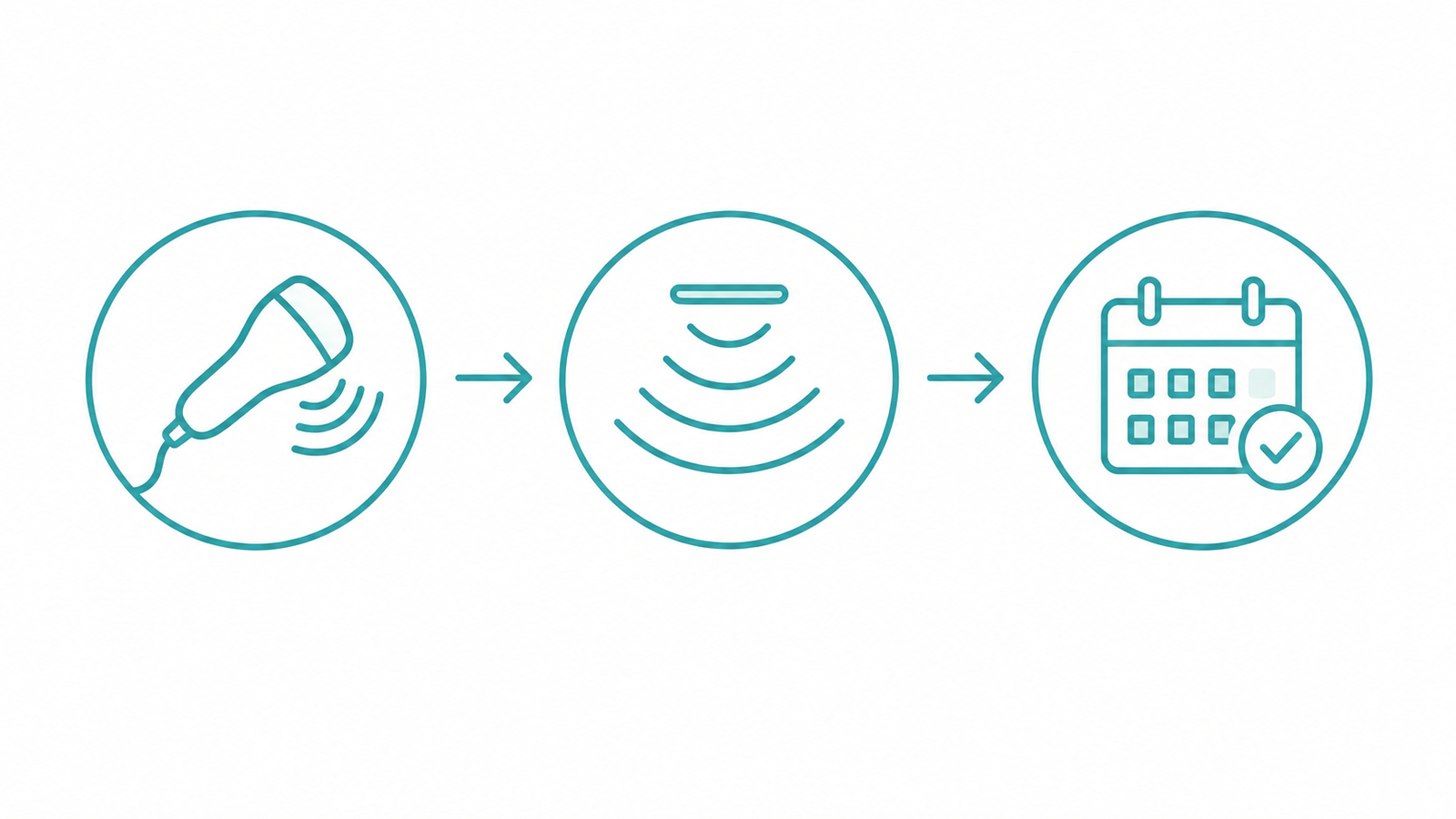
A non-surgical skin tightening session begins with cleansing the treatment area and, for deeper or more intensive approaches, applying a topical numbing cream beforehand for comfort. For ultrasound-based treatments, the clinician uses real-time imaging to actually see the layers of tissue being treated before delivering any energy, which allows precise targeting of the intended depth and helps avoid affecting structures that shouldn’t be touched.
The treatment itself is typically delivered in a systematic pattern across the treatment area, working zone by zone to ensure even coverage. Mechanical, needle-based approaches work slightly differently, with the device making rapid, automated insertions across small sections at a time. Most single sessions for a defined area like the lower face or neck take well under an hour. Depending on the specific technology used, the skin may feel warm during treatment, and mild redness, swelling, or in some cases pinpoint scabbing can follow for a few hours to a few days afterward.
Technology Guide: What Each Approach Actually Does
| Technology Category | How It Works | Fat Layer Impact |
|---|---|---|
| Deep-focused ultrasound | Converges energy at the same structural layer used in surgical facelifts | Requires careful depth control in thin tissue |
| Mid-dermal ultrasound | Delivers energy in a tightly confined band within the mid-skin layer only | Specifically designed to avoid the fat layer |
| Broad radiofrequency | Spreads heat across a wider depth range using electrical energy | Risk of fat reduction if over-applied |
| Radiofrequency microneedling | Combines fine needles with precise, adjustable-depth heat delivery | Can be intentionally adjusted for mild fat reduction |
| Mechanical tissue micro-removal | Physically removes tiny tissue cores without any heat | No fat layer impact; purely mechanical |
| Biostimulatory injectable | Triggers the body’s own collagen production through a biologic response | Adds structural volume over time rather than reducing it |
The right technology depends on laxity severity, facial fat volume, and treatment goals – this is a decision made with a dermatologist, not a one-size-fits-all choice.
What the Research Shows?
Published dermatologic and aesthetic medicine research supports several specific points about non-surgical skin tightening:
- Depth-targeted technologies show measurable, lasting tightening: Clinical studies on deep-focused ultrasound report progressive tissue contraction developing over several months that persists for a year or longer in appropriately selected patients.
- Fat-sparing designs show a strong safety record: Published clinical data on mid-dermis-confined ultrasound technology reports zero cases of facial fat loss across more than a million treatments, supporting its safety profile for volume-conscious patients.
- Combining technologies improves outcomes for significant laxity: Research on combination approaches, pairing deeper structural techniques with surface-level methods, shows enhanced skin tightening compared to using a single approach alone.
- Mechanical tissue removal shows genuine improvement without thermal risk: Published research on non-thermal, needle-based tissue removal reports meaningful improvement in skin laxity and texture with healing that avoids visible scarring.
These findings reflect published dermatologic and aesthetic medicine research; the right technology and treatment plan for an individual still depends on an in-person evaluation.
Doctor Review Block
This article has been medically reviewed by Dr. Tejansu Dalal, MD (Dermatology), for clinical accuracy. Non-surgical skin tightening genuinely works, but only when the technology and treatment depth are matched carefully to each patient’s anatomy – getting that matching right is what protects facial volume while still delivering real, visible tightening.
References & Citations
This article draws on dermatologic and aesthetic medicine research on non-surgical tissue tightening, including findings published by the National Center for Biotechnology Information on non-thermal mechanical tissue tightening for skin laxity, and reference material from the National Institutes of Health on technology-based treatment of submental skin laxity. Clinical outcome details reflect published aesthetic medicine research.