
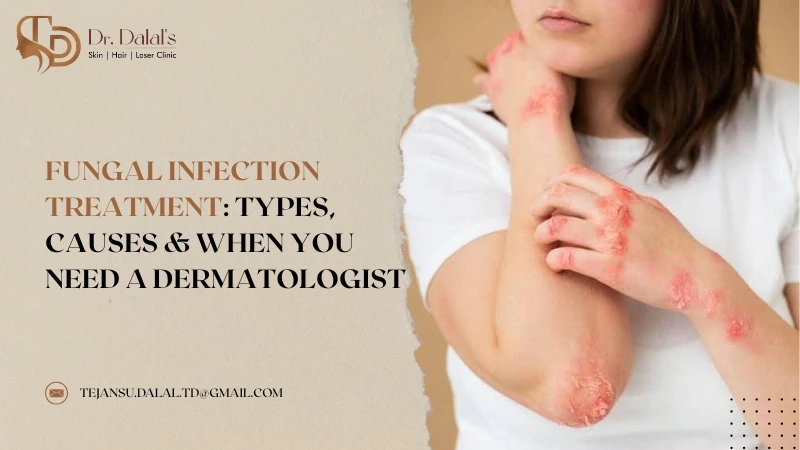
Ahmedabad’s heat and humidity make fungal skin infections one of the most common reasons people visit a dermatologist – and one of the most commonly mismanaged with over-the-counter creams. This guide explains the different types of fungal infections, why some cases are becoming harder to treat, and what proper fungal infection treatment actually looks like.
Fungal infection treatment depends on confirmed diagnosis and infection type – topical antifungals work for mild, localized cases, while oral antifungal medication is needed for nail infections, widespread involvement, or infections that keep coming back. A dermatologist can confirm the diagnosis with a simple skin scraping before starting treatment, which matters more than ever given the rise of treatment-resistant fungal strains.
Key Takeaways
- Ring-shaped, itchy, scaly patches with a raised, active border are the classic sign of a dermatophyte (ringworm-type) infection.
- Fungal nail infections respond far better to oral treatment than topical alone once more than 60% of the nail is involved.
- Widespread use of over-the-counter steroid-antifungal combination creams has fueled the rise of a harder-to-treat, terbinafine-resistant fungal strain – avoiding these combination creams matters.
- A simple skin scraping test, examined under the microscope, confirms the diagnosis before treatment starts and prevents unnecessary or ineffective medication.
- Recurring or unusually stubborn fungal infections deserve a dermatologist’s evaluation rather than repeated self-treatment with the same cream.
Introduction
Fungal skin infections are extremely common in India’s hot, humid climate, and most people have dealt with some form of it – an itchy patch of ringworm, athlete’s foot, or a discoloured nail that won’t clear up. The trouble is, many of these infections are self-treated with whatever cream is available at the local pharmacy, often a combination product containing a steroid – and this exact habit has fueled the emergence of a newer, considerably harder-to-treat fungal strain across India in recent years. This guide walks through the common types of fungal infections, how they’re properly diagnosed, and what evidence-based treatment actually involves.
What Is a Fungal Infection?
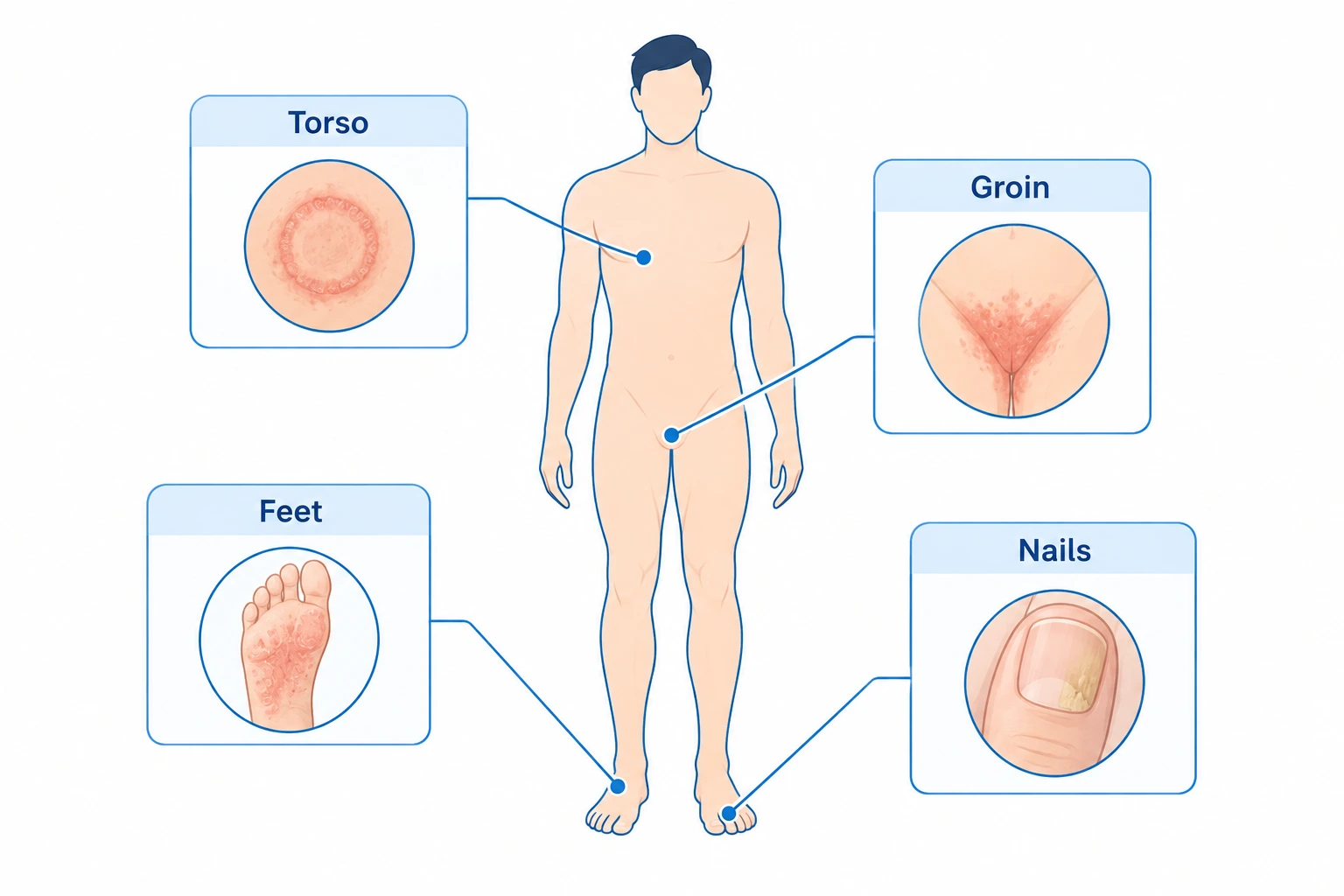
A fungal infection (mycosis) occurs when fungi – organisms that normally live harmlessly on skin, in soil, or in the environment – multiply beyond their usual limits and invade skin, hair, or nails. The most common skin-level infections are caused by dermatophytes (a group of fungi that specifically target keratin in skin, hair, and nails), producing the classic ring-shaped rash commonly called ringworm, or tinea, depending on the body site involved – tinea corporis on the body, tinea cruris in the groin, tinea pedis on the feet, and tinea unguium on the nails. A separate group, Candida yeasts, normally live on skin and mucosal surfaces but can overgrow under conditions like excess moisture, skin friction, or after antibiotic use.
Clinical Overview
Fungal infections range from mild, superficial skin involvement to, in rare cases involving people with weakened immune systems, more serious infection. Since the visible symptoms of fungal, bacterial, and viral skin infections can look remarkably similar at first glance, an accurate diagnosis matters before treatment begins. For most otherwise healthy people, the concern is superficial: itchy, ring-shaped, scaly patches with a distinct raised, active border and often central clearing – this “active edge” pattern is one of the most recognizable features of a dermatophyte infection. Location gives useful clues too – for example, groin infections that spare the scrotal skin typically point to a dermatophyte, while those involving the scrotum and surrounding skin with small satellite bumps often point to a Candida yeast infection instead.
A significant recent development is the emergence of a fungal strain that resists standard treatment. This resistant strain produces unusually extensive, intensely itchy, and inflamed patches that fail to respond to the typical short course of oral antifungal medication. Its rise is closely linked to the widespread, unsupervised use of over-the-counter combination creams that mix an antifungal, an antibacterial, and a strong steroid – the steroid component actually suppresses the skin’s local immune response while providing inadequate antifungal exposure, creating ideal conditions for the fungus to develop resistance.
Diagnosis
Confirming the diagnosis before starting treatment matters more than many people realize, since several other skin conditions – psoriasis, eczema, and contact dermatitis among them – can closely resemble a fungal infection on first glance. A proper evaluation typically includes:
- Skin scraping and microscopy: A small sample of skin, hair, or nail debris is examined under the microscope using a simple potassium hydroxide preparation, which can confirm the presence of fungal elements within minutes.
- Fungal culture: Growing the sample on specialized culture media identifies the exact fungal species involved, which is particularly useful for guiding treatment in resistant or unusual cases.
- Clinical pattern recognition: Location, border appearance, and associated symptoms (itching, scaling pattern) help narrow the diagnosis even before lab results return.
- Nail assessment: For suspected nail fungus, the dermatologist evaluates how much of the nail plate is affected and whether the nail matrix (the growth centre) is involved, since this directly determines whether topical treatment alone will be sufficient.
Skipping this diagnostic step and reaching straight for an over-the-counter cream is exactly the pattern that has contributed to the rise of treatment-resistant infections – confirming the diagnosis first is a small step that meaningfully improves treatment success.
Treatment
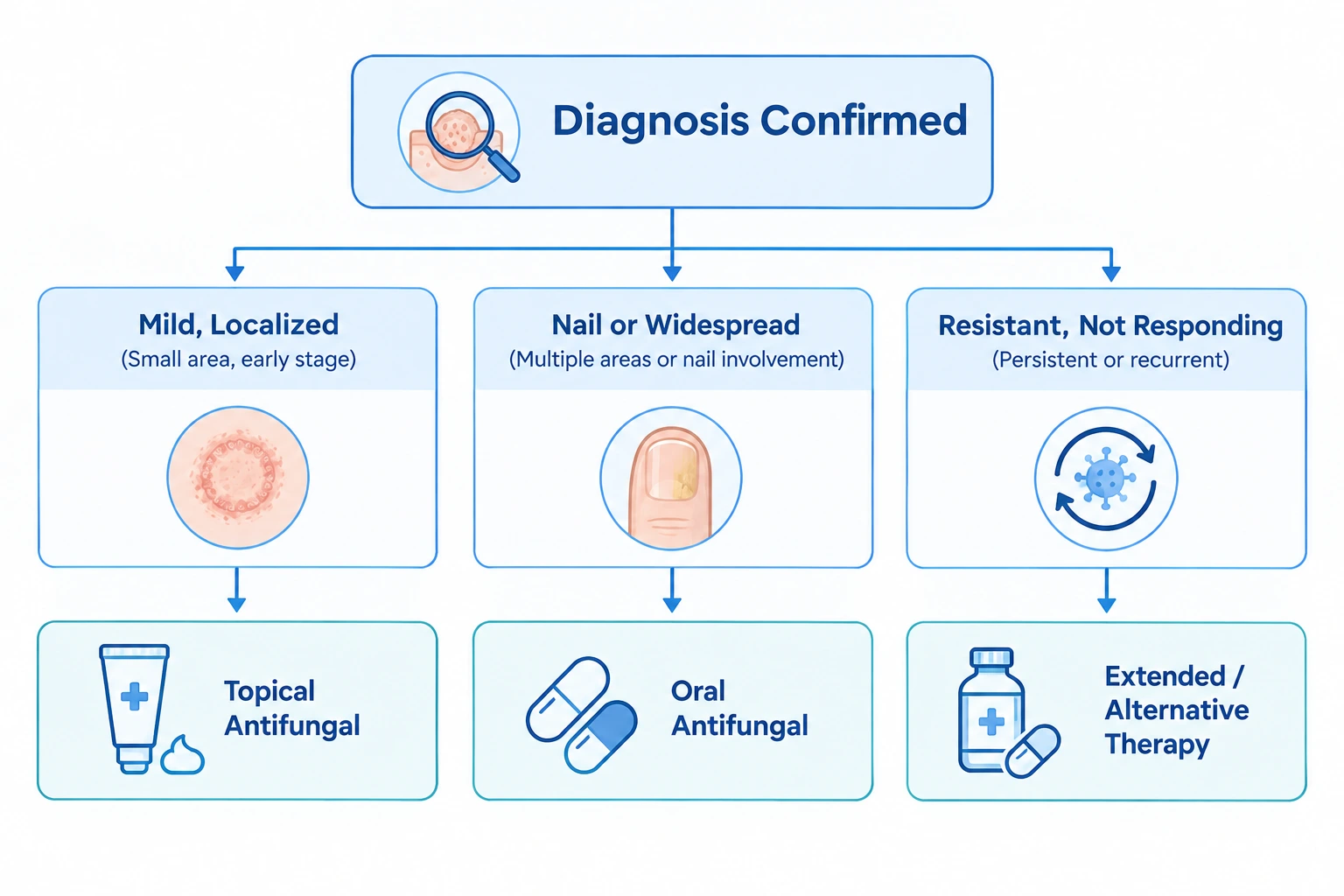
Fungal infection treatment is matched to the site, extent, and type of infection involved:
Topical Antifungals
For mild, localized skin infections, topical antifungal creams applied consistently over several weeks are typically sufficient and carry minimal side effects since they act locally rather than throughout the body.
Oral Antifungal Therapy
Required for nail infections with significant involvement, widespread skin infections, or infections that haven’t responded to topical treatment. Oral options are selected based on the specific fungus involved, the patient’s other health conditions, and drug interaction risk, since some oral antifungals require liver function monitoring.
Treatment for Resistant Infections
When an infection fails to respond to standard treatment, it may represent a resistant strain requiring a different drug class altogether and a meaningfully longer treatment course – sometimes extending to 8 to 12 weeks rather than the standard few weeks.
Nail-Specific Topical Therapy
For milder nail involvement, a topical antifungal solution applied daily over many months can achieve clearance without the systemic exposure of oral medication, and is often a good option for patients who cannot take oral antifungals.
What to Avoid
Over-the-counter combination creams that mix a steroid with an antifungal are best avoided entirely – while they may temporarily reduce itching and redness, they consistently make the underlying infection worse and harder to treat over time.
Clinical Trial Data
Research on antifungal treatment outcomes shows some clear, consistent patterns:
- Oral terbinafine, the standard first-line treatment for nail fungus, achieves complete cure in roughly 38 to 76% of cases and mycological clearance (a negative lab test) in about 70 to 74% of cases.
- Topical nail treatments show meaningfully lower complete cure rates in adults (around 15 to 18%) compared to oral therapy, though they carry a much lower risk of systemic side effects, making them a reasonable choice for milder cases.
- Interestingly, the same topical nail treatments show notably higher success in children (around 40% complete cure), largely because children’s nails grow faster and are thinner, allowing quicker clearance.
- Terbinafine-resistant infections treated with an alternative oral antifungal have shown cure rates of roughly 67 to 86% over 8 weeks, though this requires closer monitoring for side effects and drug interactions than standard first-line treatment.
- Guideline recommendations in this field rely heavily on expert consensus rather than large randomized trials, reflecting how genuinely difficult large-scale fungal infection research is to conduct – this is a field where a dermatologist’s clinical judgment, not just published statistics, plays a significant role in treatment decisions.
These figures come from published dermatology and infectious disease literature; individual response depends on the specific fungal species, extent of infection, and adherence to the full treatment course.
Medication Guide
| Medication/Therapy | Type | Typical Use |
|---|---|---|
| Terbinafine | Oral allylamine | First-line for nail and widespread skin infections; requires baseline liver monitoring |
| Itraconazole | Oral triazole | Alternative first-line, including for resistant strains; multiple drug interactions |
| Fluconazole | Oral triazole | Alternative when terbinafine or itraconazole aren’t suitable |
| Topical azole creams (clotrimazole, luliconazole) | Topical | Mild, localized skin infections; adjunct to oral therapy in resistant cases |
| Efinaconazole solution | Topical (nail) | Mild-to-moderate nail involvement, once-daily application over many months |
Never use a combination steroid-antifungal cream without medical guidance – this specific habit is directly linked to the rise of harder-to-treat, resistant fungal infections.
Doctor Review Block
This article has been medically reviewed by Dr. Tejansu Dalal, MD (Dermatology), for clinical accuracy. Treatment recommendations should always be personalised through an in-person consultation and, where appropriate, laboratory confirmation of the specific fungal infection involved.
References & Citations
This article draws on dermatology and infectious disease clinical literature, including data published by the National Institutes of Health on emerging terbinafine-resistant fungal strains, and clinical guidance from the Centers for Disease Control and Prevention. Treatment outcome figures reflect published dermatology trial data on oral and topical antifungal therapy.