
Early hair thinning and advanced, long-standing hair loss aren’t the same problem – and treating them the same way is one of the most common reasons hair loss treatment disappoints. Matching the right approach to the actual stage and cause is what makes the real difference.
Hair loss treatment works differently depending on what’s actually causing the loss and how advanced it is. Early, genetic thinning usually responds well to topical or oral medications that slow the process down. More advanced genetic loss often needs a combination approach or surgical hair transplantation. A separate, less common type caused by the immune system attacking hair follicles responds to an entirely different class of medication. Getting the diagnosis right is what determines which path actually works.
Key Takeaways
- Most hair loss is genetic thinning that happens gradually over years – but a smaller number of cases are caused by the immune system, which needs a completely different treatment approach.
- Mild-to-moderate genetic hair loss generally responds well to topical or oral medications that slow the process and support regrowth.
- Combining more than one treatment approach – such as a topical option with an oral one – tends to work better than relying on a single treatment alone.
- For severe cases caused by the immune system, a newer class of oral medication has significantly changed what’s possible, helping many patients regrow substantial hair coverage.
- Surgical hair transplantation works well for advanced, stable genetic hair loss, but it still needs to be paired with ongoing medical treatment to protect the surrounding hair that wasn’t transplanted.
Introduction
Hair loss treatment often gets approached as one single problem with one single fix – but that’s rarely how it actually works. The cause behind hair loss, and how advanced it has become, changes everything about which treatment is likely to help. This article walks through the different stages of hair loss, what separates mild cases from severe ones, and what the current range of treatment options actually does at each stage.
What’s Actually Causing the Hair Loss
The most common type of hair loss is genetic thinning, where hair follicles that are more sensitive to a specific hormone gradually shrink over time. This happens slowly and predictably – in men, it typically starts at the hairline and the crown; in women, it usually shows up as gradual thinning along the central part, while the hairline itself tends to stay intact.
A separate, less common cause involves the immune system itself attacking hair follicles, leading to sudden patches of hair loss rather than gradual thinning. This type behaves completely differently and needs a different treatment approach altogether. A third, much less common category involves scarring that permanently damages the follicle – once this type of scarring has set in, the hair loss in that area generally can’t be reversed, which is exactly why catching it early matters so much.
Clinical Overview: Why Stage Matters as Much as Cause
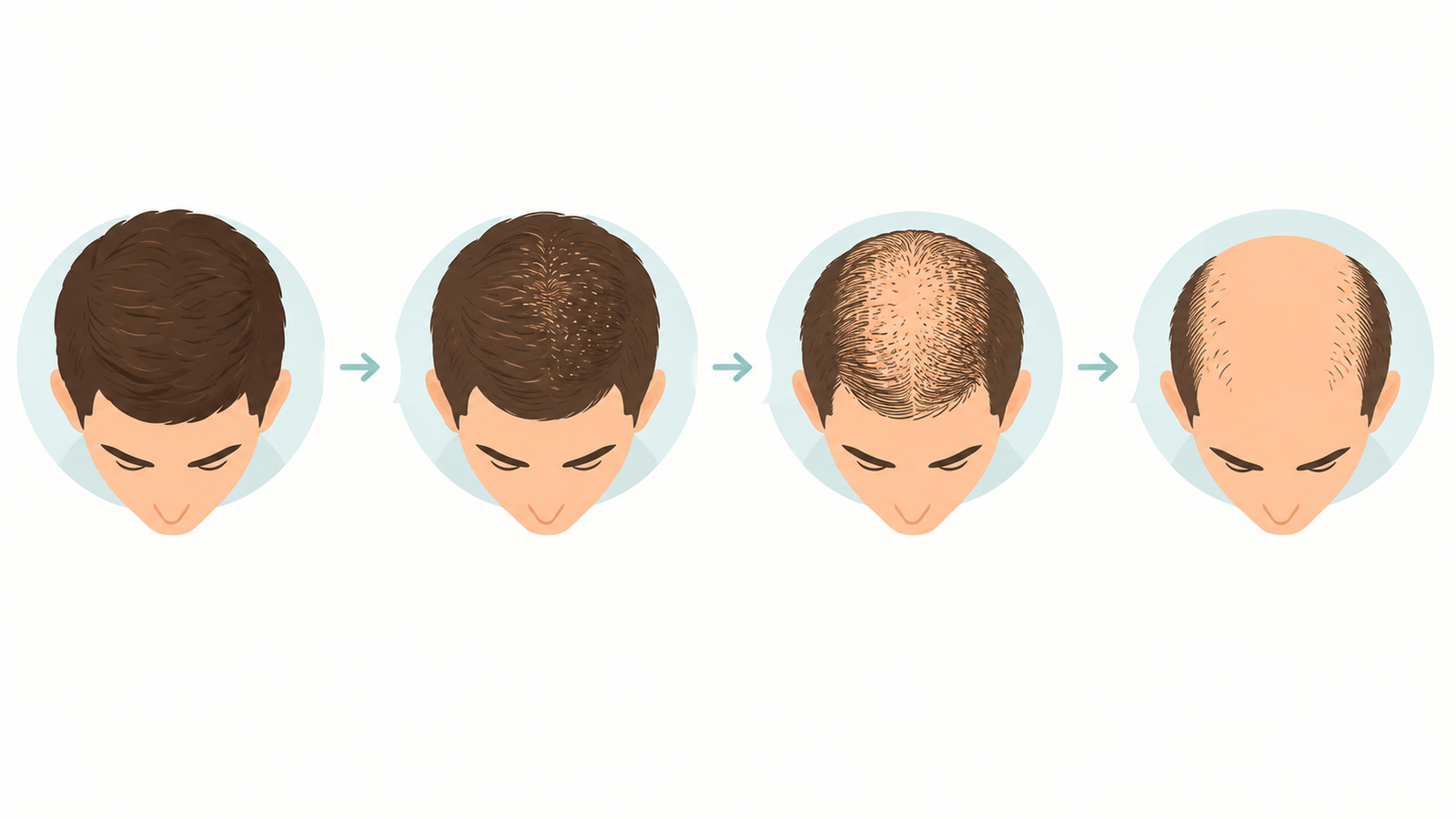
Beyond identifying the cause, dermatologists also grade how advanced the hair loss has become, because this directly shapes which treatments are realistic. In genetic hair loss, this ranges from mild, early thinning to advanced, extensive loss where very little original hair remains in the affected area. In the immune-related type, severity is measured by what percentage of the scalp has lost hair.
This staging matters because early-stage hair loss still has follicles present, just shrinking – which means they can often be coaxed back into growing with the right treatment. Very advanced loss, where follicles have been inactive for a long time, responds far less predictably to medication alone, which is exactly why more advanced cases often shift toward combination treatment or surgical options rather than medication by itself.
Diagnosis: How Stage and Type Get Identified
A dermatologist typically uses a few specific methods to pin down both the cause and the stage:
- Pattern recognition: Where the thinning is happening – hairline and crown, central widening part, or sudden round patches – points strongly toward which type of hair loss is present.
- Standardized grading scales: Specific scoring systems are used to grade exactly how advanced the loss is, which directly guides how aggressive treatment needs to be.
- Scalp examination: A close look at the scalp and remaining hair can reveal signs of inflammation, scarring, or active shedding that point toward a specific cause.
- Family and medical history: Genetic hair loss tends to run in families, while sudden patchy loss or signs of scalp inflammation point toward investigating other causes.
Treatment: Matching the Approach to the Stage
For mild-to-moderate hair loss treatment, the first-line approach generally combines a topical solution applied directly to the scalp with an oral medication that works from within, since this combination consistently outperforms either approach used alone. Adding in-clinic micro needling sessions can further help by boosting how well topical treatments absorb into the scalp.
For more advanced genetic hair loss, treatment often escalates to a stronger oral medication option or adds platelet-rich plasma therapy, which uses a concentrate prepared from the patient’s own blood to stimulate dormant follicles. When hair loss has become extensive and stable over time, surgical hair transplantation becomes the main option for restoring visible density – though this still needs to be paired with ongoing medical treatment afterward to protect the hair that wasn’t transplanted.
For hair loss caused by the immune system, when it affects a significant portion of the scalp, a newer category of oral medication specifically designed to calm this immune reaction has meaningfully changed what’s achievable, helping many patients regrow substantial coverage where older treatments offered limited, inconsistent results.
Medication Guide: What Each Option Actually Does
| Option | How It Works | Typical Timeline |
|---|---|---|
| Topical scalp solution | Improves blood flow to hair follicles and extends the growth phase | Visible change around 3 to 6 months |
| Oral hormone-blocking medication | Slows the hormone-driven shrinking of genetically sensitive follicles | 6 to 12 months for full effect |
| Platelet-rich plasma therapy | Uses the patient’s own blood-derived growth factors to stimulate follicles | Series of sessions, then periodic maintenance |
| Immune-calming oral medication (for immune-related loss) | Blocks the specific immune signaling that attacks hair follicles | Noticeable regrowth by around 6 months in responders |
| Surgical hair transplantation | Moves permanently resistant follicles to thinning areas | Final results visible at 12 to 18 months |
The right combination depends on the underlying cause, how advanced the loss is, and individual health history – this is a decision made with a dermatologist, not a one-size-fits-all routine.

What the Research Shows
Published dermatologic research supports several specific points about hair loss treatment:
- Combination therapy outperforms single treatments: Clinical studies consistently show that combining a topical and an oral treatment produces faster, stronger density gains than either approach used alone.
- Stronger oral options show measurably higher results: Research comparing different oral hormone-blocking medications shows one option achieving notably higher density improvements than the standard choice, though individual suitability varies.
- Immune-calming medication has transformed outcomes for severe cases: Large clinical trials report that roughly a third to over 40 percent of patients with significant, immune-related hair loss achieved 80 percent or more scalp coverage within about six months of starting treatment, compared to a small fraction on placebo.
- Transplanted hair stays resistant, but surrounding hair still needs protection: Research confirms that surgically transplanted follicles remain resistant to the hormone that causes genetic thinning, but surrounding native hair continues to need ongoing medical treatment to prevent further loss around the transplant.
These findings reflect published dermatologic research; the right treatment path still depends on an individual diagnosis and evaluation.
Doctor Review Block
This article has been medically reviewed by Dr. Tejansu Dalal, MD (Dermatology), for clinical accuracy. Hair loss treatment works best when it’s matched precisely to the cause and stage present – getting that diagnosis right from the start is what separates a treatment plan that actually works from one that disappoints.
References & Citations
This article draws on dermatologic hair restoration research, including findings published by the National Center for Biotechnology Information on the management of male pattern hair loss, and reference material from the National Institutes of Health on scarring alopecia and related conditions. Clinical outcome figures reflect published dermatologic clinical trial data.