
Mesotherapy is described in many ways: a “vitamin boost for the scalp,” a “glow injection,” a “hair growth cocktail.” These phrases sound exciting, but they do not tell you what is actually going into your skin, whether it works and how many sessions you may need. This guide explains mesotherapy treatment in simple language, with a focus on hair, so you can separate what is well supported from what is mostly hype.
Mesotherapy treatment uses very fine needles to place small amounts of active ingredients into the upper layers of the skin or scalp. For hair, the aim is to deliver nutrients and hair-growth medicines directly around the follicles, so more reaches the target and less enters the body. Studies support it most for early pattern hair loss, when the mix contains proven hair medicines, and for certain pigment problems. Evidence for general vitamin “glow” mixes on the face is weak. Results typically appear over a few weeks and usually need maintenance sessions.
Key Takeaways
- Mesotherapy is a way of delivering medicines or nutrients through many tiny injections placed just under the skin surface. It is a method, not one single drug.
- What works depends on what goes in the syringe. Mixes based on proven hair medicines and some pigment treatments have the best support. Vitamin-only facial mixes have much weaker proof.
- Many results need repeat or maintenance sessions, because the effect usually fades after a few months.
- Common effects are redness, mild swelling, small bruises and pinpoint pain. Serious infections are rare and linked to unsterile technique.
- Safety depends on a trained doctor, single-use sterile needles and standard, tested formulas.
- Mesotherapy works best as part of a plan, not as a standalone cure for hair loss.
Introduction
Hair fall is one of the most common reasons people visit a skin clinic, and mesotherapy is one of the treatments they hear about most. Friends mention it, social media promotes it and clinics advertise it. What is often missing is a clear explanation of what is being injected, why tiny needles matter and which kinds of hair or skin problems it can realistically help.
This article answers those questions honestly. If you are considering mesotherapy treatment, it will help you ask better questions at your consultation and avoid disappointment.
What Mesotherapy Is?
Mesotherapy was developed in France in the 1950s, originally for pain and circulation problems. Today, it is also used in dermatology and hair care. In this procedure, very small amounts of an active mixture are injected into the upper layers of the skin using ultra-fine needles. Instead of swallowing a tablet or applying a cream, the active ingredients are placed right where they are needed.
For hair, the mixture is often a custom blend that may include hair-growth medicines, vitamins, amino acids and minerals, selected after examining your scalp. For skin, mixes may target pigmentation, hydration or small areas of stubborn fat.
Clinical Overview: How the Tiny Injections Work
Mesotherapy works in two ways at once.
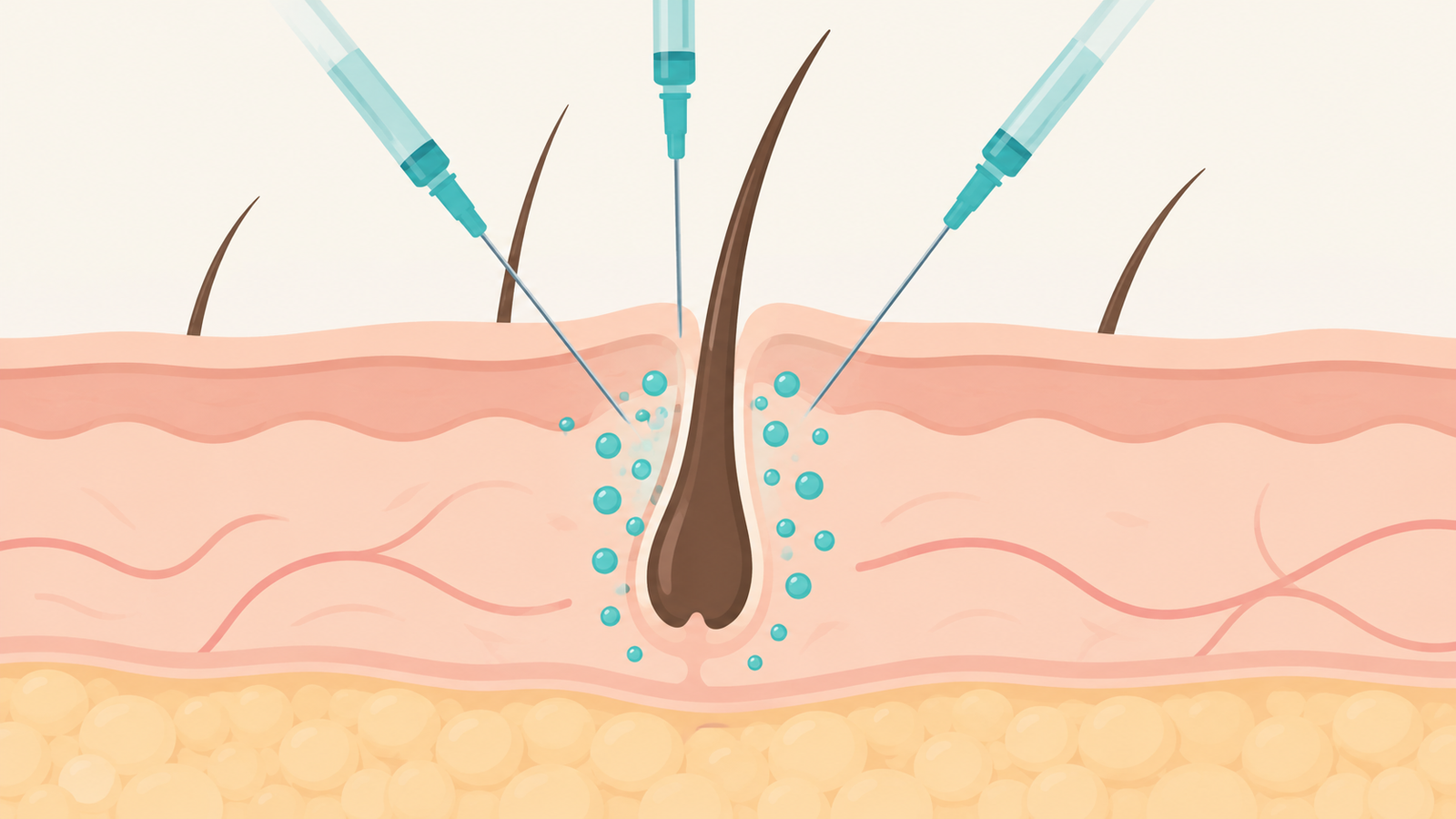
1. The ingredients themselves. A cream has to cross the tough outer layer of the skin, and a tablet has to travel through the whole body. Injections placed in the upper skin layers skip both barriers. The skin then holds the mixture like a small reservoir, releasing it slowly over several hours, so the target area gets more exposure while the rest of the body gets much less.
2. The needle itself. Each tiny puncture triggers a mild healing response in the skin. This can increase blood flow and wake up repair cells. This is also why some of the quick “glow” after a session is due to temporary swelling and water held in the skin, rather than deep structural change.
Depth matters. For scalp treatment, the mixture is placed in many shallow points across the thinning area, close to the hair roots. For other uses, the depth and technique change. Placing a mixture at the wrong depth is one of the main reasons for poor results and side effects, which is why the injecting doctor’s training matters.
Needle-free versions, which use ultrasound or electric currents, are more comfortable but deliver only a fraction of what injections do, so they are generally less effective.
What the Research Shows?
Mesotherapy is not one treatment with one result. The evidence varies sharply depending on what is injected and why:
- Pattern hair loss: Controlled studies of micro-injections containing proven hair-growth medicines have reported better hair density and thicker hair shafts in early pattern hair loss. Results were comparable to daily topical use, without the need to apply anything every day.
- Melasma and some pigmentation: Reviews show clear improvement in pigment with certain injected mixes, particularly those containing an anti-pigment medicine, with benefits seen at 1 to 5 months.
- Pain conditions: Low-dose injections have helped muscle and joint pain in some studies, with outcomes similar to oral pain medicine and fewer stomach side effects.
- Facial vitamin “rejuvenation”: Studies that took skin samples before and after courses of multivitamin injections did not find a meaningful increase in collagen or elastin. The skin looks fresher for a short time mainly from swelling and temporary water retention.
- Fat reduction: Evidence is mixed, and the procedure carries more risk if the mix is placed at the wrong depth.
- Regulation: Mixed mesotherapy cocktails for cosmetic use are not approved as a single product in many countries. Individual ingredients are approved for other uses. This is why medical supervision and standard formulas matter.
The simple lesson is that mesotherapy is as good as the formula and the technique behind it. These findings come from published reviews and studies. Your own result depends on your hair loss type, the mix chosen and follow-up.
Mesotherapy Compared With Other Treatments
| Feature | Mesotherapy | PRP | Dermal Fillers | Microneedling |
|---|---|---|---|---|
| What is placed in the skin | A custom mix of medicines, vitamins or other ingredients | Your own concentrated platelets from a small blood sample | A gel that adds volume | Nothing; tiny needles only create micro-channels |
| Main idea | Direct delivery to the target area | Your own growth signals to repair tissue | Fill and lift | Trigger collagen through controlled micro-injury |
| Usually used for | Early hair thinning, some pigmentation, skin hydration | Hair density, deeper skin repair | Deep lines and volume loss | Texture, scars, pores |
| Typical onset | A few weeks | Several weeks | Immediate | Several weeks |
| How long it lasts | Often 1 to 3 months, so maintenance is common | Often 6 to 12 months after a series | 6 to 24 months depending on the product | About 3 to 6 months |
| Needs your blood to be processed | No | Yes | No | No |
These are general ranges from published reviews. Your doctor will choose what fits your condition.
A combination of mesotherapy and PRP is sometimes used, because one supplies nutrients and medicines while the other provides growth signals. Studies of such combinations suggest better results than either alone, but the plan should be individual.
Diagnosis: Who May Benefit
A proper hair assessment comes first. A top skin doctor in ahmedabad will look at your scalp, the pattern and stage of hair loss, how long it has been happening and your health history. Some hair loss comes from reversible causes, such as stress, illness, crash diets or low iron, and needs those causes treated first.
Often suitable:
- Early pattern thinning with hair roots still alive
- Increased shedding after illness, stress or a seasonal change, once any underlying cause is checked
- People who want an option beyond daily creams or tablets
- Those already using hair medicines or PRP who want an additional boost
Not ideal or needs caution:
- Long-standing, shiny bald areas where follicles have closed, as injections cannot revive them
- Active scalp infection or open wounds
- Pregnancy, unless your doctor says it is safe
- Active inflammatory skin disease such as psoriasis, because injuries to the skin can trigger new patches
- Known allergy to an ingredient in the mix
Treatment: What a Session Involves
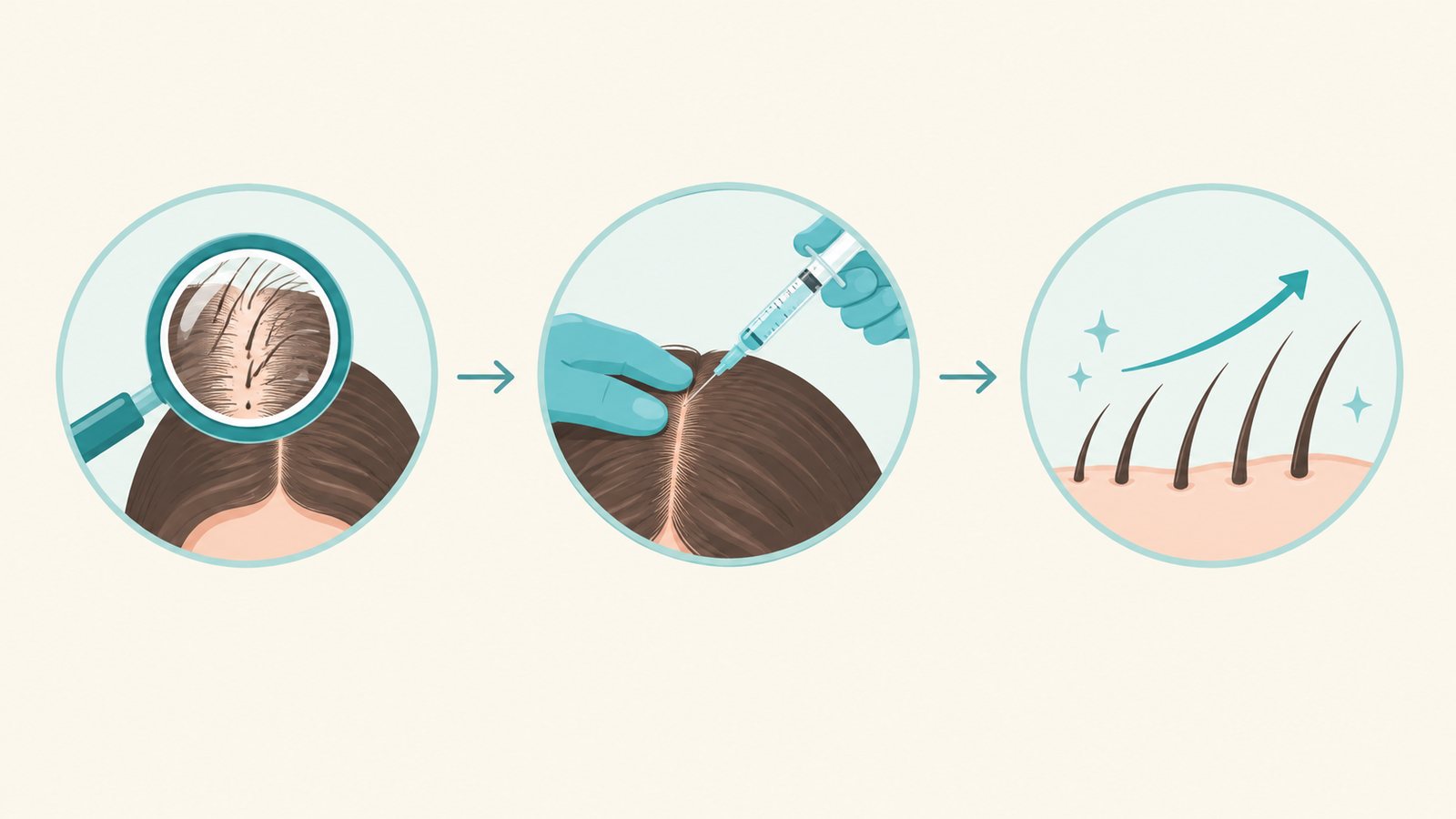
A well-run mesotherapy treatment starts with the scalp check, then a mix chosen for your type of hair loss. The scalp is cleaned with a medical-grade antiseptic, and a numbing cream may be applied. The doctor then places many small injections across the thinning area in a planned pattern. The session is usually short, and most people feel pinpricks and mild stinging rather than significant pain.
Afterwards, expect mild redness, tiny bumps, tenderness or small bruises for a day or two. Most people return to their routine the same day, but your doctor may ask you to avoid heavy sweating, harsh hair products and scalp scrubbing for a short time. Because results usually fade, the doctor will plan a series of sessions and then maintenance, and will review your progress at each visit. Hair treatments of this kind work best when your doctor combines them with other options for your type of hair loss. At the best hair clinic in ahmedabad, mesotherapy is typically one part of a larger plan that may also include medicines, PRP and lifestyle correction.
Safety is the most important part. Serious complications, such as slow-growing skin infections, have mostly been traced to unsterile technique or mixes prepared and shared across patients. Insist on a licensed doctor, single-use needles and syringes, a clean procedure area and a standard, labelled formula. Other uncommon problems include lumps or granulomas, darkening of the skin, a flare of an existing skin condition and temporary extra shedding.
Doctor Review Block
This article has been medically reviewed by Dr. Tejansu Dalal, MD (Dermatology), for clinical accuracy. In my experience, mesotherapy helps most when the hair loss is early, the mix is chosen for the patient and follow-up is regular. It is not a shortcut for hair that has already been lost, and a clear conversation about what to expect is the best way to avoid disappointment.