
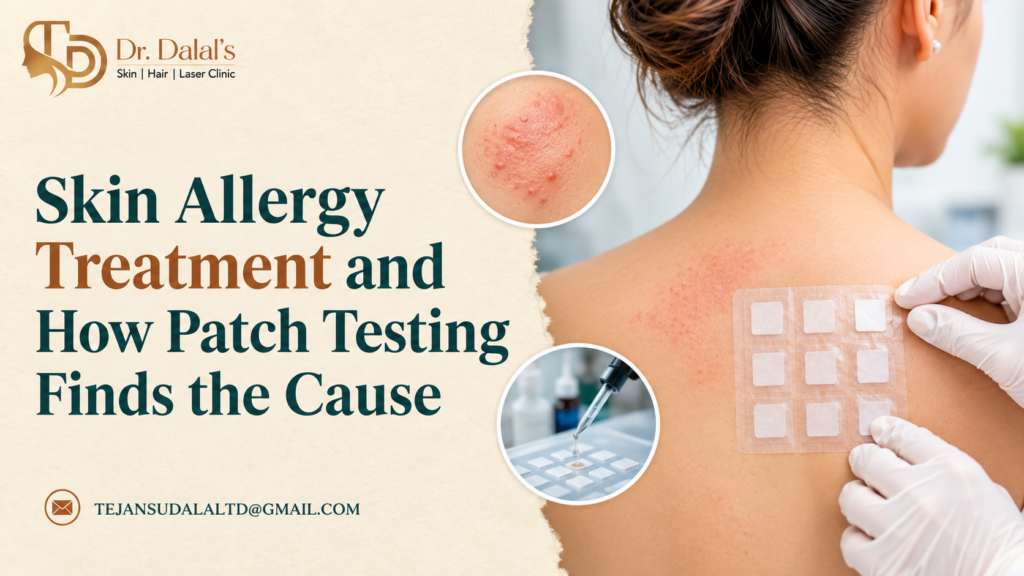
A rash that keeps coming back around the neck, wrists, scalp or hands is often blamed on “sensitive skin” or on whatever you used last. The real trigger can be something you touch every day, such as a metal, a hair dye, a fragrance or a skin care product. The most reliable way to find it is patch testing, a simple test done on the back. This guide explains how skin allergy treatment begins with finding the cause, how patch testing works and what the results can and cannot tell you.
Skin allergy treatment works best when the trigger is found, and for contact allergy the most reliable test is patch testing. Small amounts of common allergens are placed on the upper back under patches, and left in place for about two days. The skin is then checked at about two days and again at about four days, and sometimes at one week. A positive spot shows which substances you are allergic to. Patch testing does not diagnose hives, food allergy or breathing allergies, and some medicines and sun exposure can affect the result, so your doctor will give you a preparation plan.
Key Takeaways
- Skin allergy treatment works best when the trigger is found, not only when the rash is calmed.
- Patch testing is the standard test for contact allergy and is done on the back without needles.
- Patches stay on for about two days, and the skin is read again at about three to four days.
- Some medicines and sun exposure can hide a real allergy, so follow your doctor’s preparation plan.
- A positive result must be matched with your daily life before it is called the cause.
- Patch testing does not diagnose hives, food allergy or breathing allergy.
- After the test, avoiding the trigger and a clear product list give the best chance of a lasting result.
Introduction
Many people with a repeating rash try one cream after another. The rash settles and then returns, because the trigger is still there. Treatment that only calms the skin without removing the cause often fails in the long run.
Skin allergy treatment starts with a different question: what is the skin reacting to? For a rash that appears where the skin touches something, a doctor often recommends patch testing. It can identify the trigger in a way that guesswork cannot, and it turns “avoid everything” into a short, clear list of things to avoid.
What Skin Allergy Means
A skin allergy is a reaction of the skin to a substance. The most common type is allergic contact dermatitis. In this type, the immune system learns to react to a substance after repeated contact, and the next time the skin touches it, a red, itchy rash appears, often with small blisters or dry, scaly skin. The rash usually shows up one to three days after contact, not at once, which is why the cause is hard to guess.
It is different from an irritant reaction, where a harsh substance such as soap, bleach or a strong cleaner damages the skin directly. Irritant reactions do not need earlier exposure and can happen to anyone with enough contact.
Other skin allergy problems, such as hives and deeper swelling of the lips or eyelids, work in a different way and need different tests.
How Patch Testing Is Done
Patch testing is simple and does not use needles.
- Consultation: Your doctor asks about your rash, your products, your work and hobbies, your jewellery and your medicines, and looks at the pattern of the rash.
- Choosing the allergens: A standard set of common allergens is chosen, such as metals, fragrances, preservatives, hair dye chemicals, rubber chemicals and some medicine ingredients. Extra items, such as your own products, can be added if needed.
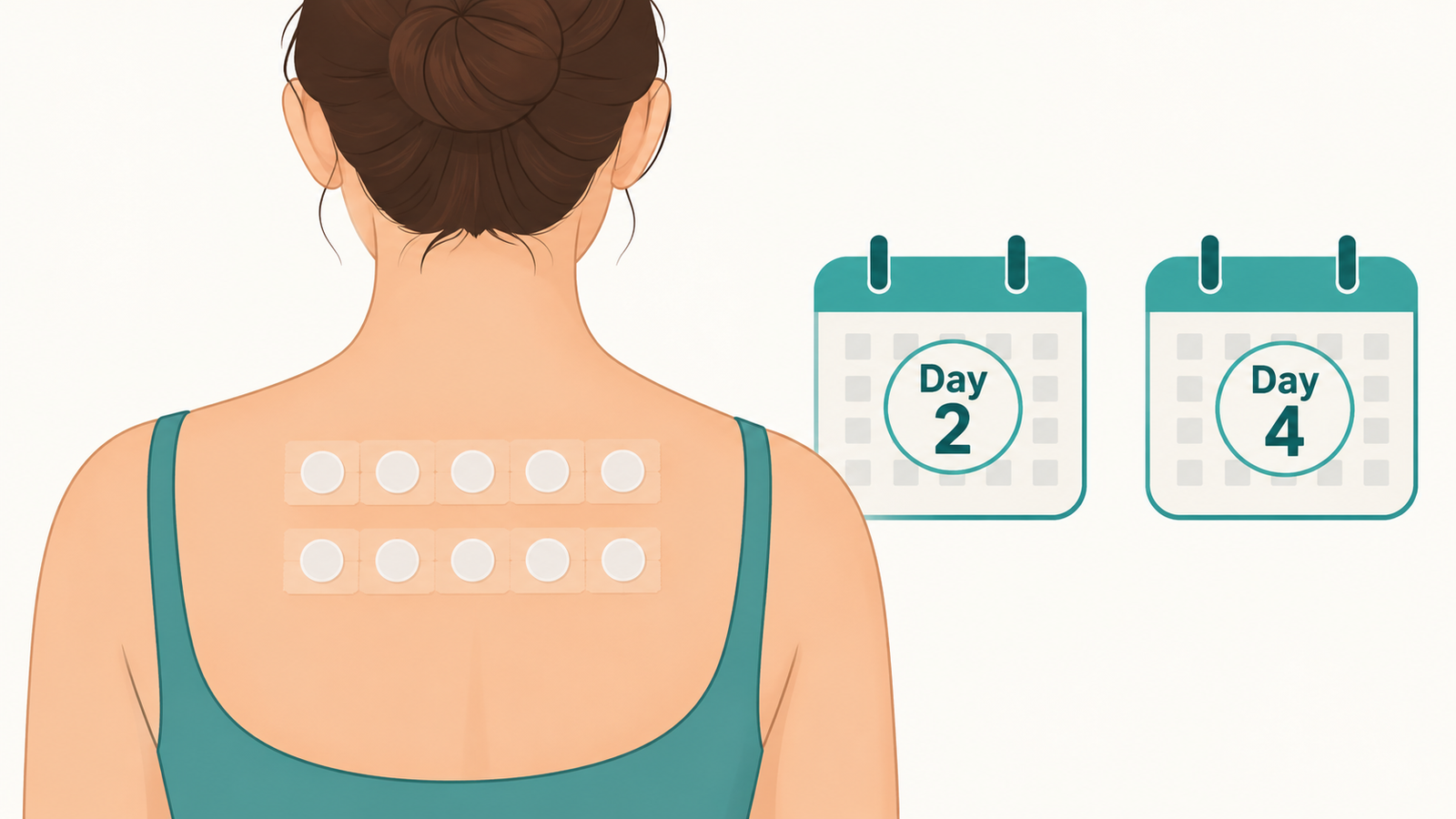
- Applying the patches: Small amounts of each allergen are placed in tiny chambers on tape and stuck to the upper back. The positions are marked so each spot can be identified later.
- Wearing the patches: You keep them dry and in place for about 48 hours. No heavy sweating, no showering that wets the back and no sun on the area.
- First reading: The patches are removed after about two days. Your doctor waits a short time for the pressure marks to fade and then checks the skin.
- Second reading: A second check at about three to four days is important, because many true allergic reactions appear or get stronger by then, while irritation tends to fade. Some slow reactions need a further check at about one week.
Preparing for the Test
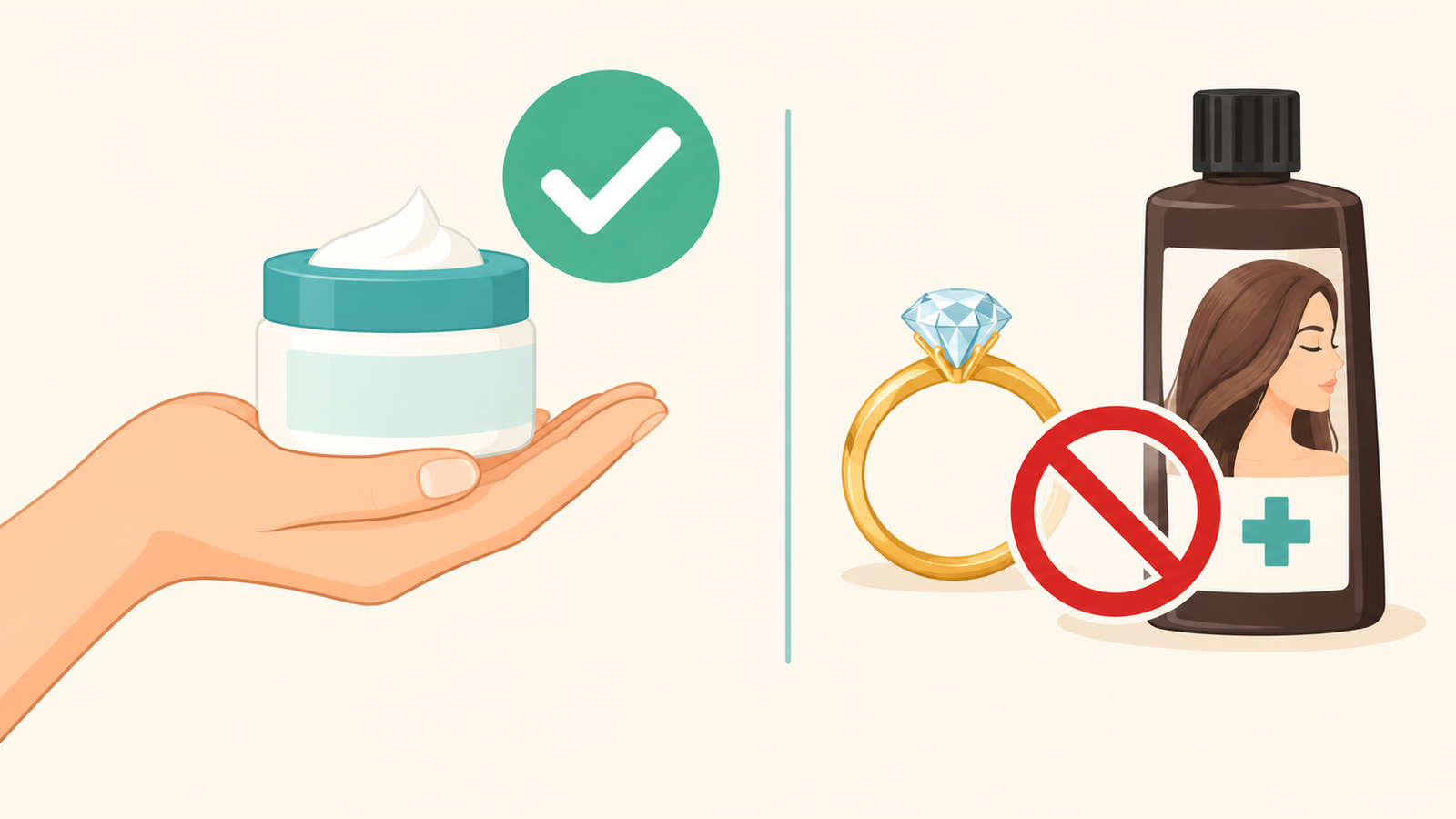
Some medicines and habits can hide a real allergy and give a false negative result, so preparation matters.
| Item | What Usually Applies | Why It Matters |
|---|---|---|
| Steroid tablets | Usually stopped for a couple of weeks before testing, only if your doctor advises | They quiet the immune reaction that patch testing needs to see |
| Steroid creams on the back | Avoid on the test area for about two weeks | They hide skin reactions where patches are placed |
| Other anti-inflammatory creams | May need to stop for several days to a week | They can dull the reaction |
| Antihistamine tablets | Usually can be continued | They do not block this type of reaction |
| Sun and tanning | Avoid on the back for one to two weeks | Sun exposure weakens the skin’s reaction |
| Active rash on the back | Test may need to wait | Inflamed skin can give false results |
| Creams, powder or oils on the day | Keep the back clean and free of products | Products can affect how patches stick |
Never stop any prescribed medicine on your own. Your doctor will tell you what to stop, for how long and what to do instead.
Reading and Understanding the Results
Doctors read each patch spot and grade it by how it looks and feels.
- No change: negative for that substance
- Faint redness only: doubtful, and may need a repeat or another test
- Redness with a raised, firm area: weak allergic reaction
- Redness, bumps and tiny blisters: stronger allergic reaction
- Strong redness with swelling and large blisters: very strong allergic reaction
- Burn-like or glazed look, which fades by the second reading: usually irritation, not allergy
A true allergy tends to get stronger between the first and second readings. Irritation tends to peak early and then fade. This is why the second reading cannot be skipped.
A positive result is not the same as the cause. It means your skin is sensitive to that substance. Your doctor then checks whether you actually meet it in daily life, in your products, work or home. A positive result may explain your rash now, may explain an earlier rash, or may be something to avoid in the future. If the link is unclear, your doctor may ask you to apply the suspect product on a small area of the forearm twice a day for one to two weeks, which is called a repeated open application test.
When you have many positive spots at once, it can be due to a very reactive skin state from an active rash elsewhere. In such cases, doctors repeat the test on individual items later.
What Patch Testing Cannot Find
- Hives and swelling: These usually involve a quick reaction and are not found by patch testing. They need a careful history, and sometimes other tests.
- Food, pollen, dust and insect allergy: These are checked with other kinds of tests, chosen by your doctor.
- Irritant reactions: Patch testing can help separate these from allergy, but it does not test for them directly.
- Allergies not in the tested set: A standard set may miss a rare allergen, so your own products may need to be tested.
- Sun-triggered allergy: Rashes on sun-exposed skin from sunscreens, fragrances or some medicines may need a special version of the test with light.
A negative test does not always mean “no allergy”. It can also mean the cause is irritation, eczema from another cause, or an allergen that was not tested.
What the Research Shows
- Patch testing is the standard test for contact allergy: It is the accepted method worldwide for finding delayed-type contact allergy, and it is more reliable than guessing from a product list.
- Timing matters: Studies stress reading the patches at more than one time, because reading too early can miss real allergy or mistake irritation for allergy.
- Common triggers are everyday items: Metals such as nickel, hair dye chemicals, fragrances, preservatives in cosmetics, rubber chemicals and cement-related chromium are among the most frequent triggers. Hair dye, jewellery and black henna are common sources in India.
- Use tests help find the real culprit: A report on the repeated open application test describes how it helps judge weak or doubtful patch test results and test finished products at home.
- Steroid creams can themselves cause allergy: Some people with long-standing eczema worsen on steroid creams because of an allergy to the cream, and patch testing can identify this. A review of allergic contact dermatitis to corticosteroids describes how to recognise and manage it.
- Preparation changes the result: Studies note that steroid tablets, strong steroid creams and sun exposure can hide positive results.
Skin Allergy Treatment After the Test
Once the trigger is known, treatment has two parts.
1. Avoid the trigger. This is the most important step. Your doctor gives you a list of substances and the many names they appear under in product labels. You then choose products, jewellery, hair colour and work gloves that do not contain them. Many people find that the rash clears and stays away.
2. Calm the skin while it heals.
- Short courses of steroid creams for flares, as advised by your doctor
- Non-steroid creams for sensitive areas such as the face, eyelids and folds
- Gentle cleansers and plain moisturisers to repair the skin barrier
- Cool compresses for blistering or weeping skin
- Tablets for severe or widespread rashes, only under medical supervision
- Antihistamine tablets if itching disturbs sleep, as advised by your doctor
A planned skin allergy treatment therefore begins with history, examination and, when suitable, patch testing, and continues with follow-up to check that the rash stays away. The top skin doctor in ahmedabad will also tell you honestly when your rash is eczema, hives or another condition instead of contact allergy.
Practical steps at home:
- Keep a note of new products, jewellery, hair dye and work materials around the time a rash starts
- Patch test any new skin product on a small area of the forearm for a few days before using it widely
- Switch to simple, fragrance-free products where advised
- Wear protective gloves at work if your doctor advises, and check what the gloves are made of
- Take photos of a rash while it is active, to show your doctor
A skin clinic ahmedabad can also help you with a safe product list once your results are known.
Doctor Review Block
This article has been medically reviewed by Dr. Tejansu Dalal, MD (Dermatology), for clinical accuracy. In my experience, the biggest change in patients comes when they finally know what the skin is reacting to. A rash that came back for years often settles once the right trigger is removed and the skin is allowed to heal.
References & Citations
This article draws on published research on contact allergy and patch testing, including a report on the repeated open application test available through the National Institutes of Health, and a review of allergic contact dermatitis to corticosteroids published through the National Library of Medicine. Descriptions reflect published studies and general clinical practice.