
Most warts are harmless and disappear on their own – but some need a dermatologist’s attention right away. This guide explains how to tell a routine wart from one that needs professional evaluation, and what treatment options actually work.
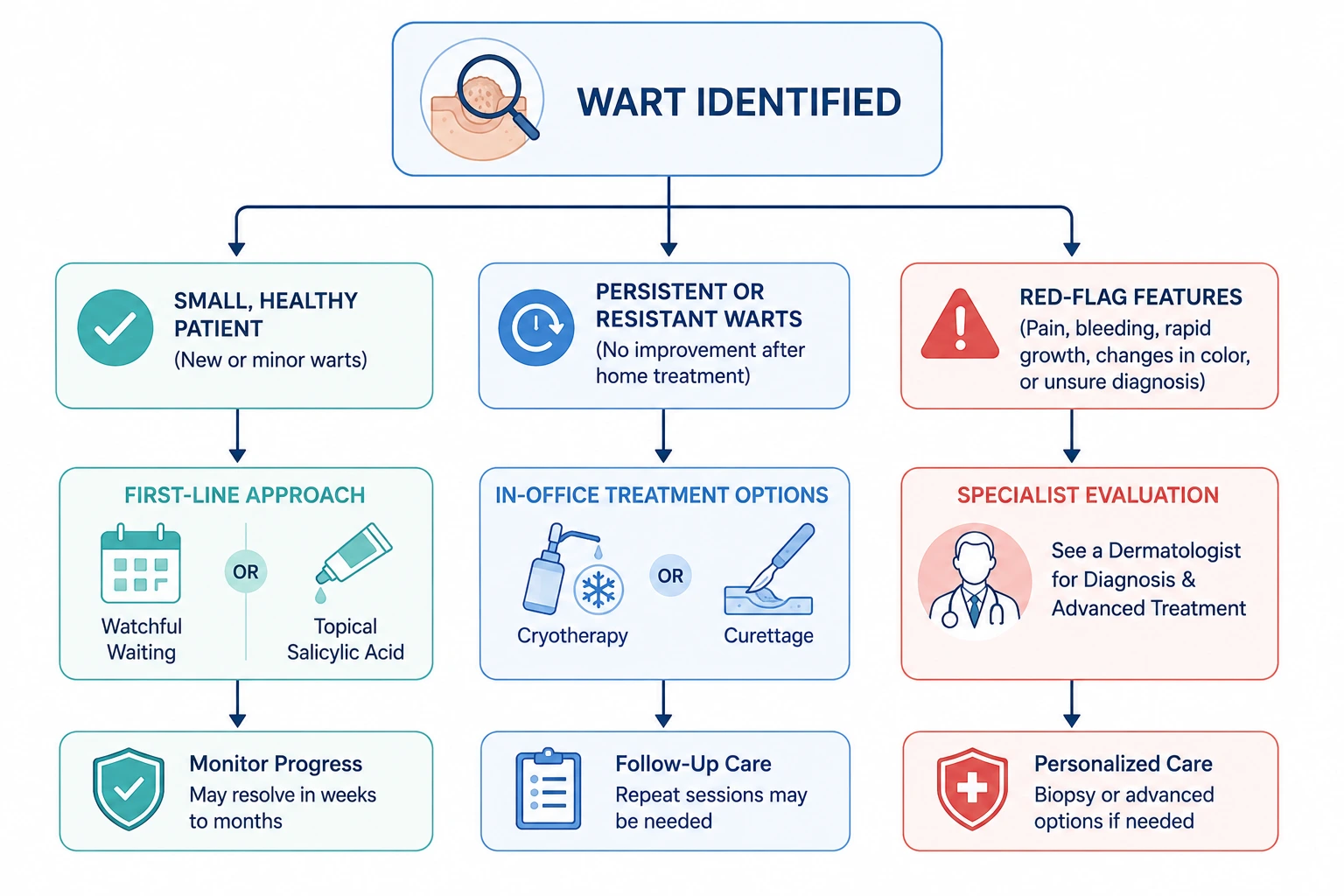
See a dermatologist if a wart-like growth changes shape or color rapidly, bleeds without injury, is very painful, appears in the genital area, doesn’t respond to weeks of home treatment, or occurs in someone with a weakened immune system. Small, typical warts on the hands or feet in an otherwise healthy person can often be managed with over-the-counter treatment first.
Key Takeaways
- About half of all warts clear on their own within a year, and roughly two-thirds within two years – patience is a legitimate first step.
- The classic sign of a true wart is tiny black or reddish dots visible after gentle filing – this distinguishes it from a corn or callus.
- Persistent bleeding, rapid growth, or an irregular, changing appearance are the clearest reasons to see a dermatologist rather than wait.
- People with a weakened immune system tend to develop more widespread, harder-to-treat warts and should be evaluated sooner.
- No single treatment clears every wart – recurrence after treatment is common, even with effective methods.
Introduction
A rough, raised bump on the hand or foot is usually nothing more than a common wart – a harmless, if stubborn, skin infection that most people will experience at some point. But not every skin growth that looks like a wart actually is one, and not every wart is safe to leave alone or treat at home. This guide walks through how warts are identified, what genuinely separates a routine case from one that needs a dermatologist, and which treatments have real evidence behind them.
What Is a Wart?
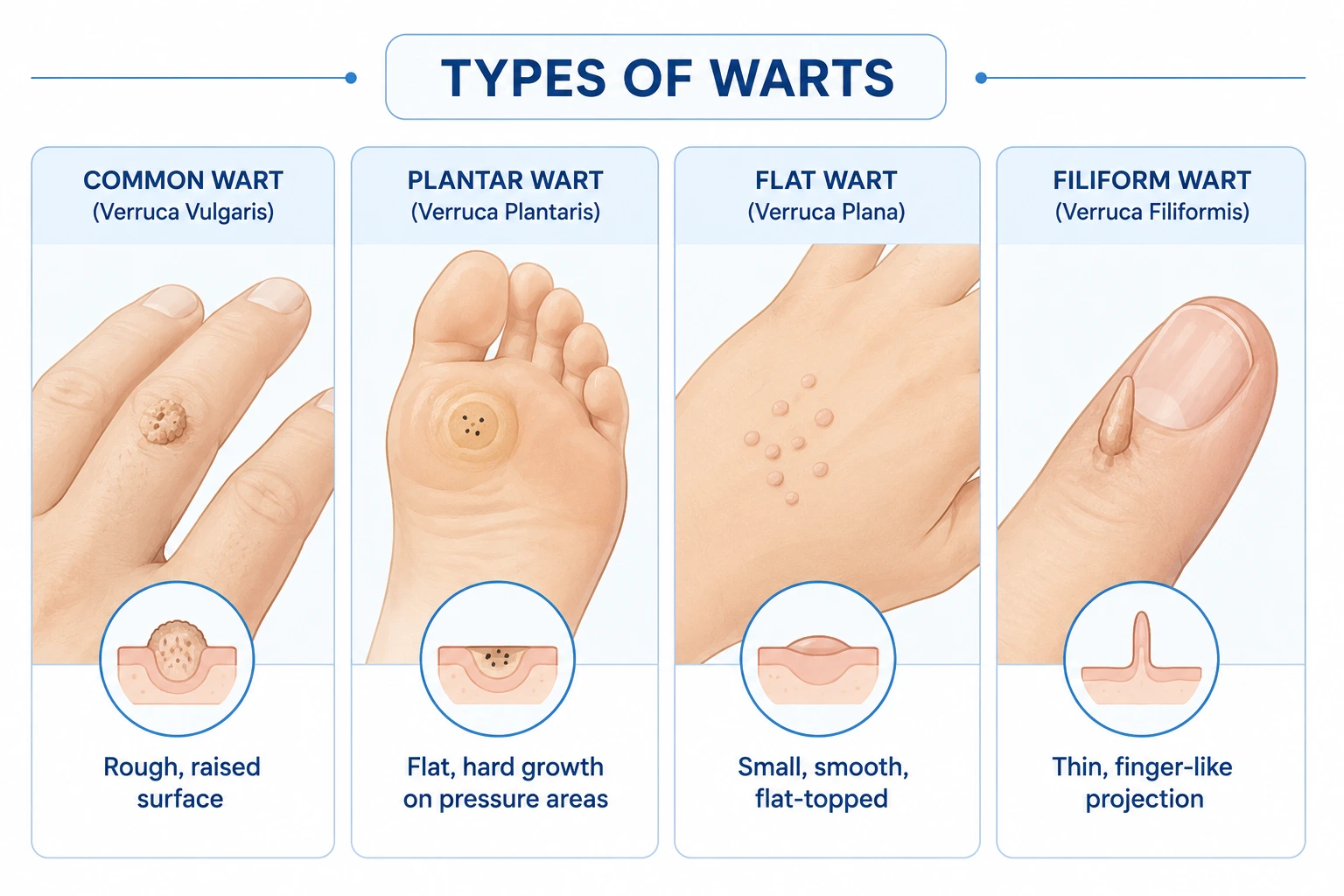
A wart is a benign skin growth caused by infection with the human papillomavirus (HPV), which triggers rapid, localized growth of skin cells. Warts appear in several forms depending on their location and the HPV type involved – including common warts on the hands, plantar warts on the soles of the feet, flat warts often seen on the face in children, and filiform warts, which have a thin, finger-like projection typically found near the eyes or mouth. Genital warts are a separate category caused by different HPV types and are managed differently from the warts discussed here.
Clinical Overview
Warts are extremely common, affecting a significant share of school-age children and teenagers in particular, though adults can develop them too. Encouragingly, most warts resolve on their own without any treatment – roughly half clear within a year, and about two-thirds within two years. That said, a meaningful minority persist for five years or longer, particularly in adults, smokers, and people with a weakened immune system.
Immunosuppression dramatically changes the picture: people on immunosuppressive medication or living with conditions that weaken immune defenses tend to develop far more widespread and treatment-resistant warts, and they carry a higher long-term risk of skin cancer at affected sites – which is exactly why this group is generally advised to see a dermatologist rather than self-treat.
Diagnosis
Diagnosing a wart is usually straightforward on clinical examination, but distinguishing it from look-alike conditions matters:
- Surface examination: A wart typically disrupts the natural skin lines at the site, while a corn or callus does not – this single sign is one of the most useful ways to tell them apart at home.
- Gentle paring: When gently filed, a true wart often reveals tiny black or dark red dots – these are small clotted blood vessels, sometimes called the “pepper dot” sign, and their presence strongly points to a wart rather than a corn.
- Dermoscopy: In clinic, a dermatologist may use a handheld magnifying device to look for the characteristic clustered, dotted vessel pattern that confirms a wart and helps rule out other lesions.
- Biopsy (when needed): Rarely necessary, but recommended if a growth looks unusual, changes rapidly, or the diagnosis remains uncertain after examination – this is done specifically to rule out something more serious.
Getting the diagnosis right matters because several other skin conditions – including some that need urgent attention – can superficially resemble a wart, which is exactly why persistent or unusual-looking growths deserve a professional look rather than a guess.
Treatment
Treatment approach depends on the wart’s location, how long it’s been present, the patient’s age, and how it’s responding (or not) to earlier attempts:
Watchful Waiting
For small, painless warts in an otherwise healthy person, simply monitoring is a legitimate option, since a large proportion resolve without any intervention within one to two years.
Topical Salicylic Acid
The standard first-line, over-the-counter option. Consistent daily or nightly application over several weeks, combined with gentle filing between applications, produces meaningful clearance in many cases.
Cryotherapy
In-clinic freezing with liquid nitrogen is one of the most widely used procedural treatments, typically requiring multiple sessions spaced a few weeks apart. It’s more effective with more aggressive freezing, though this comes with more discomfort and a higher chance of temporary skin discoloration.
Curettage or Electrocautery
Surgical scraping or heat-based removal under local anesthesia offers fast, often complete removal of an isolated wart in a single session, though it carries a higher risk of a small scar.
Laser Therapy
Reserved mainly for warts that haven’t responded to simpler treatments. Laser can clear a stubborn wart in one procedure but requires specialized equipment and carries a higher cost.
Immune-Based Approaches
For recalcitrant, treatment-resistant warts, options like intralesional immune-stimulant injections are considered – these work by provoking the body’s own immune response against the wart, though they’re generally reserved for cases where simpler methods have failed.
What Doesn’t Work Well Duct tape occlusion, once a popular home remedy, has not shown meaningful benefit over standard treatment or placebo in more recent research – it’s safe to try, but shouldn’t be relied on as a primary treatment.
Clinical Trial Data
Research on wart treatment shows a fairly consistent pattern across methods:
- Salicylic acid produces meaningfully higher clearance rates than no treatment at all, with cure rates reported in the range of 50 to 70% after 6 to 12 weeks of consistent use.
- Cryotherapy shows similar overall clearance rates (roughly 50 to 70%) after 3 to 4 sessions, though more aggressive freezing produces better results at the cost of more discomfort.
- Curettage and electrocautery report high single-session clearance for isolated warts, often exceeding 70 to 90% when the growth is fully removed, though scarring risk is correspondingly higher.
- Combination approaches (such as salicylic acid paired with cryotherapy) tend to modestly outperform either method alone.
- Recurrence is a consistent finding across nearly every treatment type – roughly 30 to 35% of treated warts return within a year, which is why patients are often advised to expect more than one round of treatment.
These figures reflect published dermatology research and clinical reviews; no single treatment method has been shown to be universally superior, and individual response varies by wart type and location.
Medication Guide
| Treatment/Therapy | Type | Typical Use |
|---|---|---|
| Salicylic acid (10-40%) | Topical keratolytic | First-line, home-applied over 6-12 weeks |
| Liquid nitrogen cryotherapy | In-clinic procedure | Multiple sessions, 2-3 weeks apart |
| Curettage / electrocautery | Minor surgical procedure | Single-session removal of isolated warts |
| Laser therapy | Procedural | Recalcitrant warts unresponsive to simpler treatment |
| Intralesional antigen or immune-stimulant injection | Injectable | Reserved for treatment-resistant, recurring warts |
Avoid attempting aggressive removal of a wart at home with sharp objects – this raises infection risk and can worsen scarring without reliably removing the underlying viral infection.
Doctor Review Block
This article has been medically reviewed by Dr. Tejansu Dalal, MD (Dermatology), for clinical accuracy. Treatment recommendations should always be personalised through an in-person consultation, since skin growths can vary significantly in cause and appropriate management.
References & Citations
This article draws on dermatology clinical literature and government health resources, including information published by the National Institutes of Health and treatment guidance from the Centers for Disease Control and Prevention. Clinical outcome figures reflect published dermatology trial data and treatment reviews.