
Not all dark spots are the same, even when they look similar on the surface – and that’s exactly why the same cream or peel can work beautifully on one person’s pigmentation and do almost nothing for someone else’s. Getting hyperpigmentation under control starts with understanding what’s actually causing it in the first place.
Hyperpigmentation happens when the skin’s pigment-making process gets triggered into overdrive in a specific area – and that trigger isn’t always the same thing. Sun exposure is the most familiar cause, but visible light, hormonal changes, inflammation from acne or injury, and even certain medications can all switch on extra pigment through different mechanisms. Because the cause varies, effective treatment depends on correctly identifying which type of pigmentation is actually present.
Key Takeaways
- Not all dark spots are the same – freckles, sun spots, melasma, and marks left after acne or injury all form differently and don’t always respond to the same treatment.
- Skin pigment isn’t triggered only by sun exposure – visible light, including the blue light from screens and bulbs, can also trigger extra pigment, especially in deeper skin tones.
- Melasma involves more than just the skin’s surface – it affects deeper structures too, which is part of why it tends to be more stubborn than simpler sun spots.
- Several different active ingredients work by blocking pigment production at different points in the process, which is why combining approaches often works better than relying on one ingredient alone.
- Certain medications can also cause skin discoloration as a side effect – this is a distinct cause worth ruling out when a dark patch doesn’t fit the usual pattern.
Introduction
Hyperpigmentation and uneven tone often get treated as a single, generic problem – buy a brightening cream, apply it, wait. But dark spots and uneven skin tone can come from genuinely different underlying causes, and treatment that ignores that difference tends to disappoint. This article breaks down what actually causes hyperpigmentation, why some spots respond to treatment faster than others, and what the different treatment approaches are actually doing at the skin level.
What’s Actually Happening When Skin Overproduces Pigment
Skin color comes from melanin, a pigment produced by specialized cells in the skin as a natural defense against sun damage. Normally, this process stays balanced. Hyperpigmentation happens when something pushes that process into overdrive in a specific area – too much pigment gets produced, pigment ends up in the wrong layer of skin, or it simply doesn’t clear the way it should.
What triggers this varies more than most people expect. Sun exposure is the most familiar trigger, but visible light – including the blue light emitted by screens and indoor lighting – can also switch on extra pigment production, particularly in deeper skin tones. Inflammation from acne, injury, or certain skin conditions can trigger it too, and so, in some cases, can specific medications. This is exactly why understanding the real cause matters more than reaching for a generic brightening product.
Clinical Overview: Why Not All Dark Spots Are the Same
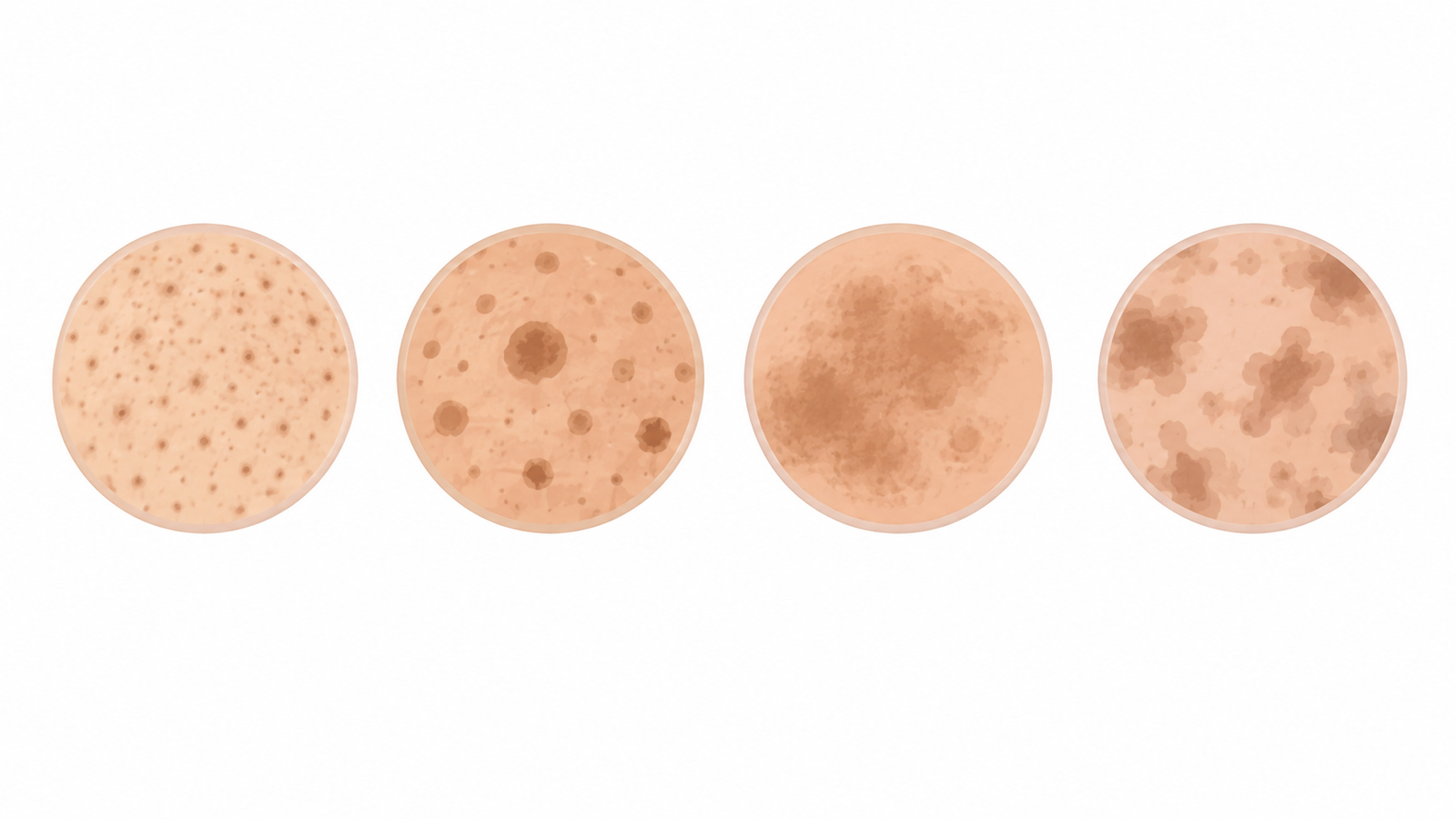
Several distinct types of hyperpigmentation exist, and they behave quite differently:
Freckles are small, sun-responsive spots that tend to run in families, darkening in summer and fading in winter – existing pigment cells simply become more reactive to sun exposure without increasing in number.
Sun spots (also called age spots) build up gradually over years of cumulative sun exposure and, unlike freckles, don’t fade with the seasons – they represent a more fixed, long-term change in the skin.
Melasma is a more complex, symmetrical pattern of pigmentation typically appearing on the face, strongly linked to hormonal changes, pregnancy, and sun exposure. It tends to involve not just the surface but deeper skin structures too, which is part of why it’s often more stubborn and more prone to returning than other types.
Post-inflammatory marks show up after acne, injuries, or other skin inflammation – the pigment left behind as the skin overreacts while healing. These often fade on their own over time but can be sped along with the right treatment.
Correctly telling these apart matters enormously, because a treatment that works well for sun spots may do very little for melasma, and vice versa.
Diagnosis: Identifying What’s Actually Causing the Spot
A dermatologist typically considers several factors to pinpoint the cause before recommending treatment:
- Pattern and location: Symmetrical facial patches point toward melasma, while scattered spots on sun-exposed areas suggest sun-related pigmentation.
- Timing and triggers: Pigmentation that appeared after pregnancy, starting a new medication, or a recent breakout or injury points toward a specific, identifiable cause.
- Seasonal behavior: Spots that fade in winter and return in summer behave differently from fixed, unchanging patches, and this distinction helps guide treatment choice.
- Medication history: Certain medications are known to cause skin discoloration as a side effect, so a careful medication review is part of ruling out this less obvious cause.
- Skin tone: Deeper skin tones are more prone to certain types of pigmentation and also need gentler, carefully chosen treatment to avoid triggering further discoloration.
Treatment: The Main Approaches
Treatment for hyperpigmentation generally combines several strategies rather than relying on a single step, because different approaches interrupt pigment production at different points.
Topical treatments remain the foundation for most cases, often combining more than one active ingredient to attack the problem from multiple angles simultaneously. For more resistant or deeper pigmentation, in-clinic procedures such as chemical peels or specific laser treatments can target pigment that topical products alone struggle to reach, by speeding up skin renewal or directly breaking down pigment deposits sitting deeper in the skin.
Consistent sun protection is non-negotiable throughout any pigmentation treatment plan – and, given how visible light also triggers pigment, protection that addresses more than just UV rays is increasingly part of the conversation for people with stubborn or recurring pigmentation. Without this step, even the most effective treatment tends to be undone by ongoing daily triggers.
Treatment Guide: What Each Ingredient Actually Does
| Ingredient | How It Works | Typical Use |
|---|---|---|
| Hydroquinone | Directly slows the pigment-production process in skin cells | Short, supervised courses under dermatologist guidance |
| Kojic acid | Interferes with the enzyme that drives pigment production | Often combined with other brightening ingredients |
| Azelaic acid | Selectively targets overactive pigment cells while sparing normal skin tone | Well suited for sensitive or reactive skin |
| Tranexamic acid | Calms the inflammatory signal that triggers excess pigment | Used topically or, in select cases, taken orally |
| Niacinamide | Blocks pigment from transferring into the surface skin layer | Gentle enough for daily, long-term use |
| Retinoids / chemical peels | Speed up skin renewal to clear pigmented cells faster | Used as part of an ongoing maintenance routine |
The right combination depends on the type of pigmentation present, skin tone, and how the skin has responded to treatment so far – this is a decision made with a dermatologist rather than a one-size-fits-all routine.
What the Research Shows?
Published dermatologic research supports several specific points about hyperpigmentation and what causes it:
- Visible light is a real, separate trigger: Research shows that blue light exposure activates a specific light-sensing pathway in pigment-producing cells, triggering pigment production independently of UV damage – and this effect is notably stronger in darker skin phototypes.
- Melasma involves more than surface pigment: Studies show melasma affects the deeper structural layer beneath the pigment-producing cells, with breakdown of supportive skin structures contributing to why melasma is often more persistent than other pigmentation types.
- Multi-ingredient approaches outperform single ingredients: Research comparing single-ingredient treatments to combined regimens consistently shows better, faster results when several mechanisms are targeted simultaneously rather than relying on one active ingredient alone.
- Certain medications are a documented, distinct cause: Published case reviews confirm that specific medications can cause lasting skin discoloration through mechanisms entirely separate from normal pigment overproduction, reinforcing why a thorough history matters when a spot doesn’t fit the usual pattern.
These findings reflect published dermatologic research; the right treatment path still depends on an individual evaluation of the specific type of pigmentation present.

Doctor Review Block
This article has been medically reviewed by Dr. Tejansu Dalal, MD (Dermatology), for clinical accuracy. Understanding what’s actually causing a specific area of hyperpigmentation is what makes treatment effective – a careful evaluation upfront saves far more time and disappointment than jumping straight to a generic brightening product.
References & Citations
This article draws on dermatologic pigmentation research, including findings published by the National Center for Biotechnology Information on the mechanisms underlying melasma, and reference material from the National Institutes of Health on topical approaches to managing skin pigmentation. Clinical mechanism details reflect published dermatologic and photobiology research.