

Botox and fillers get lumped together constantly, but they solve two completely different problems on the face. This guide explains exactly how each one works, which lines each one treats, and how a specialist decides between them – or combines both.
Botox treats wrinkles caused by muscle movement – like forehead lines and crow’s feet – by temporarily relaxing the muscle, while fillers restore lost volume and fill static lines that remain even when your face is at rest, such as deep nasolabial folds or hollow cheeks. Many people need both, since the two treatments address entirely different causes of facial aging rather than competing for the same job.
Key Takeaways
- Botox only works on wrinkles caused by muscle movement – it does nothing for volume loss or lines that are visible even when the face is completely still.
- Fillers restore lost structural volume and smooth static lines, but they don’t stop the muscle contraction that causes expression lines in the first place.
- Botox results typically last 3 to 4 months, while filler results can last anywhere from 6 months to 2 years depending on the type used.
- Combining Botox with filler in the same area often makes the filler last longer, since a relaxed muscle causes less mechanical stress on the filler.
- Filler carries a rare but serious risk of vascular complications, which is why administration by an experienced, licensed provider matters significantly.
Introduction
“Should I get Botox or filler?” is one of the most common questions in cosmetic dermatology, and the honest answer is that it depends entirely on what’s actually causing the line or hollow you’re trying to fix. Botox and dermal fillers work through completely different mechanisms, target different types of aging, and are often most effective when used together rather than as a either-or choice. This guide breaks down exactly how each treatment works, which concerns each one is built for, and how age and facial anatomy typically shape the decision.
What Are Botox and Fillers?
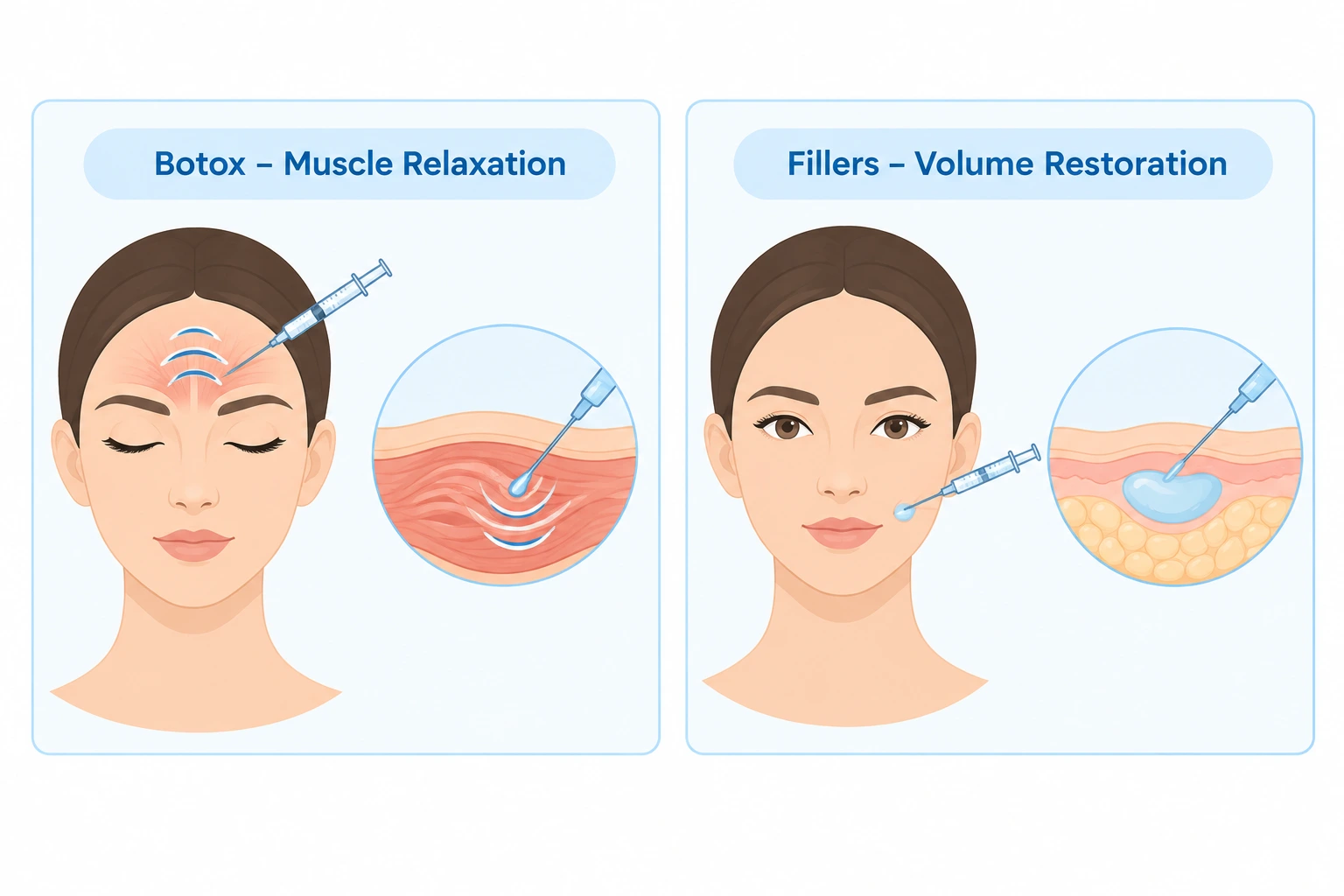
Botox (and similar neuromodulators) is a purified protein that temporarily blocks the nerve signals telling a muscle to contract. When injected into a specific facial muscle, it relaxes that muscle just enough to smooth the wrinkle it was creating, without affecting surrounding tissue. Dermal fillers, by contrast, are gel-based substances – most commonly hyaluronic acid – injected beneath the skin to physically restore lost volume, fill in deep static lines, or rebuild facial contour. One relaxes muscle activity; the other adds physical structure back to the face.
Clinical Overview
Facial aging happens through two distinct processes, and understanding which one is causing your specific concern is the entire basis for choosing between Botox and filler. The first process is repeated muscle movement – every time you frown, squint, or raise your eyebrows, the underlying muscle creases the skin above it. Over years, this repeated creasing becomes a permanent line even when the face is relaxed, but in its earlier stages, this type of line – called a dynamic wrinkle – only appears during movement and disappears at rest. This is exactly what Botox is designed to treat.
The second process is structural volume loss – the skin’s collagen and elastin naturally decline with age, fat pads beneath the skin shift and shrink, and even the underlying bone can lose density. This creates static lines and hollows that are visible even when the face is completely still, and no amount of muscle relaxation can fix them, because muscle movement was never the cause. This is where fillers come in, physically replacing lost volume rather than changing muscle behavior.
Age plays a meaningful role in which concern predominates. Younger patients in their 20s and early 30s typically have isolated dynamic lines with intact underlying volume, making them well-suited to preventative Botox alone. Patients in their late 30s to 50s often have a mix of both dynamic lines and early volume loss, benefiting from a combination approach. Patients over 55 typically show more pronounced structural volume loss, where filler and volume-restoring treatments play the larger role, since Botox alone has limited effect once skin folds remain visible regardless of muscle activity.
Diagnosis
A proper cosmetic consultation involves more than simply pointing at a line you don’t like – it requires distinguishing what’s actually causing it:
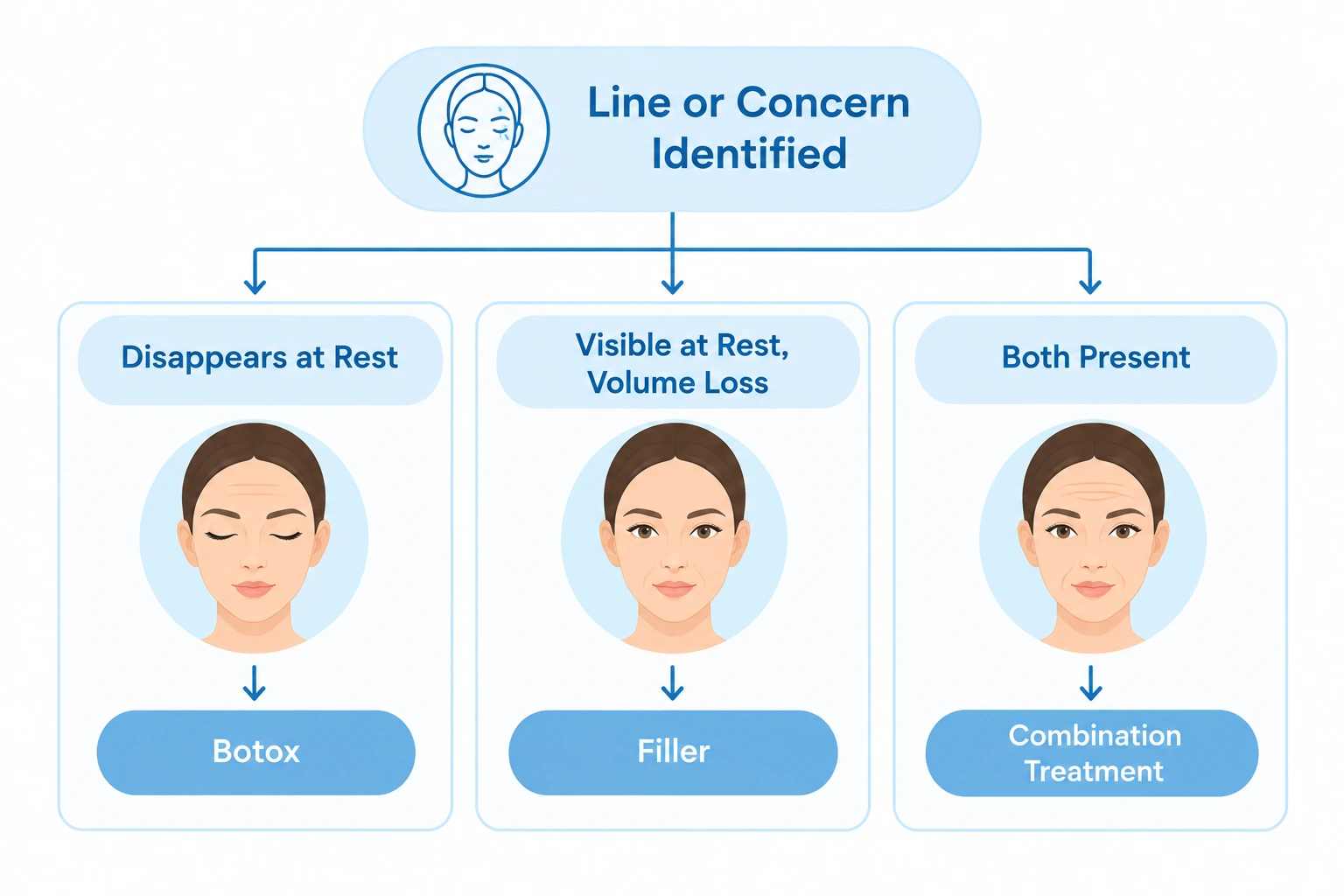
- Dynamic vs. static assessment: The provider asks you to make specific expressions (frowning, smiling, raising eyebrows) to see whether a line disappears completely at rest (dynamic) or remains visible (static) – this single test often determines the entire treatment plan.
- Volume assessment: Areas like the cheeks, temples, and under-eye region are evaluated for volume loss that may be contributing to an aged or hollow appearance, separate from any wrinkle concern.
- Facial mobility and anatomy: The provider maps out relevant facial muscles and vascular danger zones before any injection, since precise anatomical knowledge is what keeps both treatments safe.
- Medical history review: Certain conditions – including neuromuscular disorders, pregnancy, or active skin infection at the treatment site – are contraindications that need to be ruled out before proceeding with either treatment.
Skipping this step and simply requesting “the filler everyone’s getting” or “Botox because a friend recommended it” is exactly how mismatched treatment happens – the right choice depends on your specific lines and anatomy, not trend.
Treatment
Botox for Dynamic Wrinkles
Best suited for forehead lines, frown lines between the brows, and crow’s feet around the eyes – areas where muscle movement is the primary driver of the wrinkle. Results typically appear within a few days to a week and last 3 to 4 months before the muscle activity gradually returns.
Fillers for Static Lines and Volume Loss
Used to restore volume in hollow cheeks, deep nasolabial folds, thinning lips, and under-eye hollows. Results are visible immediately after injection and can last anywhere from 6 months to 2 years, depending on the specific filler type and treatment area.
Combination Therapy
Increasingly considered the standard approach for patients with both dynamic lines and volume loss. Treating a muscle with Botox first can also help filler last longer in that same area, since a relaxed muscle places less mechanical stress on the filler over time.
Age-Based Treatment Planning
Younger patients with isolated expression lines and preserved volume are typically well-suited to Botox alone. Middle-aged patients with early volume loss alongside expression lines often benefit from combining both treatments. Patients with more advanced structural volume loss generally see the most benefit from filler and volume-restoring treatments as the primary approach.
Clinical Trial Data
Research and clinical data on both treatment categories show some consistent, well-documented patterns:
- Botox and similar neuromodulators are among the most commonly performed minimally invasive cosmetic procedures worldwide, with a well-established safety record spanning over two decades of clinical use.
- Effect duration for standard Botox formulations is consistently reported at 3 to 4 months, though certain newer, longer-acting formulations have shown effects extending to 6 to 9 months in some patients.
- Hyaluronic acid fillers show a clinical duration ranging from 6 to 18 months depending on the specific product’s cross-linking density, while longer-acting biostimulatory fillers have been associated with effects persisting up to 2 years.
- Combination treatment protocols – using Botox to relax a muscle before or alongside filler placement in the same area – have been associated with improved filler longevity compared to filler used alone, since reduced muscle movement lessens mechanical breakdown of the filler material.
- Vascular complications from filler injection, while rare, remain the most serious documented risk associated with the procedure, underscoring why injector experience and anatomical knowledge are consistently identified as critical safety factors in the clinical literature.
These findings reflect published cosmetic dermatology research and regulatory safety data; individual results and treatment duration vary based on the specific product used, treatment area, and individual metabolism.
Treatments Explained
| Treatment | Best For | Typical Duration |
|---|---|---|
| Botox | Forehead lines, frown lines, crow’s feet | 3-4 months |
| Hyaluronic acid filler | Nasolabial folds, lips, under-eye hollows | 6-18 months |
| Biostimulatory filler | Broad volume loss, cheek and temple hollowing | Up to 2 years |
| Combination Botox + filler | Patients with both dynamic lines and volume loss | Varies by area treated |
Always confirm your provider is licensed and experienced, and that any product used is a genuine, regulator-approved formulation – counterfeit or unapproved injectable products carry serious safety risks.
Doctor Review Block
This article has been medically reviewed by Dr. Tejansu Dalal, MD (Dermatology), for clinical accuracy. Treatment recommendations should always be personalised through an in-person consultation, since facial anatomy, the specific cause of a line, and individual goals all meaningfully affect which treatment is appropriate.
References & Citations
This article draws on cosmetic dermatology clinical literature and regulatory safety information, including consumer guidance published by the U.S. Food and Drug Administration on dermal filler safety, and research summarised by the National Institutes of Health on hyaluronic acid fillers and botulinum toxin. Treatment outcome figures reflect published cosmetic dermatology research.