
The days after a skin biopsy, mole removal, or minor excision often bring more questions than the procedure itself – how much swelling is normal, when do stitches come out, and what actually helps a scar heal well. This guide walks through what genuinely happens during recovery, stage by stage.
Recovery after minor dermatologic surgery follows a predictable pattern: swelling and mild discomfort peak around day 2, the wound closes over roughly 1 to 3 weeks depending on the procedure, and full scar maturation takes several months to over a year. Keeping the wound consistently moist with a plain ointment, rather than letting it dry into a hard scab, is the single most well-supported step for faster healing and a better-looking scar.
Key Takeaways
- Swelling typically peaks on day 2 after surgery and gradually improves from there – this is a normal part of healing, not a warning sign on its own.
- A wound kept moist with plain ointment heals noticeably faster than one left to form a dry scab.
- Plain petroleum jelly works as well as antibiotic ointment for most clean surgical wounds, without the allergic reaction risk that antibiotic ointments carry.
- Stitch removal timing depends entirely on location – facial stitches often come out in days, while stitches on the trunk or legs stay in for two weeks or more.
- Lingering pink discoloration after a wound has healed is usually just residual redness that fades over months, not a true scar problem.
Introduction
After a mole removal, skin biopsy, or minor excision, the procedure itself is often the easy part – the weeks that follow raise far more questions. Is this much swelling normal? Should the area be kept covered or left open to air? Why does the site still look pink months later? This guide walks through the actual biological process your skin goes through after minor surgery, what aftercare genuinely helps versus what’s outdated advice, and how to tell normal healing from something that needs a follow-up call.
What Happens to Skin After Minor Surgery?
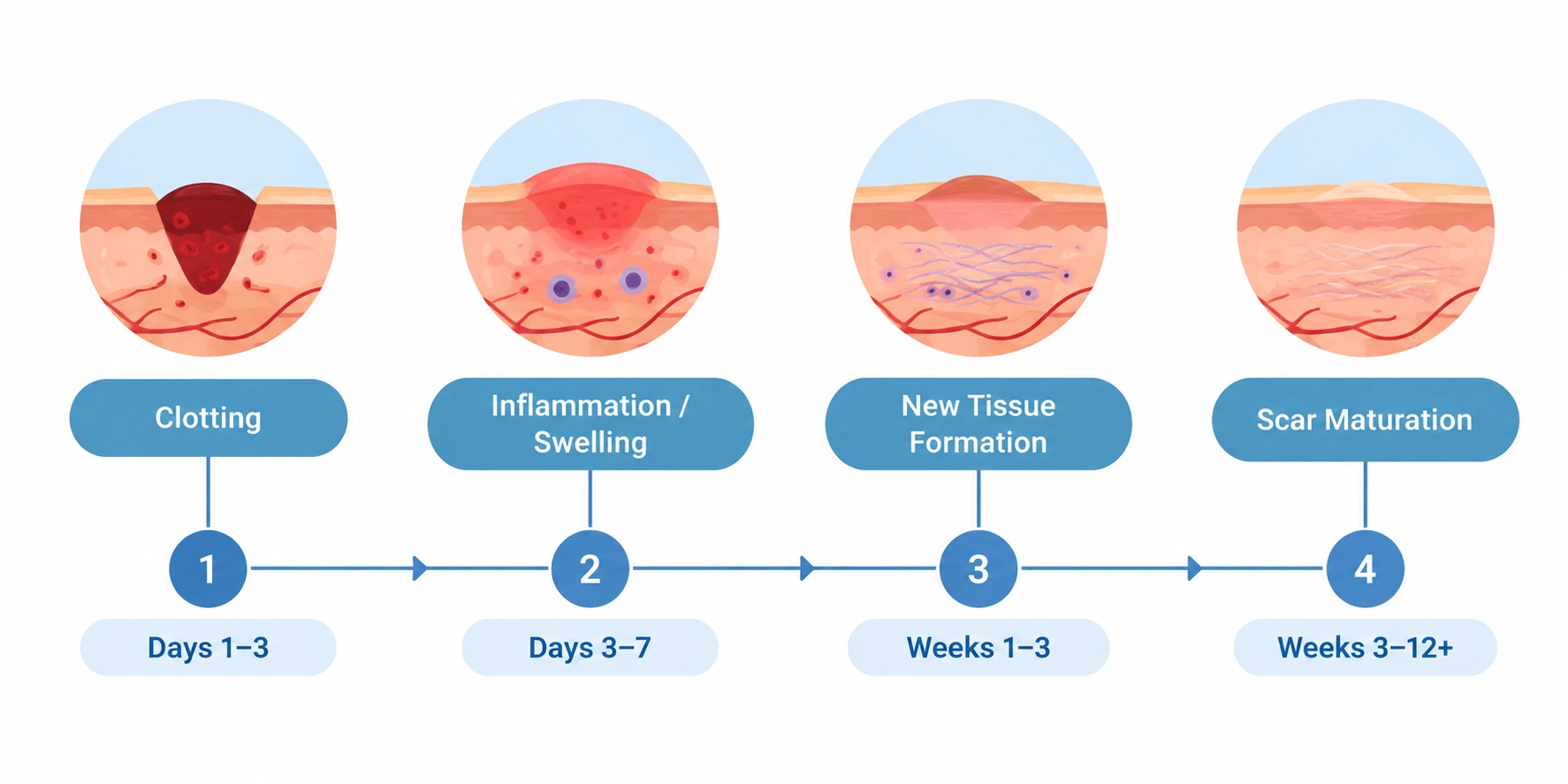
After any minor dermatologic surgery – whether a biopsy, mole removal, cyst excision, or freezing treatment – the skin goes through the same fundamental repair process, just at different speeds depending on the procedure and location. Blood clotting first seals the wound, immune cells then clear away damaged tissue and fight off potential infection, and finally, new tissue is built to close the gap and gradually strengthen over time. Understanding that this is a staged process – not something that’s simply “done” once the stitches come out – helps make sense of what’s normal to see at each point along the way.
Clinical Overview
The first few days after minor surgery are dominated by the body’s inflammatory response – this is exactly why mild swelling, redness, and tenderness are completely normal in this window, typically peaking around the second day after the procedure before gradually settling. Areas with rich blood supply, like the face, neck, and scalp, tend to show more visible swelling and occasional bruising simply because of how vascular these regions are – this is expected and not a sign that something has gone wrong.
Over the following one to three weeks, the body shifts into actively rebuilding tissue, closing the wound surface and beginning to lay down new collagen. This is the stage where the wound visibly “heals over,” though the tissue underneath is still far from its full strength. In fact, even once a wound looks closed on the surface, it holds only a small fraction of its eventual strength – full tensile strength isn’t reached for many months, which is exactly why gentle handling of the area matters well beyond the point where it looks healed.
The final stage, scar maturation, is the longest and least visible part of the process, often continuing for up to a year or more. During this time, the initial tissue that closed the wound is gradually replaced with stronger, more organized tissue, and any lingering pink or red discoloration slowly fades as this remodeling completes.
Diagnosis
Distinguishing normal healing from a genuine complication comes down to a few specific signs, and knowing them can save an unnecessary worry-filled call – or prompt an appropriately urgent one:
- Timing and pattern of swelling: Swelling that peaks around day 2 and then steadily improves is normal; swelling that keeps getting worse past that point, or suddenly appears after things had been improving, deserves attention.
- Pain trajectory: Mild, gradually improving discomfort is expected; pain that is severe, worsening, or feels disproportionate to a minor procedure is not typical and warrants a call to your provider.
- Discharge character: Clear or slightly blood-tinged fluid in the first day or two is normal; thick, yellow-green, or foul-smelling discharge is not.
- Distinguishing irritation from infection: A rash that itches intensely and matches the exact shape of a bandage or ointment application often points to a reaction to that product rather than a true infection, which instead tends to cause spreading redness, warmth, and worsening pain rather than itching.
- Texture of new tissue: Tissue that looks unusually raised, moist, and bleeds easily with minimal contact may represent an overgrowth of healing tissue, which is generally manageable but is worth having assessed rather than left alone indefinitely.
Treatment
Wound Care Fundamentals
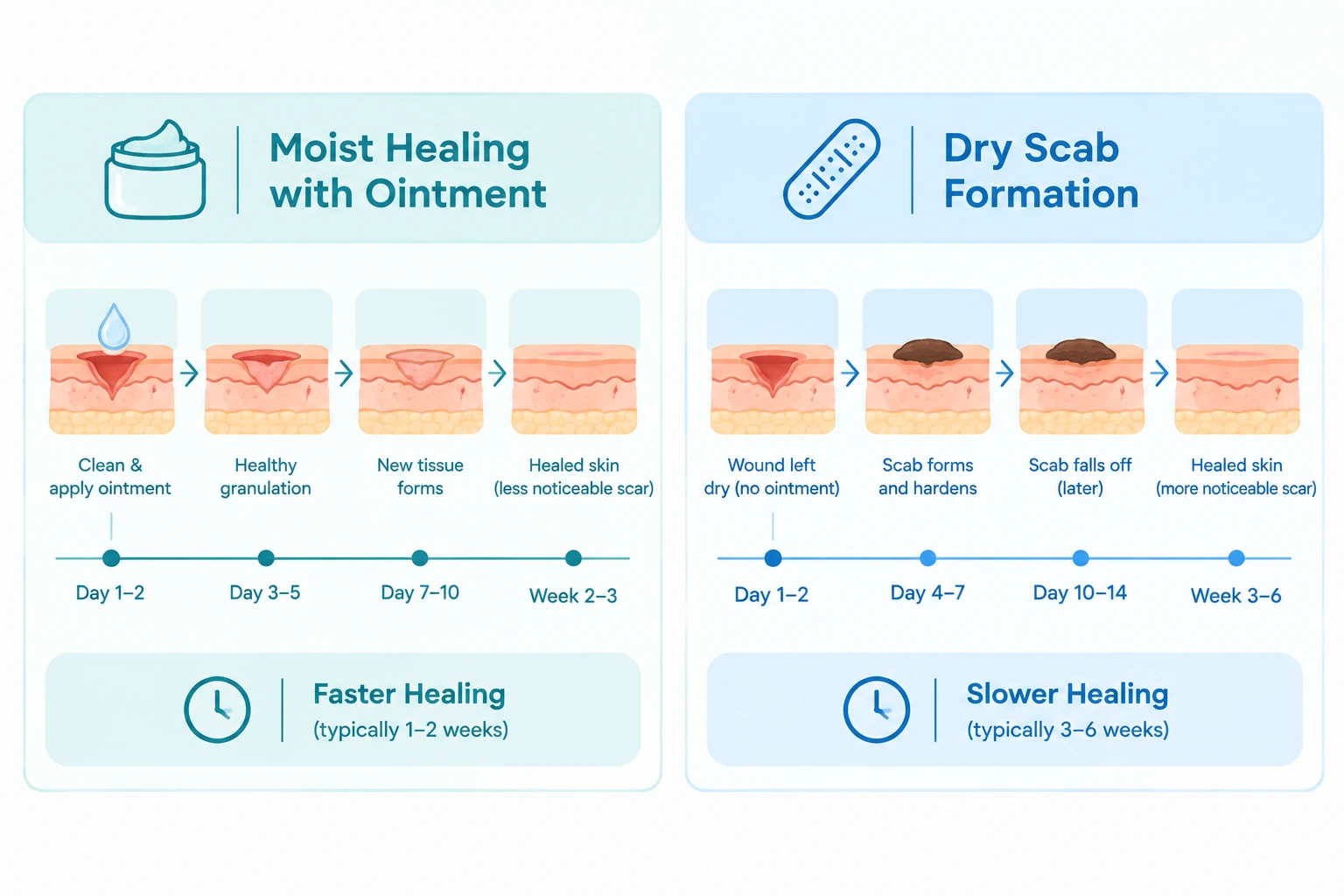
Keeping the wound consistently moist with a plain ointment – rather than allowing it to dry into a hard scab – is one of the most well-established steps for both faster healing and a better cosmetic outcome. A scabbed, dried wound actually takes longer to heal, since new skin cells have to tunnel underneath the hard crust rather than migrating smoothly across a moist surface.
Ointment Choice
Plain petroleum jelly is now generally preferred over antibiotic ointments for clean surgical wounds, since it provides equivalent protection without the meaningful risk of an allergic skin reaction that antibiotic ointments carry.
Dressing Approach
Some modern dressing types can stay in place for several days at a time rather than requiring daily changes, which many patients find considerably more convenient – though the right approach depends on the specific procedure and wound location, so it’s worth confirming with your provider which is appropriate for you.
Managing Overgrown Healing Tissue
If tissue appears raised, moist, and prone to bleeding easily, several straightforward in-clinic treatments can address it effectively, and this is generally a manageable part of recovery rather than a cause for alarm.
Long-Term Scar Care
Once the wound has fully closed and any stitches are removed, consistent sun protection over the treated area for several months to a year meaningfully reduces the risk of lasting discoloration. For patients concerned about the eventual appearance of the site, evaluating scar and keloid risk factors early in the process allows for a more proactive approach if needed.
Clinical Trial Data
Research on post-surgical wound care consistently supports several specific practices:
- Moist wound care has been shown to complete surface healing several days faster on average compared to wounds left exposed or covered with a dry dressing, along with improved final cosmetic appearance.
- Plain petroleum jelly shows no meaningful difference in infection rates compared to antibiotic ointment on clean surgical wounds, while carrying a substantially lower risk of triggering an allergic skin reaction.
- Modern semi-occlusive dressings have shown strong patient preference in comparative studies, largely due to reduced dressing-change frequency and improved comfort, with equivalent infection rates to traditional daily dressing changes.
- Suture removal timing varies significantly by body location – highly vascular areas like the face typically support removal within days, while areas under more mechanical tension, like the trunk or lower legs, require considerably longer retention to avoid the wound reopening.
- Lingering pink discoloration after a wound has closed is well-documented to fade gradually over 6 to 12 months in most cases, representing residual blood vessel activity rather than a structural scarring problem.
These findings reflect published dermatologic surgery and wound care literature; individual healing time varies based on the specific procedure, its location, and personal healing factors.
Aftercare Products Explained
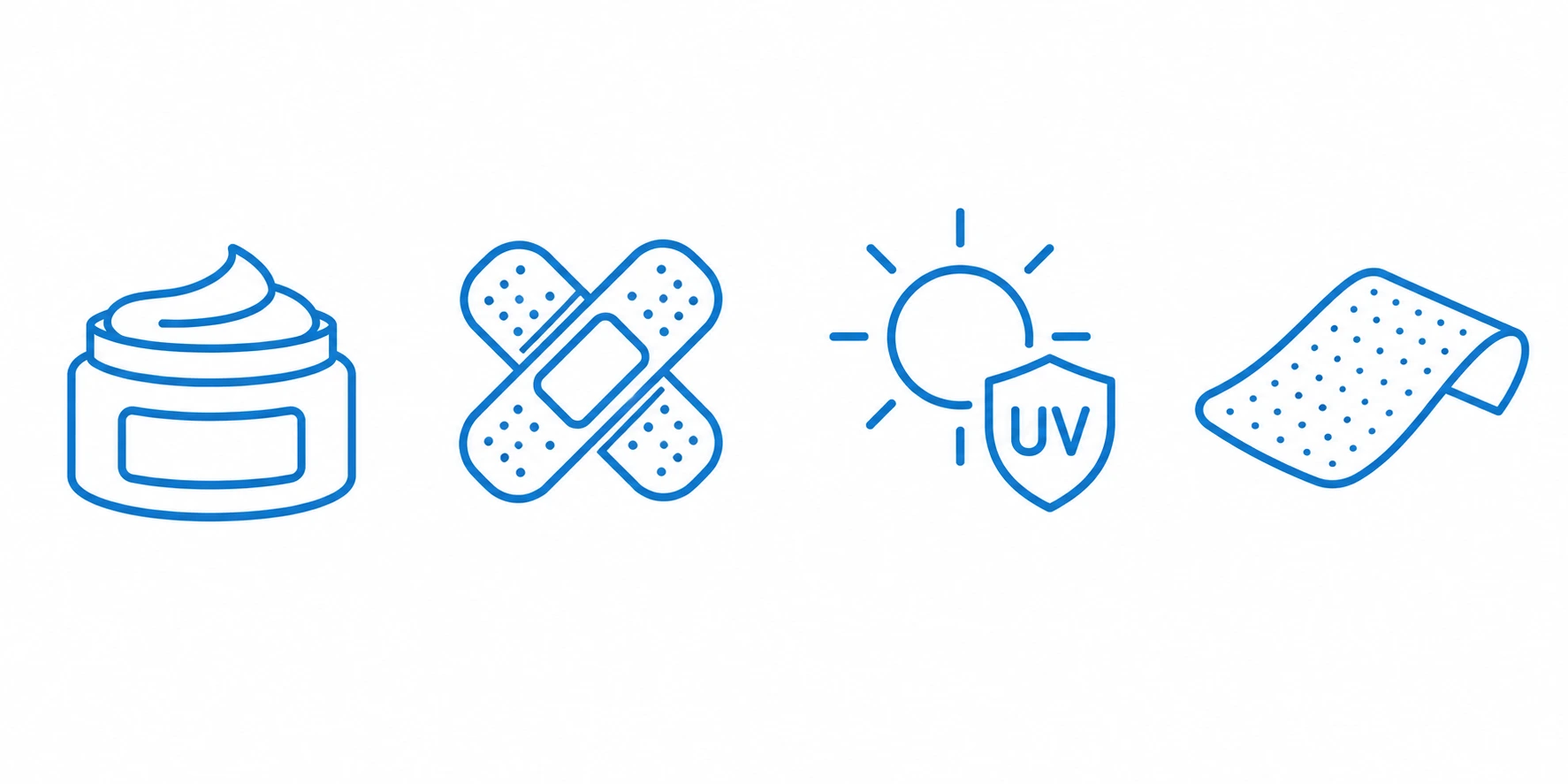
| Product/Approach | Purpose | Typical Duration |
|---|---|---|
| Plain petroleum jelly | Keeps wound moist, supports healing | Until fully closed |
| Non-stick dressing | Protects wound, prevents adhesion | Daily to several days, per provider guidance |
| Broad-spectrum sunscreen (SPF 30+) | Prevents permanent discoloration of healing scar | 6-12 months post-procedure |
| Silicone gel or sheeting | Supports optimal scar texture once fully closed | Several weeks to months, once stitches are out |
Avoid picking at scabs or peeling tissue during healing – this is one of the most common, and most avoidable, causes of a worse final scar.
Doctor Review Block
This article has been medically reviewed by Dr. Tejansu Dalal, MD (Dermatology), for clinical accuracy. Recovery timelines vary by procedure type and individual healing factors, so always follow the specific aftercare instructions given for your dermatologic surgery rather than general guidance alone.
References & Citations
This article draws on dermatologic surgery and wound care clinical literature, including information published by the National Institutes of Health on surgical wound healing and reference material from the National Center for Biotechnology Information on post-procedure skin care. Treatment outcome figures reflect published dermatologic surgery research.