
An itchy, red rash could be a passing skin allergy or a sign of chronic eczema – and treating one like the other rarely works. This guide explains the real differences between skin allergy and eczema, so you know which one you’re actually dealing with.
A skin allergy (like hives) typically appears suddenly, causes raised, smooth, itchy welts that move around and disappear within hours, while eczema develops more gradually, stays in one place for days or weeks, and causes dry, scaly, thickened patches rather than smooth welts. The two conditions involve entirely different mechanisms in the skin, which is exactly why they need different treatment approaches.
Key Takeaways
- Hives (a classic skin allergy reaction) resolve within hours and leave no mark behind; eczema patches persist for days to weeks and often leave discoloration as they heal.
- Eczema tends to appear in the same skin folds – elbow creases, behind the knees, wrists – while allergic hives appear randomly and move across the body.
- Antihistamines work well for hives but have limited effect on eczema itching, which is driven by a different set of immune signals.
- Eczema is a chronic, relapsing condition tied to skin barrier dysfunction, not a one-time allergic reaction.
- A rash that leaves the skin surface intact (smooth, no scaling) points toward an allergic hive reaction; visible scaling, cracking, or oozing points toward eczema.
Introduction
“Is this an allergy or eczema?” is one of the most common questions dermatologists hear, and it’s a genuinely important one – because these two conditions, despite both causing itchy, red skin, work through completely different biological processes and respond to different treatments. Confusing the two often means reaching for the wrong medication and getting frustrated when it doesn’t help. This guide breaks down exactly how skin allergy and eczema differ in appearance, timing, and cause, so you can better understand what you’re looking at before your appointment.
What Are Skin Allergy and Eczema?
A skin allergy, most commonly appearing as hives (urticaria), happens when immune cells in the skin release histamine in response to a trigger, causing rapid swelling and the classic raised, smooth welt. Eczema (atopic dermatitis) is a chronic condition rooted in a weakened skin barrier, which allows irritants and allergens to penetrate more easily and triggers ongoing, low-grade inflammation – producing dry, scaly, often thickened patches rather than a sudden welt. One is a rapid chemical reaction; the other is an ongoing barrier and immune problem.
Clinical Overview
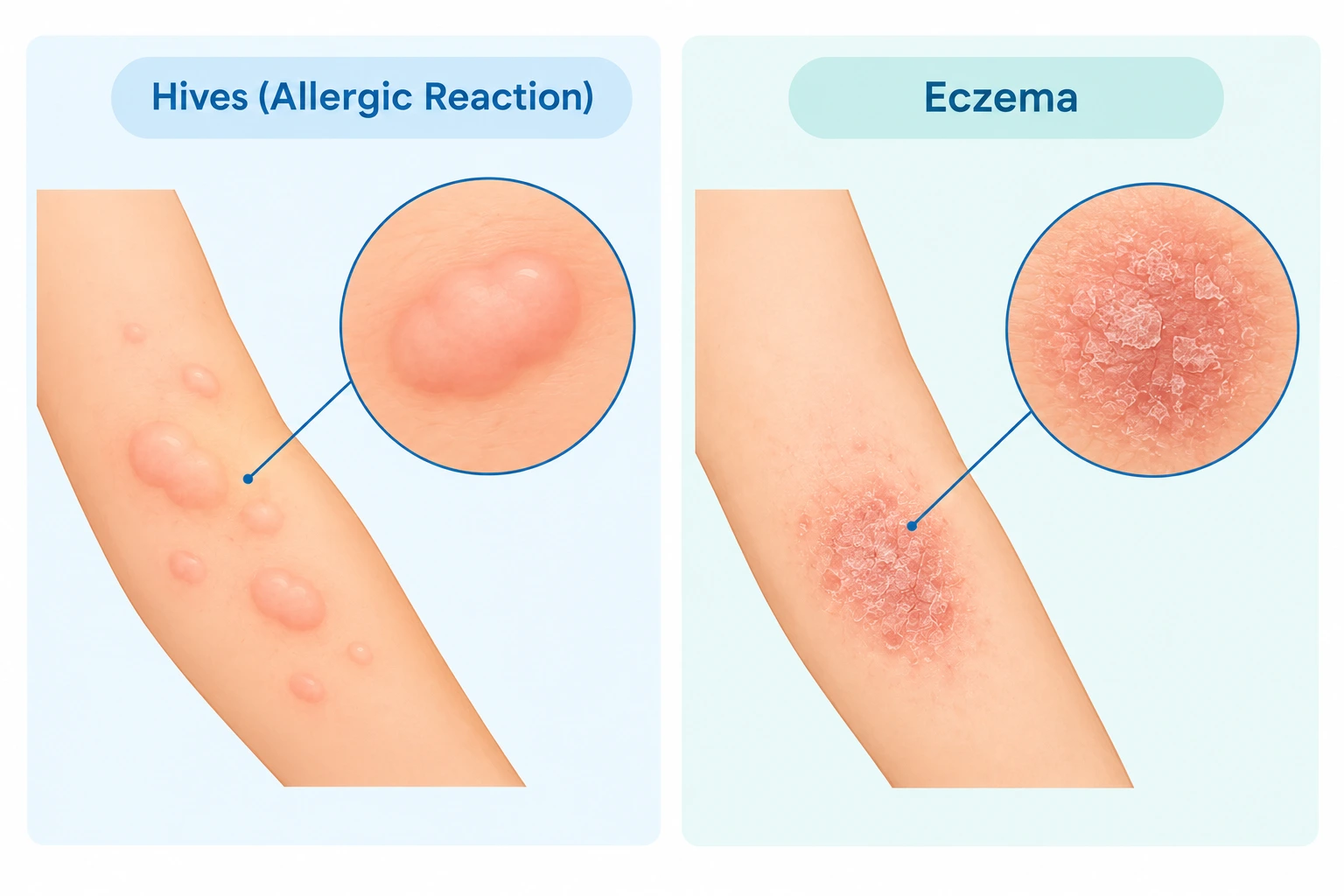
The clearest way to understand the difference between skin allergy and eczema is to look at what’s actually happening beneath the surface. In an allergic hive reaction, specialized immune cells release histamine almost immediately after contact with a trigger, causing fluid to leak into the upper layer of skin and forming a raised, well-defined welt. Crucially, this process resolves on its own – individual welts typically fade within hours, though new ones can appear elsewhere as the reaction continues.
Eczema works on a completely different timeline and mechanism. It stems from a genuinely weaker skin barrier, which lets moisture escape more easily and allows irritants, allergens, and even bacteria to penetrate more readily than normal skin. This triggers a slower, more sustained immune response that doesn’t resolve in hours – instead, it produces a fixed patch of inflammation that can persist for days, weeks, or become a long-term, relapsing pattern, particularly in the same skin fold areas each time it flares.
This distinction also shows up clearly in how each condition looks on the skin. A hive stays smooth on the surface, since the reaction happens beneath an otherwise intact layer of skin. Eczema, by contrast, visibly damages the skin surface itself – producing scaling, cracking, and over time, a thickened, leathery texture from repeated scratching.
Diagnosis
Telling the two apart usually comes down to a careful clinical evaluation of a few key features:
- Lesion behavior over time: A dermatologist will ask whether individual spots disappear within a day (pointing to hives) or persist in the same location for days or weeks (pointing to eczema).
- Surface texture: Gently examining the rash reveals whether the skin surface itself is smooth (hives) or scaly, cracked, and rough (eczema).
- Distribution pattern: Eczema classically favors specific areas – the inside of the elbows, behind the knees, wrists, and neck – while allergic hives tend to appear randomly and shift location.
- Personal and family history: A history of asthma, hay fever, or other family members with eczema supports an eczema diagnosis, since these conditions frequently run together.
- Trigger identification: For suspected allergic reactions, identifying a specific recent trigger (a food, medication, or new product) supports a hive diagnosis, while eczema flares are often tied to more general triggers like dry weather, stress, or certain fabrics rather than one specific substance.
In some overlapping or unclear cases, additional testing – such as allergy testing for suspected triggers – may be used to clarify the picture further.
Treatment
For Allergic Hives
Antihistamines are the primary treatment and work quickly by blocking the histamine response responsible for the swelling and itch. Identifying and avoiding the specific trigger, when one can be found, prevents recurrence.
For Eczema
Treatment centers on repairing and protecting the skin barrier with regular, generous use of moisturizer, alongside anti-inflammatory treatment during active flares. Because eczema itching is driven by different immune signals than hives, standard antihistamines generally provide limited relief for the itch itself.
Topical Anti-Inflammatory Options for Eczema
Topical corticosteroids remain a mainstay for calming active eczema flares, while non-steroid options are often preferred for sensitive areas like the face and skin folds, since they don’t carry the same risk of skin thinning with prolonged use.
When Standard Treatment Isn’t Enough
Eczema that doesn’t respond adequately to standard topical treatment, or hives that persist for more than six weeks (chronic), typically requires a more advanced evaluation and treatment approach beyond first-line therapy.
Clinical Trial Data
Clinical and dermatology research consistently supports several key distinguishing patterns between these conditions:
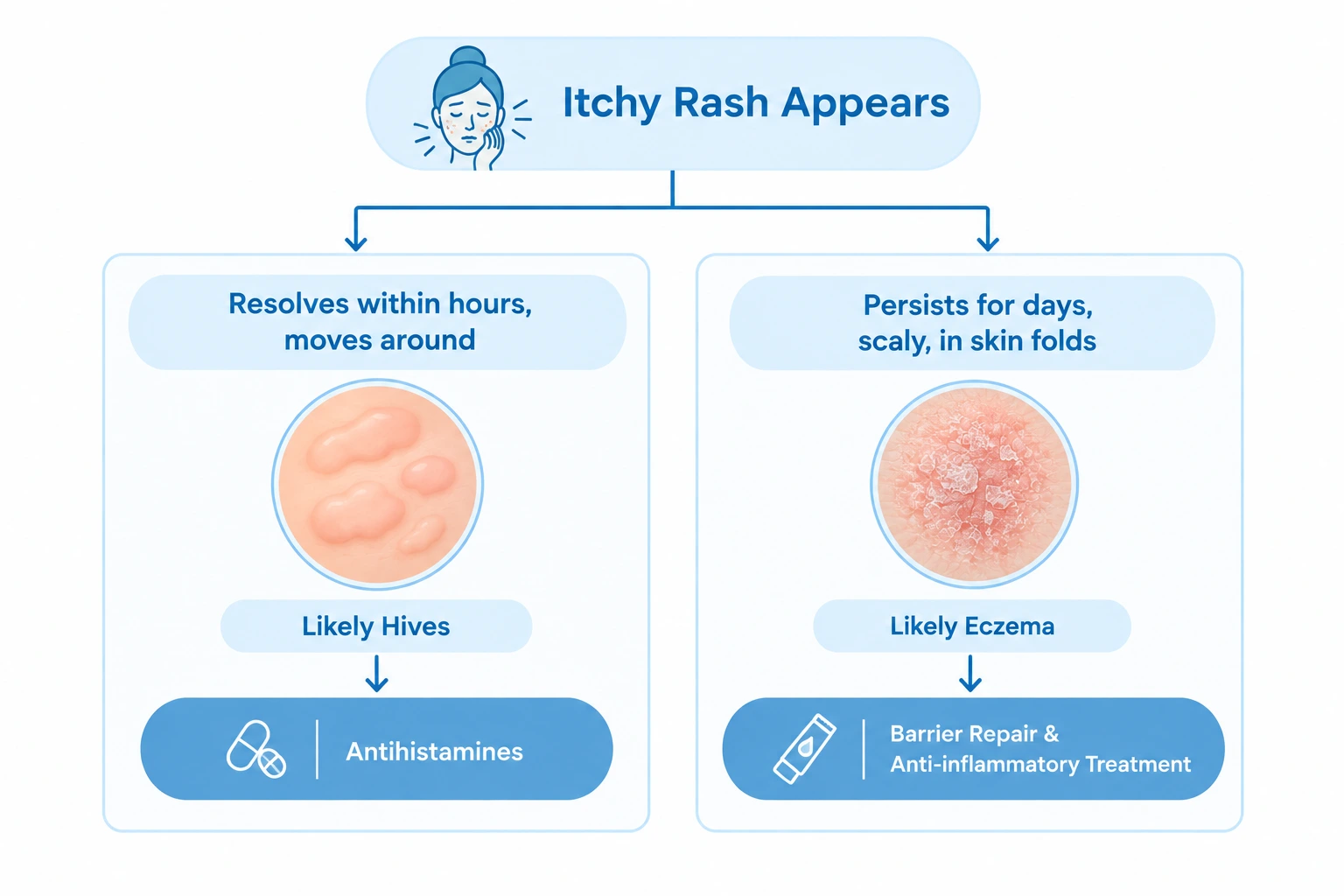
- Individual hive lesions are well-documented to resolve completely within 2 to 24 hours, often much sooner, without leaving any residual mark on the skin.
- Eczema lesions, by contrast, are consistently shown to persist for days to weeks and frequently leave temporary skin discoloration behind as they heal.
- Antihistamines show strong, well-established efficacy for hive-related itching, since histamine is the primary driver, but show limited effectiveness for eczema itch, which research has shown to be driven substantially by different inflammatory signaling molecules.
- Skin barrier repair approaches, particularly regular use of barrier-restoring moisturizers, have demonstrated meaningful reductions in eczema flare frequency and severity in clinical studies.
- A meaningful proportion of eczema patients also have a personal or family history of related allergic conditions like asthma or hay fever, supporting the well-documented link between eczema and the broader allergic tendency.
These patterns reflect established dermatology and allergy research; individual presentation can vary, and some patients experience overlapping features that require professional evaluation to sort out clearly.
Treatments Explained
| Condition | Typical Treatment | Response Time |
|---|---|---|
| Allergic hives (urticaria) | Antihistamines, trigger avoidance | Hours |
| Eczema flare | Topical anti-inflammatory treatment, barrier repair | Days to weeks |
| Chronic or recurring hives | Escalated antihistamine dosing, further evaluation | Weeks |
| Persistent eczema | Barrier-focused skincare routine, ongoing management | Long-term |
If you’re unsure which condition you’re dealing with, avoid guessing with over-the-counter treatment for more than a week or two – a proper evaluation, including allergy testing where relevant, gives a far more reliable answer than trial and error.

Doctor Review Block
This article has been medically reviewed by Dr. Tejansu Dalal, MD (Dermatology), for clinical accuracy. Diagnosis and treatment recommendations should always be personalised through an in-person evaluation, since several inflammatory skin conditions can present with overlapping features.
References & Citations
This article draws on dermatology and allergy clinical literature, including information published by the National Health Portal of India and the U.S. National Library of Medicine. Clinical distinguishing features reflect established dermatology diagnostic criteria and research.