
Deep, painful breakouts along the jawline and chin that flare up around the same time every month aren’t just “regular” acne that won’t go away – they usually follow a different biological pattern, which is exactly why standard acne products so often fail to clear them.
Hormonal acne treatment works by reducing how strongly the skin’s oil glands respond to androgens (the hormones behind most adult and jawline acne) – not necessarily by lowering hormone levels in the blood. Options range from topical treatments applied directly to the skin to oral medications like spironolactone or certain birth control pills, chosen based on the person’s health history, goals, and how the acne is actually behaving. Most people need 2 to 3 months of consistent treatment before seeing real improvement.
Key Takeaways
- Hormonal acne typically shows up as deep, tender bumps along the jawline, chin, and lower face, often worsening around the same time each month.
- Most people with hormonal acne have completely normal hormone blood test results – the issue is usually how the skin itself reacts to normal hormone levels, not an excess of hormones.
- Oral spironolactone and certain birth control pills work by lowering how much active hormone reaches the skin’s oil glands, while a newer topical cream works by blocking the reaction directly at the skin.
- A once-routine blood test for this treatment has actually been dropped from current medical guidelines for most healthy patients – it’s no longer considered necessary.
- Because this type of acne tends to come back after stronger treatments are stopped, an ongoing maintenance plan matters just as much as clearing the initial breakouts.
Introduction
Hormonal acne has a reputation for being stubborn – and for many people, that reputation is earned, simply because it’s being treated like regular acne when it actually behaves differently underneath the surface. This article walks through what’s actually happening in the skin during hormonal acne, why blood tests often come back normal even when hormones are clearly driving the breakouts, and what the current treatment options actually do.
What’s Actually Happening Beneath Hormonal Acne
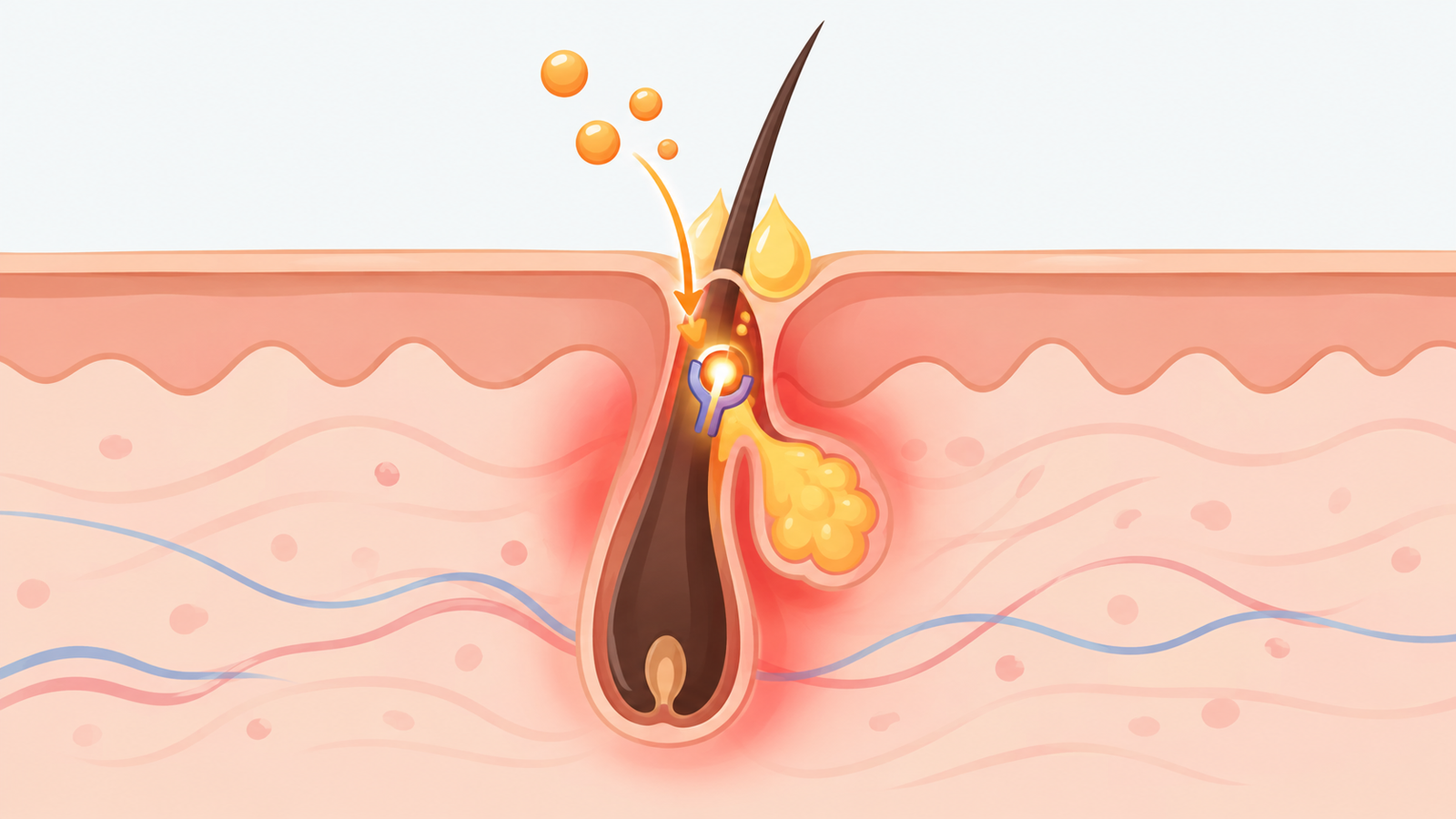
Hormonal acne is driven by androgens – a group of hormones everyone has, regardless of gender – acting on the skin’s oil glands. Inside the skin itself, certain cells convert milder, naturally circulating hormones into a much more potent form that binds strongly to receptors in the oil glands. Once that happens, several things go wrong at once: the glands start producing more oil, the oil’s own composition shifts in a way that irritates the follicle, dead skin cells stick together instead of shedding normally, and the clogged follicle becomes a comfortable environment for acne-related bacteria to multiply. The end result is the deep, inflamed, often painful bumps that make hormonal acne feel so different from typical surface breakouts.
Clinical Overview: Why Blood Tests Are Often Normal
One of the most confusing parts of hormonal acne is this: most people with it have entirely normal hormone levels on a standard blood test. That’s because the problem usually isn’t too much hormone circulating in the body – it’s that the skin’s own oil glands are simply more sensitive to normal hormone levels than other people’s skin is.
This local sensitivity, rather than a body-wide hormone excess, is why routine hormone blood testing usually isn’t useful for isolated jawline or chin acne. Blood testing becomes genuinely important only when other signs are present alongside the acne – such as irregular periods, excess hair growth, or other symptoms that suggest a broader hormonal condition needing its own separate evaluation.
Diagnosis: Recognizing the Pattern
A few specific features help identify hormonal acne rather than other acne types:
- Location: Concentrated along the lower face – jawline, chin, and sometimes the neck – rather than spread evenly across the forehead and cheeks.
- Type of lesion: Deep, tender bumps and cysts rather than mostly surface-level blackheads or whiteheads.
- Timing: A noticeable flare-up pattern tied to the menstrual cycle, often worsening in the days just before a period.
- Response to standard treatment: Little to no improvement despite consistent use of typical over-the-counter products or short courses of antibiotics.
- Associated signs that need separate evaluation: Irregular periods, excess facial or body hair, or scalp thinning alongside the acne point toward a broader hormonal pattern that deserves its own dedicated workup.
Treatment: The Main Approaches
Hormonal acne treatment generally follows a tiered approach, built around how strongly the acne is responding to simpler options first.
For milder cases, topical treatments – including retinoids and certain acne-fighting creams – remain a reasonable starting point, sometimes paired with a topical option designed specifically to interrupt the hormone-receptor interaction at the skin level.
For more persistent or more severe hormonal acne, oral treatment often becomes necessary. This usually means either a medication that blocks the hormone’s effect at the receptor level, or a birth control pill formulated with a specific type of hormone component chosen because it doesn’t work against the treatment goal. Both approaches take time – most people need six to eight weeks before noticing real change, with the fullest results usually appearing around three to six months in.
In more severe, scarring-risk cases that don’t respond to these approaches, a stronger oral medication may be considered, though this comes with its own separate conversation about suitability, monitoring, and the fact that hormonal acne has a meaningfully higher chance of returning afterward compared to other acne types – which is why a maintenance plan matters so much once initial clearance is achieved.
Medication Guide: What Each Option Actually Does
| Option | How It Works | Typical Timeline |
|---|---|---|
| Oral hormone-receptor blocker | Blocks the hormone from binding to receptors in the skin’s oil glands | 6-8 weeks for initial change, 3-6 months for full effect |
| Certain combined birth control pills | Lowers the amount of active hormone reaching the skin via a few different pathways | Similar gradual timeline, often several months |
| Topical hormone-receptor cream | Blocks the same receptor interaction directly at the skin, without affecting the rest of the body | Visible change within about 12 weeks |
| Topical retinoid (maintenance) | Keeps pores clear and reduces inflammation on an ongoing basis | Used long-term, especially after stronger treatment is stopped |
The right combination depends on individual health history, whether pregnancy is a consideration, and how the acne has responded to treatment so far – this is a decision made with a dermatologist, not a one-size-fits-all choice.
What the Research Shows
Published dermatologic research supports several specific points about hormonal acne treatment:
- Receptor-blocking oral treatment shows strong clearance rates: Clinical studies report meaningful-to-complete lesion clearance in roughly 60 to 80 percent of adult women with persistent inflammatory acne using this approach, with maximum benefit typically seen between three and six months.
- A once-standard monitoring test has been dropped for most healthy patients: Updated 2024 clinical guidelines state that routine blood monitoring, once considered mandatory with this oral treatment, is unnecessary for healthy individuals without pre-existing kidney or heart conditions – a significant shift from older protocols.
- The topical option works without affecting the rest of the body: Clinical trial data shows that this topical treatment gets rapidly broken down once it enters the bloodstream, meaning it doesn’t disrupt the body’s broader hormone balance the way oral options can – making it suitable for a wider range of patients, including men and teenagers.
- Relapse after strong treatment is common and dose-related: Research tracking patients after stopping the strongest oral acne medication found relapse rates ranging from roughly 22 to over 46 percent, with lower relapse linked to completing a fuller treatment course rather than stopping early – reinforcing why a maintenance plan matters afterward.
These findings reflect published dermatologic and endocrine research; the right treatment path still depends on an individual evaluation.
Doctor Review Block
This article has been medically reviewed by Dr. Tejansu Dalal, MD (Dermatology), for clinical accuracy. Hormonal acne responds very differently from typical acne, and treating it effectively means addressing how the skin reacts to hormones – not just managing the surface symptoms – which is exactly why a tailored, individually evaluated plan tends to outperform generic acne products.
References & Citations
This article draws on dermatologic and endocrine acne research, including findings published by the National Center for Biotechnology Information on adult female acne and clinical practice, and reference material from the National Institutes of Health on topical hormonal acne treatment. Clinical outcome figures reflect published dermatologic clinical trial data.