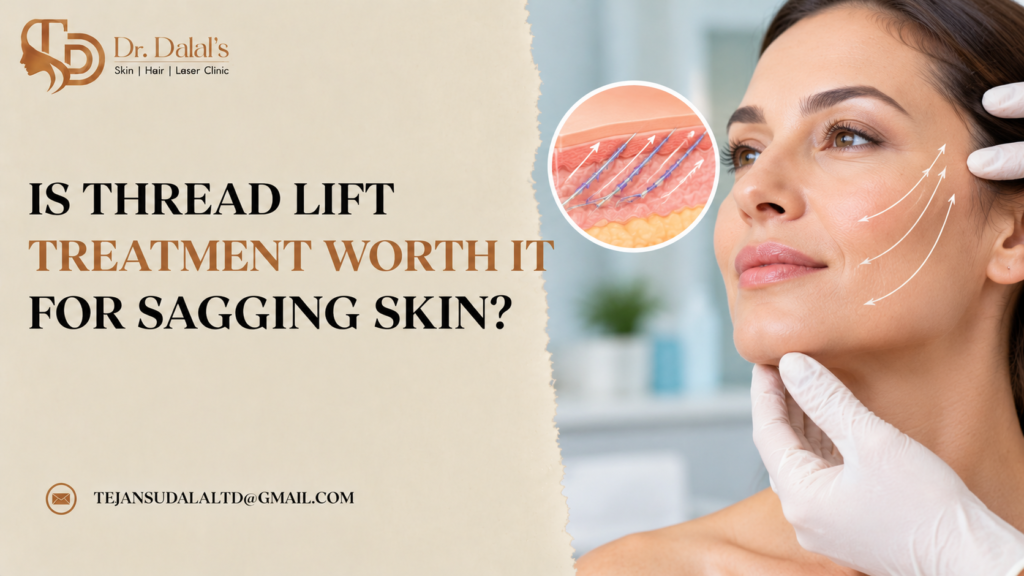
Thread lift treatment is often described as a “facelift without surgery.” That sounds simple, and it is exactly why so many people ask the same question: will it really lift my face, and for how long? The honest answer is that a thread lift can give a visible but temporary lift for the right person, and a disappointing result for the wrong one. Whether it is worth it depends on your age, how much sagging you have and what you expect.
A thread lift is worth it for mild to moderate sagging, usually in people in their late 30s to late 40s who want a subtle change and a short recovery. It is less worthwhile for heavy jowls, very loose skin or people over 50, where results fade faster and side effects are more common. The mechanical lift from the threads settles within the first 3 to 6 months. What stays longer is the firmer, better-quality skin that the threads trigger. Total visible benefit generally lasts from 6 months to about 2 years, depending on the thread material and your tissue. Thread lift treatment works best as one part of a plan, not as a replacement for surgery.
Introduction
Almost everyone who considers a thread lift is comparing it, in their mind, with two other options: doing nothing, or going through a surgical facelift. A thread lift sits in the middle. It needs no cuts and no general anaesthesia, and most people return to normal life within a few days.
But “minimal downtime” is not the same as “long-lasting.” Good decisions come from knowing three things: how a thread lift actually works, how long the lift realistically lasts, and what side effects are common. This article explains all three in plain language, so you can decide whether a thread lift treatment suits you before you book a consultation.
Key Takeaways
- A thread lift places dissolvable threads under the skin to lift sagging tissue and to trigger new collagen.
- The immediate lift comes from the threads pulling the tissue. This part settles in the first 3 to 6 months. The skin-tightening effect from new collagen lasts longer.
- Satisfaction is very high in the first month, then drops over the next year as the immediate lift softens.
- Swelling and bruising are common and settle in 1 to 2 weeks. Dimpling, visible threads and nerve irritation are less common but real.
- People over 50 have higher rates of dimpling and infection, so they are not usually the best candidates.
- Dissolvable threads are safer than permanent ones. Repeated thread treatments can make a future surgical facelift more complicated.
What a Thread Lift Is and How It Works?
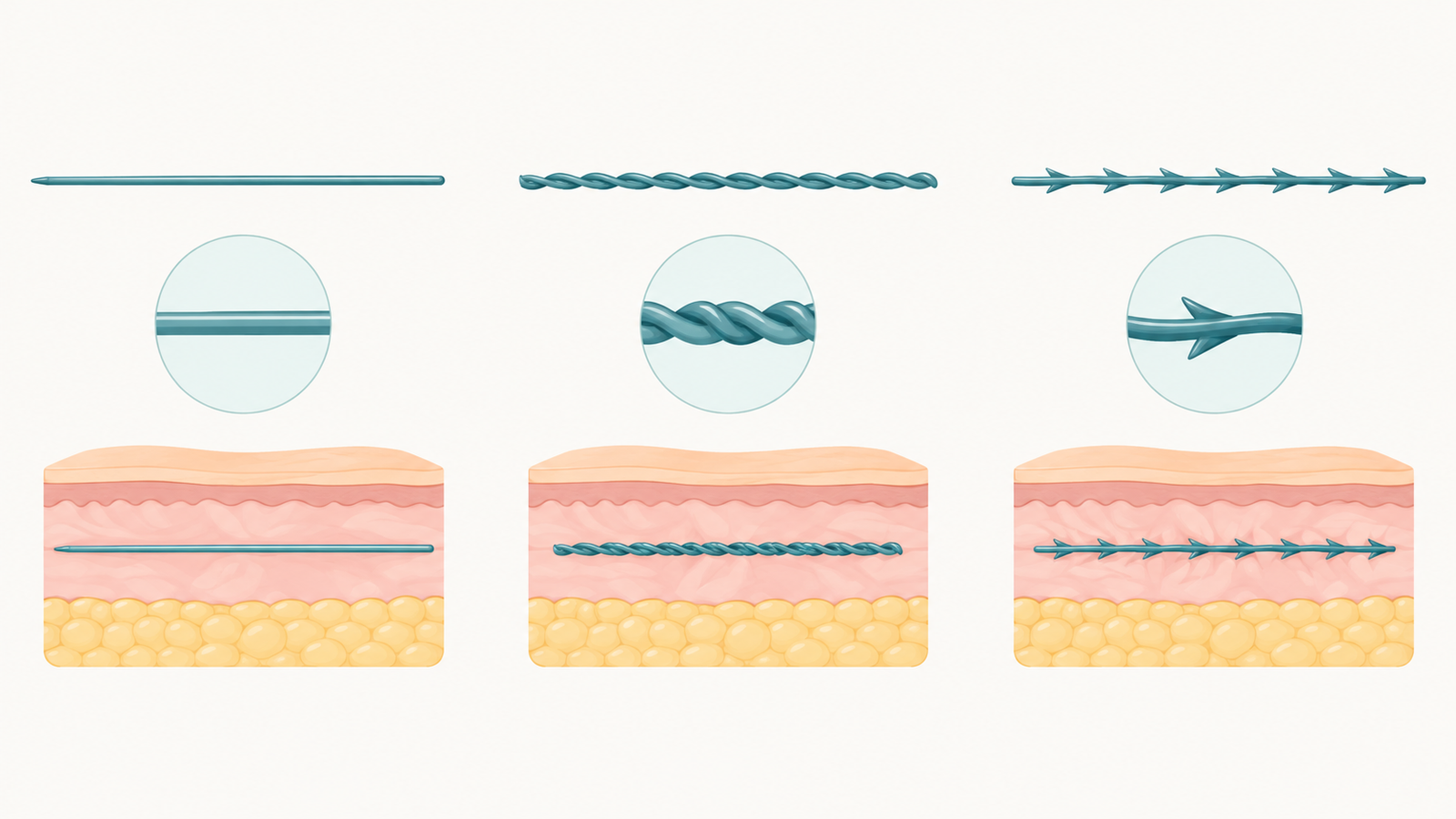
A thread lift is a procedure in which fine, medical-grade threads are placed just under the skin using a thin needle or cannula, after numbing the area. Depending on the type, the threads do one of three jobs:
- Smooth threads act as a scaffold and mainly improve skin texture and firmness. They give little to no lift.
- Twisted or coil threads add slight volume to a hollow line, such as the fold beside the nose.
- Barbed or cogged threads have tiny hooks that grip the tissue under the skin and gently reposition it upward.
Over the next months, the body slowly dissolves the threads and builds new collagen around them. This is why a thread lift gives two kinds of benefit: an early mechanical lift and a slower improvement in skin firmness.
Clinical Overview: Why the Lift Fades
Understanding why results fade helps set the right expectations. Sagging of the cheeks, jowls and neck is driven by deeper changes: loosening of the ligaments that hold the face in place, descent of the deeper fat pads and loss of skin elasticity. A thread lift does not cut or release these deeper structures. The threads rely only on grip within the soft fat layer under the skin.
Over time, muscle movement, gravity and shifting fat slowly loosen that grip, and the tiny hooks can slip. This is why the initial lift softens noticeably in the first 3 to 6 months. What remains after that is mainly the skin-quality benefit from the new collagen.
How long you see a benefit also depends on how quickly the thread material dissolves, which is explained in the material guide below.
What the Research Shows?
Large reviews of facial thread lifting have given a clearer picture than marketing alone:
- Satisfaction falls with time: Satisfaction in the first month is around 97% to 98%, mostly because of the immediate lift and swelling. By 12 months, it falls to about 88% in clinical studies and nearer 75% in real-world reports.
- Common, short-lived effects: Visible swelling affects roughly 16% to 35% of patients and bruising about 19% to 26%. Most settle in 7 to 14 days.
- Less common effects: Skin dimpling occurs in about 7% to 10%, visible or palpable threads in about 4% to 10%, nerve irritation in about 1% to 6%, infection in about 2% to 2.5% and a thread working its way out of the skin in about 1.6% to 2%.
- Age matters: In people over 50, dimpling is about three times more frequent (about 16% versus 5.6%), and infection is much more frequent (about 5.9% versus 0.7%).
- Material matters: Permanent threads carry a much higher risk of problems, including a thread surfacing through the skin and long-lasting numbness, than dissolvable ones.
- Repeated treatments have a trade-off: Many thread treatments over the years create scar-like tracks under the skin, which can make a later surgical facelift more difficult.
These findings come from published reviews. Your own risks depend on your skin, your age, the thread chosen and the doctor’s technique.
Diagnosis: Who Is a Good Candidate
A proper assessment is the most important step, and it matters more than the thread itself. A dermatologist will look at how much your skin sags, how thick and elastic it is, how much facial fat you have and what you want to change.
People who usually do well:
- Late 30s to late 40s with mild to moderate sagging
- Early softening of the jawline or cheeks, with little or no heavy jowling
- Enough natural facial fat and reasonably firm skin
- People who want a subtle, natural change and accept that touch-ups may be needed
People who usually do not do well:
- Over 50, where thin, less elastic skin raises the risk of dimpling and infection
- Heavy, pendulous jowls, very loose skin or marked neck banding
- Very thin skin, where threads can be visible or palpable
- People who want a dramatic, long-lasting result like surgery
A best dermatologist doctor in ahmedabad will tell you honestly if a thread lift is not the right tool for you, and may suggest a different route, such as a combination plan or a surgical consultation.
Treatment: Planning a Thread Lift
A well-planned thread lift treatment starts with choosing the right thread for the right job. The type of thread, the number of threads and the direction of lift are decided after examining your face. After numbing, the threads are placed through tiny entry points, and the session is usually short. Afterwards, expect tightness, mild swelling and bruising. Cold compresses, sleeping with your head raised and avoiding hard chewing, heavy exercise and facial massage for the first weeks help results settle well.
Thread lifts perform best when they are combined with other approaches. Volume loss is better handled by fillers, and surface-level loosening responds to energy-based tightening treatments. A thoughtful anti aging treatment in ahmedabad plan uses each tool for what it does best, instead of expecting threads to do everything.
If a complication occurs, such as dimpling, a visible thread or signs of infection, early review is important. Many problems are easily fixed when addressed early, for example with gentle massage or release of the dimple, or by trimming or removing the thread.
Thread Material Guide
| Thread Material | How Long It Takes to Dissolve | Main Action | How Long a Benefit Usually Lasts | Often Considered For |
|---|---|---|---|---|
| Quick-dissolving type (PDO) | About 6 to 9 months | Mainly immediate lift, moderate collagen boost | About 6 to 12 months | Early jowling, jawline definition, younger skin |
| Medium-dissolving type (PLLA) | About 12 to 18 months | Gentle lift plus stronger collagen and volume effect | About 18 to 24 months | Mild mid-face volume loss, deeper smile lines |
| Slow-dissolving type (PCL) | About 12 to 24 months or more | Flexible support, long-lasting collagen remodelling | About 24 to 36 months | Thinning skin, long-term contour support |
Ranges are typical figures from published reviews. Actual results vary with your tissue, the threads used and the technique. The right choice is decided after examination.
Doctor Review Block
This article has been medically reviewed by Dr. Tejansu Dalal, MD (Dermatology), for clinical accuracy. In my experience, thread lifts give the happiest results when the candidate is chosen carefully and the goal is a refreshed look, not a changed face. The most common disappointment comes from expecting a thread lift to do the work of surgery.
References & Citations
This article draws on published research on thread lifting, including a review of thread materials published by the National Center for Biotechnology Information and a meta-analysis of complication rates available through the National Institutes of Health. Percentages and timelines reflect published clinical reviews.