

The repair itself takes a short time, and most people are back to their routine quickly. The part that decides whether the repair lasts is what happens next: how well the lobe heals underneath, and when and where you pierce it again. Pierce too early or in the wrong spot, and the lobe can tear again. This guide explains the healing timeline, the right time to re-pierce and how to protect your repair.
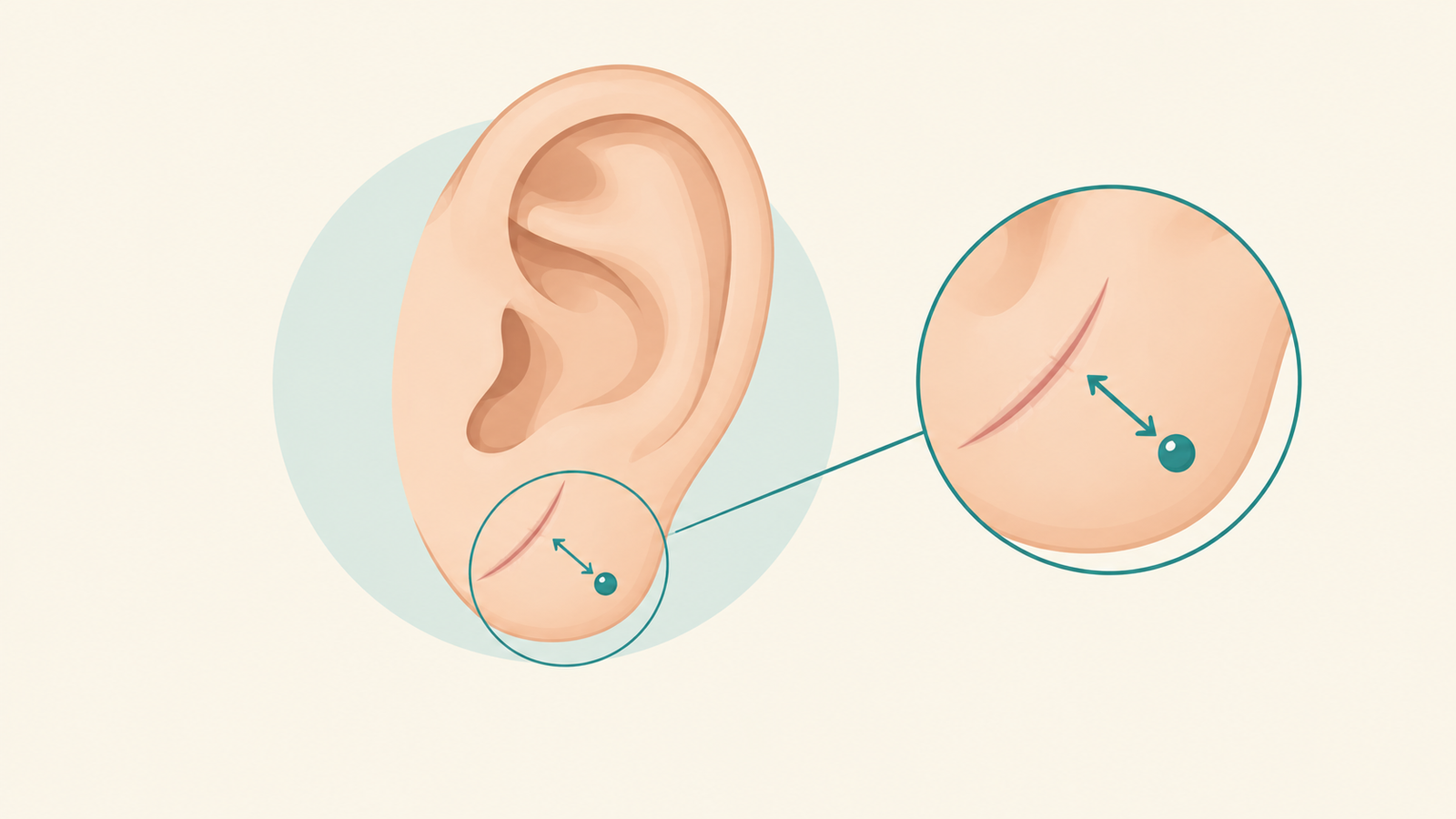
Wait at least 3 months after ear lobe repair before piercing again, and place the new hole at least 3 mm away from the scar. Most people return to daily routine within a day or two, and the stitches or skin glue come off in about one to two weeks. But deeper strength takes around three months to build. Re-piercing before 3 months raises the chance of tearing again several times over compared with waiting. Use light studs first, and keep heavy earrings for much later.
Introduction
An earlobe has no bone or cartilage. It is only skin, fat and a thin supporting layer. That is why heavy earrings, gauges and a sudden snag can tear or stretch it so easily, and why a repaired lobe needs more care than most people expect.
Many people see the lobe looking healed within one or two weeks and assume it is ready for earrings. On the surface it is. Underneath, the scar is still weak. Understanding this difference is the single most useful thing you can learn before and after ear lobe repair.
Key Takeaways
- The skin surface closes within one to two weeks, but the deeper scar needs about three months to become reasonably strong.
- The safest time to re-pierce is at least 3 months after repair. Complex repairs may need 3 to 6 months.
- A new hole should be placed at least 3 mm away from the scar line, in healthy tissue.
- A hollow needle is gentler on the repaired lobe than a spring-loaded piercing gun.
- After re-piercing, light studs only for the first months, and no heavy or dangling earrings for 6 to 12 months.
- A repaired lobe never becomes as strong as untouched skin, so lifelong care with heavy jewellery is wise.
What Ear Lobe Repair Is and Who Needs It?
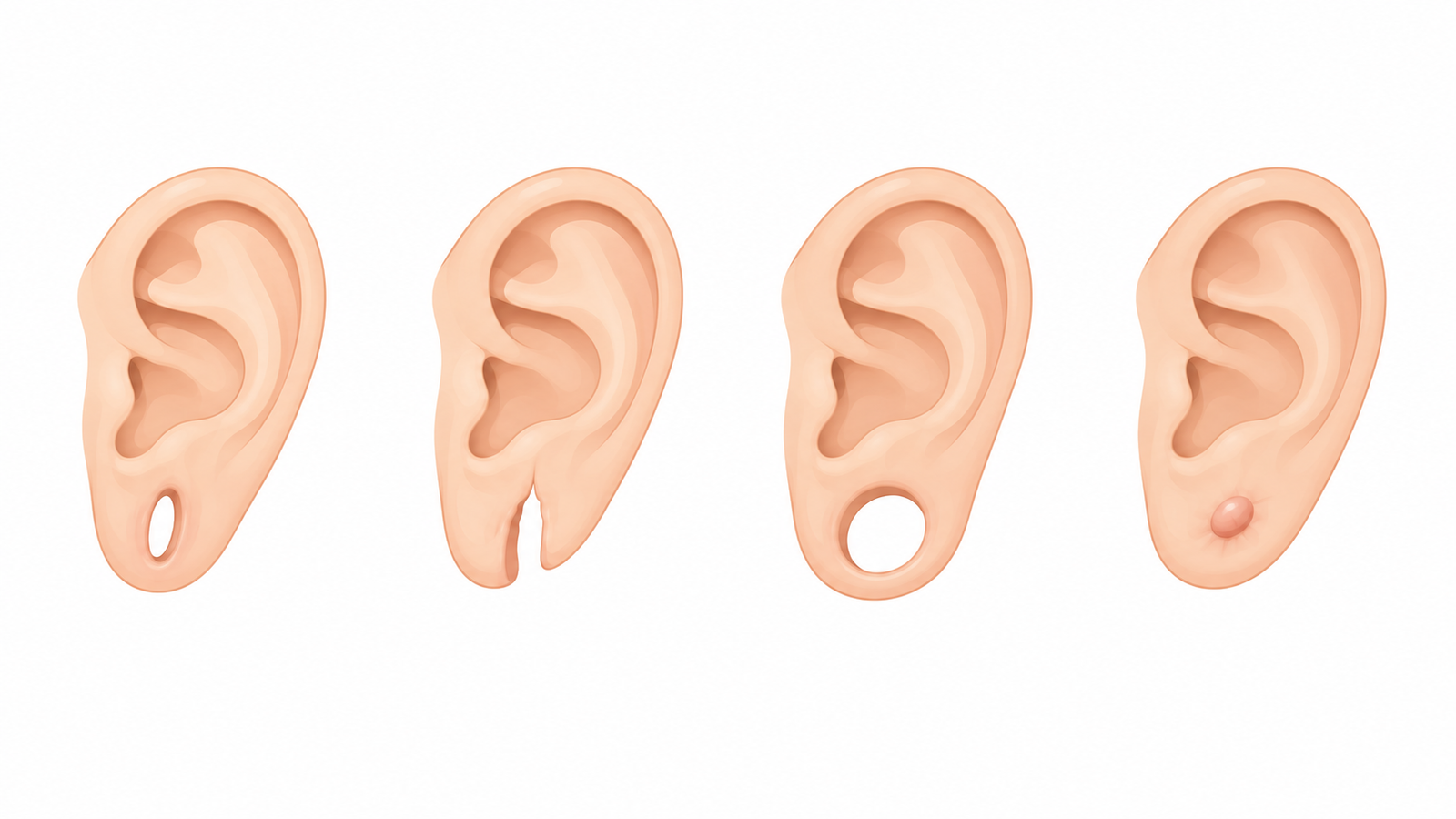
Ear lobe repair, also called lobuloplasty, is a small surgical procedure done under local anaesthesia to rebuild a damaged lobe. The damage usually falls into one of these groups:
- Partial split: The piercing hole has stretched into a long slit, but a thin strip of skin remains at the bottom.
- Complete tear: The lobe has split all the way through the edge, often from a snagged or pulled earring.
- Stretched or gauged lobe: The hole is wide and the lobe is thin, saggy or has lost its natural shape.
- Scarred lobe: A thick or raised scar has formed after a piercing or an earlier repair.
Each type needs a slightly different repair, which is why a proper examination matters before surgery.
Diagnosis: Assessing the Damage
The assessment decides how the repair is done and how long you will need to wait before re-piercing. A doctor looks at the shape of the defect, how much healthy lobe tissue is left, how thick and elastic the skin is and whether you have a history of thick scars. This last point matters most. Some people, particularly those with darker skin or a personal or family tendency toward keloids, are more likely to form raised scars on the earlobe, and they need a more careful plan.
The best dermatologist in ahmedabad for this kind of repair will also ask what you want from the result. If you plan to wear earrings again, the doctor can plan the repair and the later piercing position together. If you only want a natural-looking lobe without earrings, the plan can be simpler.
Treatment: How the Lobe Is Repaired
Modern ear lobe repair usually follows the same broad steps. The area is numbed, the old, skin-lined hole or slit edge is trimmed to create fresh edges, and the layers are carefully brought together with very fine stitches or, in some cases, skin glue. The technique matters for the final shape. A straight closure is simple and effective, but a straight scar along the edge can tighten as it heals and leave a small notch. To reduce this, surgeons often use small zig-zag or angled cuts that break up the scar line and keep the lobe edge smooth. For stretched or gauged lobes, extra tissue is trimmed and reshaped so the lobe looks natural and balanced.
In some cases, a tiny channel can be preserved so that a new piercing is possible without a second visit, but this needs careful technique, and many doctors prefer to keep re-piercing as a separate step after healing. Repairs of this kind are part of everyday work for a team experienced in dermato surgery in ahmedabad, where scar planning matters as much as the procedure itself.
Clinical Overview: The Healing Timeline
Healing happens in layers, and the surface heals long before the deeper tissue does:
- Days 1 to 3: Mild swelling, redness and throbbing are normal. Keep the area clean and dry.
- Days 4 to 14: The skin surface closes. Stitches, if not dissolving, are usually removed at around day 7 to 10, and skin glue slowly peels off. Itching often replaces pain, which is a normal sign of healing.
- Weeks 2 to 6: The scar strengthens and the new collagen reorganises. At two weeks, the scar is still only a small fraction of normal skin strength, and by around six weeks it has reached roughly a third.
- Weeks 6 to 12: The scar reaches around 80% of normal strength by about three months. This is the point at which re-piercing becomes reasonably safe.
- Months 3 to 12: The scar continues to soften, flatten and fade.
Even at its best, scar tissue does not regain the full strength or stretch of normal skin. That is why a repaired lobe stays more vulnerable to heavy earrings for life.
Re-Piercing and Jewellery Guide
| Stage | Typical Timing | What to Do | What to Avoid |
|---|---|---|---|
| Right after repair | Days 1 to 14 | Keep clean and dry for the first 1 to 2 days, then gentle washing as advised. Sleep on your back with your head slightly raised for the first few nights. | Rubbing, snagging on clothes or hair, sleeping on the repaired side |
| Early healing | Weeks 2 to 6 | Start scar care such as silicone gel and gentle massage once your doctor says the surface has healed. Use sun protection. | Swimming for 4 to 6 weeks, contact sports for 3 to 4 weeks, any earrings |
| Ready for re-piercing | At least 3 months, or 3 to 6 months for complex repairs | Choose a hollow needle, and place the new hole at least 3 mm from the scar | Piercing guns, placing the hole in or beside the scar |
| First studs | First 6 to 8 weeks after piercing | Wear small, light, hypoallergenic studs continuously | Removing studs early, heavy or dangling earrings |
| Light jewellery phase | Months 2 to 6 after piercing | Switch only to other light studs | Hoops, dangles, chandelier styles |
| Gradual return | Months 6 to 12 after piercing | Small light hoops or short dangles for short occasions | Wearing weighted jewellery all day |
| Long term | After 1 year | Slowly introduce heavier styles, with breaks | Clip-on or magnetic earrings, which squeeze the lobe |
These are typical guidelines. Your doctor’s instructions for your own repair come first.
What the Research Shows?
Published studies on repaired earlobes give clear numbers on timing and placement:
- Waiting works: Re-tearing was seen in about 12.5% of people who were re-pierced before 3 months, compared to about 1.8% of those who waited at least 3 months.
- Placement matters: A piercing placed in or close to the scar tore again in about 13% of cases. When the hole was placed at least 3 mm away from the scar, no re-tears were seen in the study.
- Repair technique matters: A simple straight closure has a notch rate of roughly 11% to 15%, and zig-zag type repairs reduce this.
- Overall satisfaction is high: More than 9 in 10 patients are satisfied with the result.
- Re-tearing is the main long-term failure: Most cases are traced to piercing too early or piercing into the scar.
- Scars need sun care: Sun exposure during the first months can darken the scar line, so sunscreen or shade is advised for up to 6 months.
These findings come from published studies, and individual results depend on the technique, your skin and how well the aftercare is followed.
Doctor Review Block
This article has been medically reviewed by Dr. Tejansu Dalal, MD (Dermatology), for clinical accuracy. The most common reason a repair fails is not the surgery itself but re-piercing too soon or in the wrong place. A few extra weeks of patience protect the result far better than any technique.
References & Citations
This article draws on published clinical guidance on earlobe reconstruction, including a review of auricular lobuloplasty published by the National Center for Biotechnology Information and practical surgical advice on cosmetic earlobe repair available through the National Institutes of Health. Healing timelines and re-tear rates reflect published studies.