

Not every skin rash needs an allergy specialist – but some do, urgently. This guide explains exactly which skin reactions warrant a visit to an allergy specialist in Ahmedabad, what tests and treatments to expect, and when a reaction is a medical emergency.
See an allergy specialist if your skin reaction is severe, recurring for more than 6–8 weeks, tied to a specific trigger (food, drug, insect, occupational chemical), or occurs alongside asthma or allergic rhinitis. Isolated, short-lived rashes with an obvious cause can usually be managed by a dermatologist first – but persistent or complex cases benefit from targeted allergy testing.
Key Takeaways
- Chronic hives or dermatitis lasting more than 6–8 weeks is a clear signal to seek specialist evaluation.
- Any breathing difficulty, throat tightness, or facial swelling alongside a skin reaction is a medical emergency – not a wait-and-watch situation.
- Skin prick tests, specific IgE blood tests, and patch tests each serve different diagnostic purposes and are not interchangeable.
- Antihistamines alone are not sufficient treatment for anaphylaxis – epinephrine is required.
- Patients with asthma or allergic rhinitis alongside skin symptoms often need combined, coordinated care rather than treating the skin in isolation.
Introduction
Ahmedabad’s climate and pollution load mean skin reactions are common – but figuring out whether a rash is a passing irritation or something that needs a specialist’s attention isn’t always obvious. Some reactions clear up with an over-the-counter antihistamine and cool compress; others are the first sign of a serious, systemic allergic process. This guide breaks down the specific red flags that separate a routine skin irritation from a case that belongs with an allergy specialist, what the diagnostic process actually looks like, and what questions to bring to your first appointment.
What Counts as an Allergic Skin Reaction?
An allergic skin reaction occurs when the immune system overreacts to a substance – a food, drug, insect sting, or environmental trigger – that is otherwise harmless to most people. Common presentations include urticaria (hives), contact dermatitis (localized rash from direct skin contact with an irritant or allergen), and atopic dermatitis (chronic eczema often linked to a broader allergic tendency). Not every skin reaction is allergic in origin, which is exactly why an accurate diagnosis – rather than guesswork – matters before starting treatment.
Clinical Overview
Skin allergies span a wide severity range, from a mild, localized rash to a life-threatening systemic reaction. Dermatologists typically manage isolated, skin-limited conditions such as straightforward contact dermatitis or mild eczema. Allergy specialists become necessary when the picture is more complex: chronic or recurring hives, reactions tied to a suspected trigger that needs formal testing, or skin symptoms occurring alongside asthma or allergic rhinitis – a pattern that often points to a broader allergic condition rather than an isolated skin issue.
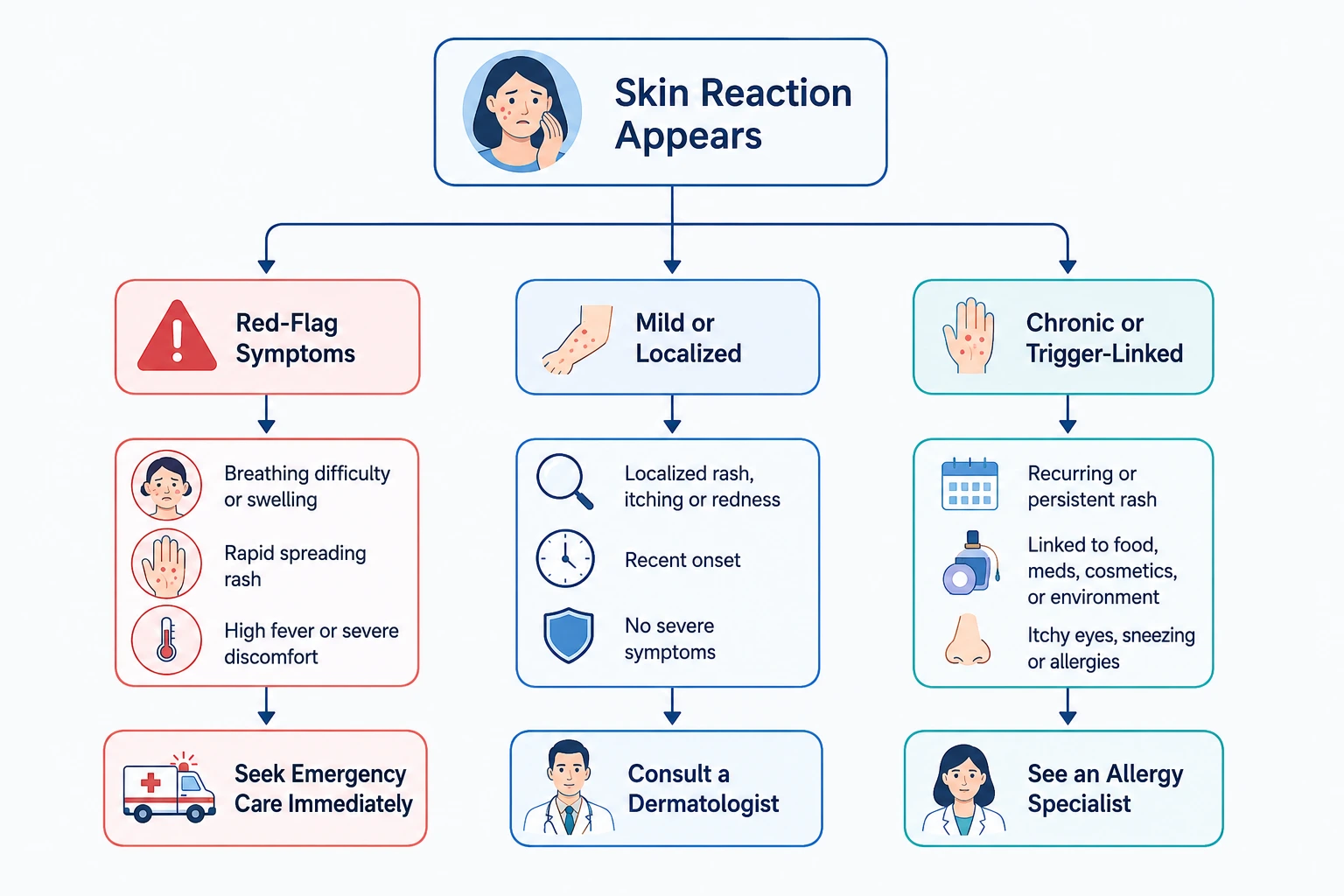
Occupational exposures are also worth flagging separately: contact dermatitis linked to a workplace chemical or a specific product can significantly affect quality of life and often needs formal patch testing to identify the exact culprit substance, rather than trial-and-error avoidance.
Diagnosis
Getting an accurate diagnosis typically involves more than a visual exam. A thorough evaluation includes:
- Detailed history-taking: Onset, duration, seasonal pattern, suspected triggers, and any family history of asthma, eczema, or hay fever.
- Skin prick testing: Identifies IgE-mediated sensitivity to common inhalant, food, or drug allergens, with results typically available within 15–20 minutes.
- Specific IgE blood tests: A useful alternative when skin testing isn’t appropriate – for example, on active eczema sites, or when antihistamines can’t be paused before testing.
- Patch testing: The standard method for identifying delayed contact allergens in dermatitis, though it requires the skin to be observed over 48–96 hours across multiple visits.
- Oral food challenges: Used selectively to confirm a suspected food allergy under direct medical supervision, given the small risk of triggering a reaction during the test itself.
Which test is appropriate depends heavily on the type of reaction and its suspected trigger – this is precisely why a specialist consultation, rather than self-directed testing, gives the most reliable answer.
Treatment
Treatment is matched to both the severity and the underlying cause of the reaction:
Topical Therapy
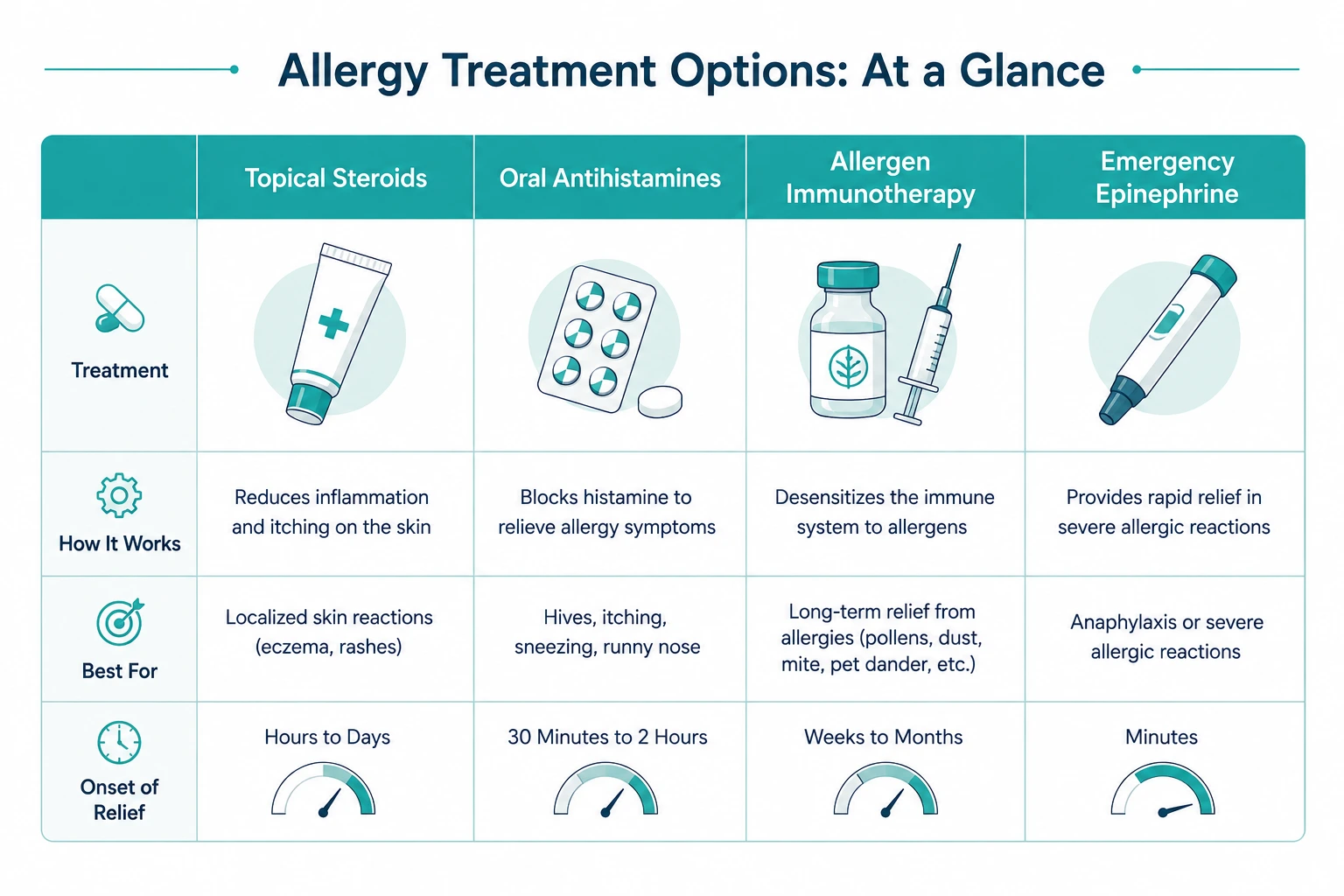
Topical corticosteroids and calcineurin inhibitors remain first-line for eczema and contact dermatitis, effectively controlling inflammation, though prolonged steroid use requires monitoring for skin thinning.
Systemic Antihistamines
Oral antihistamines like cetirizine are the standard first-aid approach for hives and itching, though they are not curative for chronic or recurring cases and are not sufficient on their own for a severe systemic reaction.
Systemic Steroids or Immunosuppressants
Reserved for severe, widespread dermatitis or urticaria that hasn’t responded to standard topical treatment – typically used short-term given their side-effect profile.
Biologic Therapy
For refractory chronic urticaria that doesn’t respond to antihistamines, biologic agents offer an additional treatment layer, though cost and the need for specialist administration limit their routine use.
Allergen Immunotherapy
For confirmed environmental allergies (dust mites, pollen), immunotherapy – delivered as injections or sublingual tablets – works by gradually desensitizing the immune system, reducing reliance on medication over time. This is a multi-year commitment rather than a quick fix.
Emergency Treatment
For anaphylaxis, epinephrine is the only appropriate emergency treatment, followed by observation, since symptoms can recur even after initial improvement.
Clinical Trial Data
Diagnostic and treatment evidence for allergic skin conditions consistently points to a few clear patterns:
- Skin prick testing is well-established as a fast, sensitive method for detecting IgE-mediated sensitivity to common allergens, though it requires intact skin and a pause on antihistamines beforehand.
- Specific IgE blood testing shows somewhat lower sensitivity than skin testing for many allergens, but remains a safer option for patients with active skin disease or those who cannot stop antihistamine use.
- Patch testing remains the recognized standard for identifying delayed-type contact allergens, with results read across multiple follow-up visits rather than in a single sitting.
- Allergen immunotherapy is documented to be disease-modifying – meaning it can reduce underlying sensitivity over time – rather than simply masking symptoms, though the treatment course typically runs over several years.
- Chronic urticaria unresponsive to antihistamines has shown meaningful improvement with biologic therapy in cases where standard treatment has failed.
These patterns reflect general allergy and dermatology practice standards rather than outcomes from a single trial; individual response depends on the specific trigger and reaction type involved.
Medication Guide
| Medication/Therapy | Type | Typical Use |
|---|---|---|
| Cetirizine (or similar) | Oral antihistamine | First-line for hives and itching |
| Topical corticosteroids | Topical | Eczema, contact dermatitis flare control |
| Tacrolimus / Pimecrolimus | Topical calcineurin inhibitor | Steroid-sparing option for sensitive areas |
| Omalizumab (or similar biologic) | Injectable biologic | Chronic urticaria unresponsive to antihistamines |
| Epinephrine auto-injector | Emergency injectable | Anaphylaxis – immediate use required |
| SCIT / SLIT immunotherapy | Injection or sublingual tablet | Long-term desensitization to confirmed environmental allergens |
Never substitute an antihistamine for epinephrine during a severe reaction – always use prescription medication under medical supervision and carry an auto-injector if one has been prescribed to you.

Doctor Review Block
This article has been medically reviewed by Dr. Tejansu Dalal, MD (Dermatology), for clinical accuracy. Treatment recommendations should always be personalised through an in-person consultation, as allergic reactions vary significantly in cause and severity between patients.