
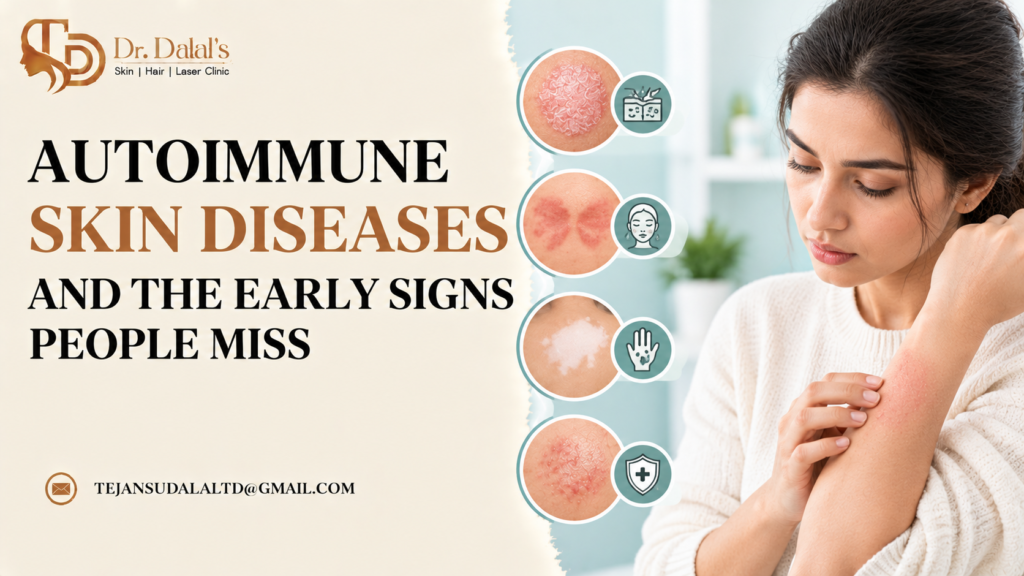
Many autoimmune skin conditions do not start with an obvious blister, a bright white patch or a dramatic rash. They start with itch that creams do not fix, a mouth sore that will not heal, a faint purple tint on the eyelids or a few hairs that break near a bare spot. These early signs are easy to mistake for eczema, a fungal infection or a vitamin problem, and months can pass before the real cause is found. This guide explains which early signs are worth taking seriously, what they can be mistaken for and when to see a doctor.
Early autoimmune skin disease often looks like something harmless, so persistence is the clue. Itch with no clear cause that does not respond to usual creams, mouth ulcers that do not heal in 2 to 3 weeks, white or pale patches with a sharp edge, hair loss in round patches, a purple tint on the eyelids or knuckles, and tightening skin on the fingers or neck are all reasons to see a skin doctor. Most autoimmune skin diseases are controlled long term rather than cured, and treatment works best when it starts early.
Introduction
The immune system normally protects the body from germs. In an autoimmune disease, it mistakenly attacks the body’s own tissue. When the target is the skin, hair, nails or the lining of the mouth, the result is a skin disease. Common examples include vitiligo, alopecia areata, psoriasis, lichen planus and pemphigus. Some are linked to conditions that also affect muscles, joints and blood vessels, such as scleroderma and dermatomyositis.
The skin is often the first place a problem shows, which is helpful, because early treatment protects the skin and sometimes the rest of the body. The difficulty is that early signs are quiet. They are often itchy or flat, not dramatic, and they sit in places people do not look, such as the mouth, scalp, nail folds and body folds. That is why they are so often missed.
What Autoimmune Skin Diseases Are?
Autoimmune skin diseases are conditions in which the immune system attacks parts of the skin or the tissue around it. Depending on what is attacked, the picture is very different:
- Pigment cells are attacked: the skin loses colour in patches (vitiligo).
- Hair roots are attacked: hair falls in round, bare patches (alopecia areata).
- The glue between skin cells is attacked: the skin and mouth blister and erode (pemphigus and related blistering diseases).
- Small blood vessels and connective tissue are attacked: the skin changes colour, tightens or becomes inflamed, and sometimes muscles and organs are involved (dermatomyositis and scleroderma).
- Skin cell growth is driven too fast: thick, scaly plaques form (psoriasis).
- Skin and mouth lining are inflamed: itchy, flat-topped purple bumps form (lichen planus).
These conditions are usually long-term. With the right plan, most people can keep them under control and live a normal life, though they are managed rather than permanently cured.
Clinical Overview: The Early Signs by Body Area
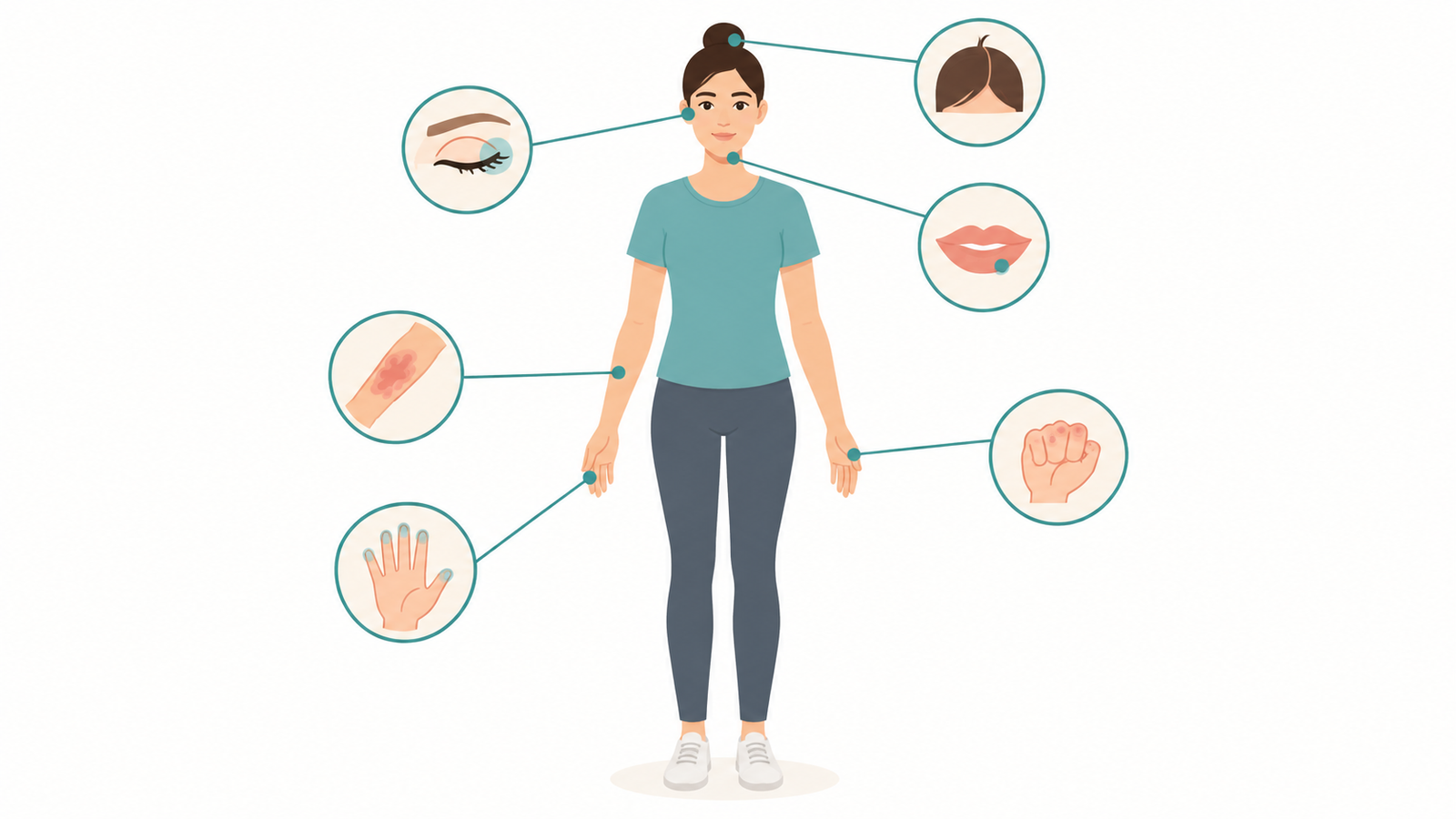
In the mouth and gums
- Painful sores or raw patches that do not heal in two to three weeks, or that keep coming back
- Red, sore, bleeding gums that do not improve with dental care
- In some blistering diseases, mouth sores can appear months before any skin blister. They are often treated at first as ordinary mouth ulcers, a yeast infection or a viral sore.
On the skin, before any blisters
- Strong itch that is hard to relieve, sometimes with no visible rash at all
- Itchy, raised, hive-like or eczema-like patches that do not behave like ordinary eczema or hives
- In older adults, this itchy phase can last for months before blisters appear, and may be called eczema or “dry skin” for a long time
On the eyelids, knuckles and hips
- A violet or purplish tint on the upper eyelids, sometimes with puffiness
- Flat or raised, scaly, purple-red bumps over the knuckles, elbows and knees
- A purple-red rash on the sides of the hips and thighs
- Muscle weakness may follow later, and the skin may show up first
On the fingers, nails and neck
- Fingers that turn white, then blue, then red in the cold
- Fingertips that lose their rounded shape and look smooth and tight
- Tiny red, dilated blood vessels and ragged cuticles around the nails
- Tightening skin on the fingers, face or neck
Pale patches
- Chalk-white patches with a sharp border, often around the eyes and mouth, on the hands, wrists and over joints
- Patches with three shades (white centre, tan ring, normal skin), or small pinpoint white spots scattered around a larger patch, which suggest active spreading
- White hairs within a patch
- New patches appearing where the skin was rubbed, scratched or injured
On the scalp and hair
- Round or oval, smooth bald patches
- Short, broken hairs that are thin near the root and wider at the tip at the edge of a bare spot
- Hairs near the edge that bend or kink easily when pressed gently along the shaft, a sign that the patch may still be spreading
Autoimmune or Look-Alike
Many early signs have a simple, non-autoimmune cause, and doctors have to tell them apart. The table below shows common mix-ups.
| What You Notice | Common Look-Alike | Autoimmune Possibility | Clue That Helps |
|---|---|---|---|
| Pale patches on the skin | Fungal patches (tinea versicolor) or faint pale patches in children (pityriasis alba) | Vitiligo | Vitiligo is chalk-white and smooth with a sharp edge. The fungal kind is scaly with a softer edge and may glow differently under a special lamp |
| Itchy rash on an older adult | Eczema, dry skin or scabies | Early stage of a blistering disease | Intense itch that is hard to relieve, or a rash that does not respond as usual |
| Mouth ulcers | Ordinary mouth ulcers, yeast infection or a viral sore | Early blistering disease or lichen planus | Ulcers that last beyond 2 to 3 weeks, or sore gums |
| Purple knuckle bumps | Psoriasis or lichen planus | Dermatomyositis | Purple tint on the eyelids and ragged cuticles |
| Round bald patch | Ringworm of the scalp or hair pulling | Alopecia areata | Smooth skin, broken short hairs and a sudden start |
| Cold, colour-changing fingers | Normal cold reaction | Scleroderma spectrum | Changes in nail-fold blood vessels, tightening skin |
This table shows general patterns. Look-alikes are often more common than autoimmune disease, so the right answer needs an examination.
Diagnosis: How Doctors Confirm It
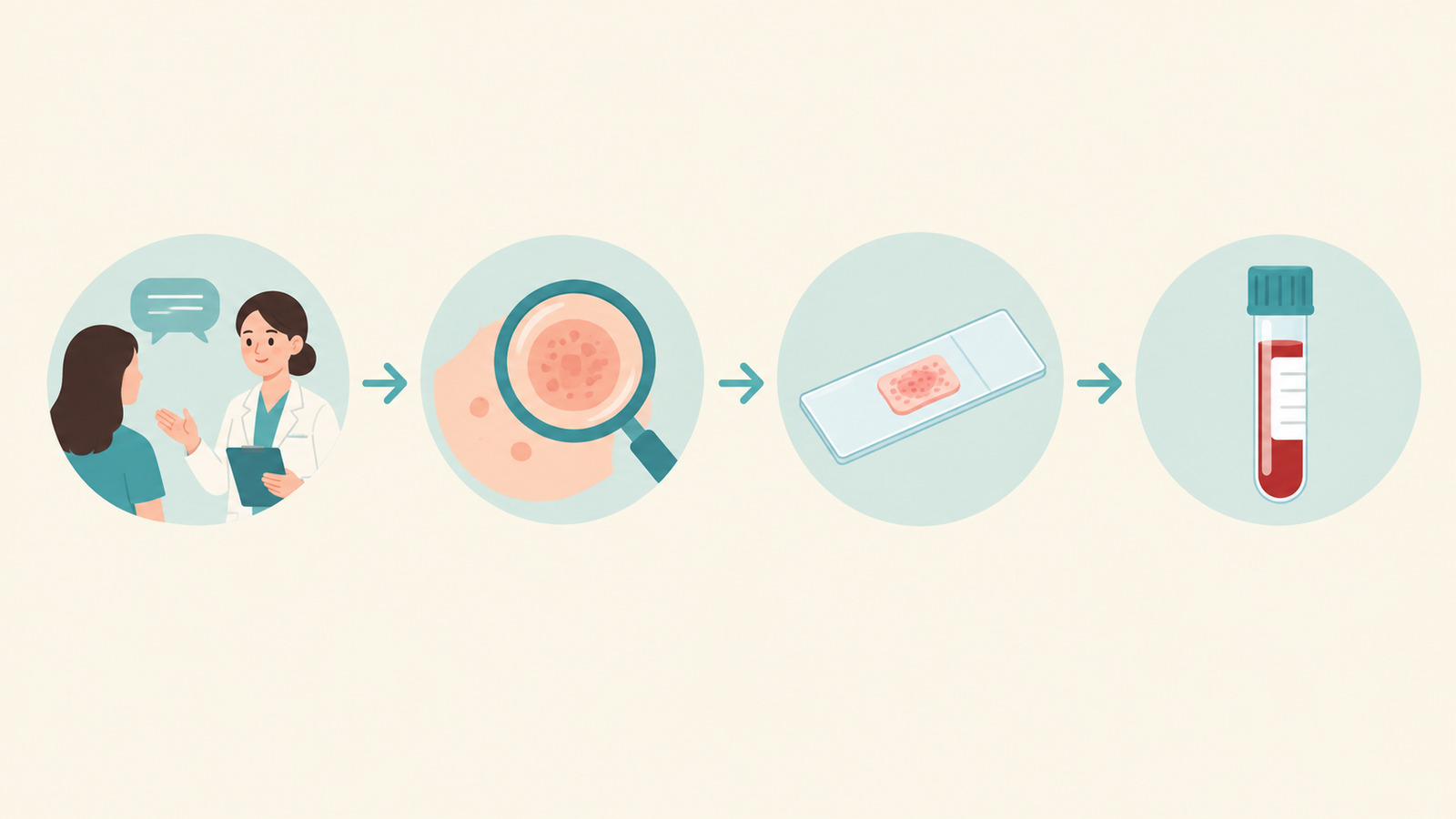
Diagnosis begins with a careful story and a full skin check. A best hair doctor in ahmedabad or skin doctor will ask when the problem started, how it has changed, whether it itches or hurts and whether family members have autoimmune conditions. The examination also covers places people forget: inside the mouth, the gums, the scalp, the nail folds, body folds and the sides of the hips.
Depending on what is suspected, the doctor may use:
- A special ultraviolet lamp: to tell pale patches such as vitiligo from fungal ones, because they glow differently.
- A hand-held scope for hair or nails: to look closely at hair roots or tiny blood vessels at the nail fold.
- A skin biopsy: a tiny skin sample is taken and examined under the microscope. For blistering conditions, a second sample from the unblistered skin next to a lesion is tested for immune proteins. Samples from raw, open skin can give false results, so the site chosen matters.
- Blood tests: to look for antibodies linked to specific conditions.
- Simple bedside checks: such as gently pressing or rubbing the skin to see if it separates, or testing whether hairs near a bare patch break easily.
A proper diagnosis often takes more than one step, and a doctor may involve a dentist, a rheumatologist or another specialist, especially when muscles, joints or internal organs may be involved.
What the Research Shows?
Medical reviews and clinical literature on autoimmune skin conditions point to several consistent findings:
- Skin is often the first clue: Skin changes are frequently the earliest sign of an autoimmune disease, sometimes before internal problems appear.
- Early signs are subtle: They are often itchy, flat, hidden in the mouth, scalp or nail folds, or look like common skin conditions.
- Misdiagnosis is common: Early autoimmune disease is often first labelled eczema, hives, psoriasis, a fungal infection or an ordinary mouth ulcer.
- Delay can have a price: Late diagnosis can allow progression, scarring or tissue hardening, serious infection in severe blistering disease, and more damage than early treatment would have allowed.
- Blistering disease can have a long quiet phase: In some older adults, an itchy phase without blisters can last for months or more than a year before blisters appear.
- Mouth sores can come first: In many people with pemphigus, the first signs are in the mouth, sometimes months before any skin blister.
- Skin signs can come before muscle weakness: In dermatomyositis, the skin rash can appear months before any muscle weakness.
- Nail-fold blood vessels give early information: Changes seen under magnification can show scleroderma-spectrum disease long before skin tightening is obvious.
- Sampling correctly matters: A biopsy from the wrong spot can miss the answer.
- Early treatment improves outcomes: Controlling the immune attack early limits permanent damage and reduces the long-term burden of treatment.
These findings come from published reviews and clinical papers. They describe general patterns, and your own case depends on what an examination finds.
Treatment: Why Early Care Matters
The right plan depends on the condition. Doctors treating autoimmune skin diseases usually begin with the gentlest effective option and adjust it over time, with regular follow-up. Depending on the diagnosis, this can include creams or ointments applied to the skin, light therapy, injections into patches, or tablets and other medicines that calm the immune system for those with more widespread or severe disease.
What matters at the early stage is:
- A correct diagnosis first: The same-looking patch can need very different treatment, and the wrong treatment can delay the right one.
- Starting before damage builds up: Early control can prevent spreading, scarring and permanent loss of function.
- Not self-treating for long: Over-the-counter products do not address the immune cause, and strong creams used for weeks without a diagnosis can hide a pattern or cause skin thinning.
- Regular follow-up: These conditions can flare, settle and flare again, and the plan often needs adjusting.
- Realistic expectations: Most of these conditions are controlled long term rather than cured, and this is true even when the skin looks normal.
Ayurvedic and home remedies have not been shown to cure autoimmune skin disease, and delaying proper care for them can allow damage to progress. A top skin doctor in ahmedabad will usually offer a clear diagnosis, an honest explanation and a step-by-step plan, and will refer you to other specialists when it is needed.
Key Takeaways
- Early autoimmune skin disease is often quiet and looks like a common skin problem.
- Itch that will not settle, mouth sores that will not heal, a purple tint on the eyelids or knuckles, sharp-edged white patches and round bald patches are all worth checking.
- Hidden places matter: the mouth, gums, scalp, nail folds and body folds.
- Look-alikes such as eczema, fungal patches and ordinary mouth ulcers are common, so a doctor’s examination is the only reliable way to tell.
- A biopsy from the right spot, a special lamp or blood tests help confirm the diagnosis.
- Most conditions are controlled long term, and early treatment protects the skin and sometimes the rest of the body.
- Home and herbal remedies have not been shown to cure these conditions, and delay can cost you.
Doctor Review Block
This article has been medically reviewed by Dr. Tejansu Dalal, MD (Dermatology), for clinical accuracy. In my experience, patients often come after months of treating the wrong problem. A rash or sore that does not behave like the usual condition is a good reason for an early visit, and the earlier a pattern is recognised, the more of the skin we can protect.
References & Citations
This article draws on published research and clinical references on autoimmune skin diseases, including an overview of dermatological autoimmune diseases from the National Center for Biotechnology Information and an overview of cutaneous signs in dermatological diseases available through the National Institutes of Health. Findings reflect published medical literature and general clinical practice.