
Choosing between PRP therapy and a hair transplant isn’t about which one is “better” – it’s about which one matches the actual state of your hair follicles. This guide breaks down the real difference between PRP and hair transplant, and how a specialist decides which one fits your case.
PRP works by reactivating hair follicles that are miniaturized but still alive, making it suited to early-to-moderate hair loss, while a hair transplant physically relocates permanent, DHT-resistant follicles to areas where follicles are already gone – making it the only option for advanced, complete baldness. Many patients aren’t choosing one over the other at all; combining both is now considered standard practice for stronger, longer-lasting results.
Key Takeaways
- PRP can only reactivate follicles that are still alive but shrinking – it cannot regrow hair where follicles have died completely.
- Hair transplant is a surgical redistribution of your own permanent hair, not a way to stop ongoing hair loss elsewhere on the scalp.
- Combining PRP with a hair transplant is associated with faster graft recovery and reduced post-surgical shedding compared to surgery alone.
- Patients under 25 with early, unstable hair loss are generally poor surgical candidates and are better served by PRP and medication first.
- Neither treatment replaces the need for ongoing medical therapy (like finasteride or minoxidil) to manage the underlying cause of hair loss.
Introduction
Hair loss affects the majority of men and roughly half of women at some point, and the two most talked-about treatments – PRP and hair transplant – get compared constantly, but rarely explained clearly. They aren’t competing options doing the same job; they work on completely different biological premises, and picking the wrong one for your specific stage of hair loss can mean wasted time and money. This guide explains exactly how each treatment works, who is actually a candidate for which, and why combining the two has become the modern standard of care rather than an either-or decision.
What Are PRP and Hair Transplant?
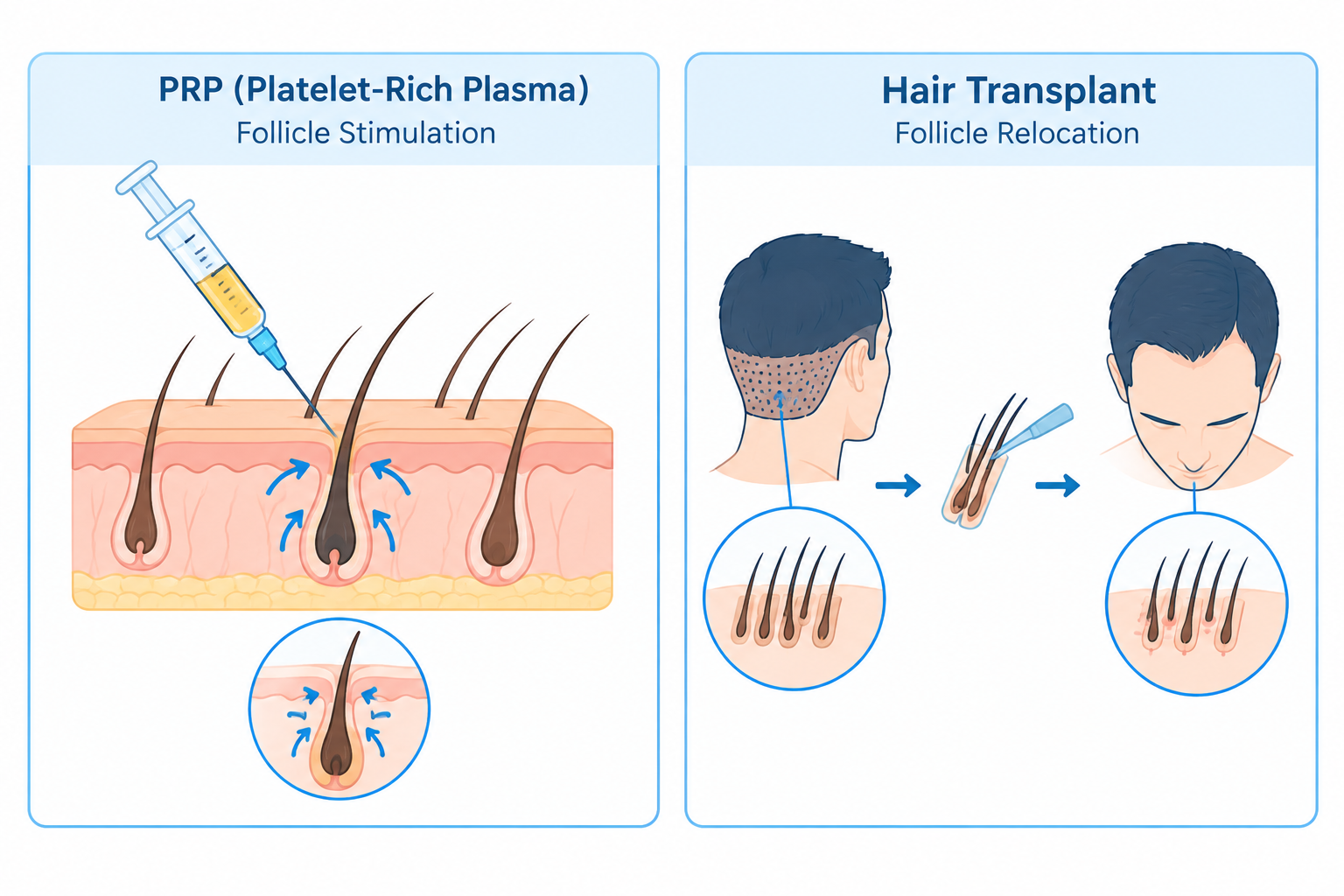
Platelet-Rich Plasma (PRP) therapy involves drawing a small sample of the patient’s own blood, concentrating the platelets, and injecting this concentrate into the scalp. The platelets release growth factors that stimulate blood flow and help reactivate hair follicles that have shrunk but not died. Hair transplant, performed via Follicular Unit Excision (FUE) or Follicular Unit Transplantation (FUT), is a surgical procedure that moves permanent, hormone-resistant hair follicles from the back of the scalp to areas of thinning or baldness. One stimulates existing biology; the other physically rebuilds structure.
Clinical Overview
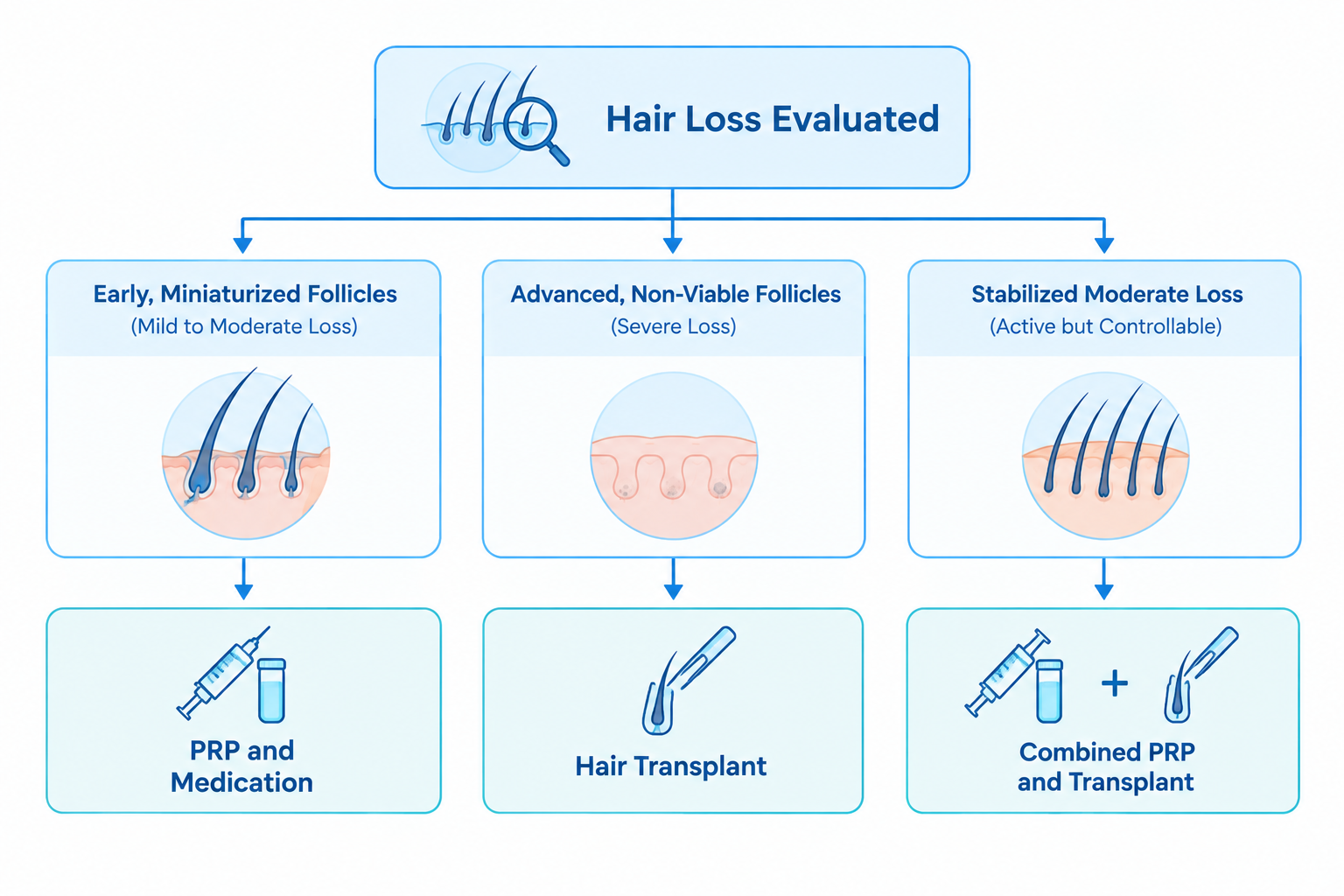
Hair loss from androgenetic alopecia progresses through recognizable stages, and which treatment is appropriate depends heavily on where a patient’s hair sits on that spectrum. In early-to-moderate thinning, hair follicles are still present but have progressively miniaturized – shrunk in size and shortened their active growth phase – without dying outright. This is exactly the population PRP is designed for, since its entire mechanism depends on stimulating follicles that are still biologically alive.
In more advanced hair loss, however, follicles in the balding area have typically undergone complete fibrotic change and are no longer capable of producing hair at all, regardless of stimulation. At this stage, no amount of PRP can regenerate a follicle that no longer exists – which is precisely why surgical transplantation, relocating living follicles from a donor area, becomes the only option capable of restoring visible coverage.
This distinction is also why age and hair loss stability matter so much in treatment planning. Younger patients with early, still-progressing hair loss are generally considered poor surgical candidates, since transplanting hair before the balding pattern has stabilized risks an unnatural result later as the surrounding native hair continues to thin.
Diagnosis
Determining which treatment (or combination) is appropriate requires a structured clinical evaluation, not a visual guess:
- Trichoscopic examination: A magnified scalp exam assesses hair density, the degree of follicular miniaturization, and the overall pattern of loss.
- Miniaturization rate assessment: A high proportion of significantly miniaturized follicles in a given area signals active, ongoing hair loss that generally responds better to non-surgical stabilization first.
- Donor zone evaluation: For anyone being considered for a transplant, the permanent donor area at the back of the scalp is assessed for density and capacity, since this determines how much hair is realistically available to relocate.
- Age and pattern stability: Younger patients with an early, still-evolving pattern are typically steered toward medical stabilization and PRP rather than surgery, which is better suited to patients with a stabilized, more advanced pattern.
This evaluation is what separates an appropriate treatment recommendation from a one-size-fits-all sales pitch – the right choice genuinely depends on these specific, measurable factors rather than personal preference alone.
Treatment
PRP as Standalone Therapy
Best suited to early-to-moderate thinning with follicles that are miniaturized but alive. A typical course involves three to four monthly sessions followed by maintenance sessions every three to six months, since the effect requires ongoing reinforcement rather than being a one-time fix.
Hair Transplant as Standalone Therapy
The only effective option once follicles in the balding area have completely and permanently stopped functioning. Results take shape gradually, with mature hair typically visible around 9 to 12 months after the procedure.
Combined PRP and Hair Transplant
Increasingly considered the standard approach for suitable candidates. PRP can be used to prepare the surgical site before grafting, to help preserve harvested grafts during the procedure, and afterward as booster injections to support faster healing and reduce post-surgical shedding of the newly placed grafts.
Supporting Medical Therapy
Neither PRP nor a transplant addresses the underlying hormonal process driving ongoing hair loss in untreated areas of the scalp. Oral or topical medications that target this process are generally recommended alongside either treatment for durable, long-term results – otherwise, native hair surrounding a successful transplant can continue thinning over time.
Clinical Trial Data
Published research on both treatments shows some consistent patterns worth understanding before deciding on a treatment path:
- PRP monotherapy has shown statistically significant improvements in hair density compared to baseline and placebo across multiple randomized trials, though its effect on the actual thickness of individual hair strands is more limited when used alone.
- PRP combined with topical minoxidil shows meaningfully greater improvement in both hair density and hair shaft thickness compared to PRP alone, supporting a combined-therapy approach even outside of surgery.
- PRP as a surgical adjunct has been associated with earlier visible hair growth after transplant surgery (around three to four months rather than the standard six months) and reduced severity of post-surgical shedding of transplanted grafts.
- FUE currently accounts for the large majority of surgical hair restorations performed globally, reflecting a broader shift toward this technique over the older strip-harvesting (FUT) method, largely due to less visible scarring and faster recovery.
- Graft survival rates during surgery depend heavily on how harvested follicles are handled and preserved between extraction and placement – specialized preservation solutions have been shown to meaningfully outperform standard saline in maintaining graft viability.
These findings reflect the current body of published research on hair restoration; individual outcomes vary meaningfully based on the extent of hair loss, follicle condition, and adherence to any recommended maintenance therapy.
Medication Guide
| Therapy | Type | Typical Use |
|---|---|---|
| PRP injections | Autologous biological therapy | Early-to-moderate hair loss with viable, miniaturized follicles |
| Finasteride / Dutasteride | Oral 5-alpha-reductase inhibitor | Long-term suppression of the hormone driving ongoing hair loss |
| Topical Minoxidil | Topical vasodilator | Supports blood flow to follicles; often paired with PRP |
| FUE (Follicular Unit Excision) | Surgical procedure | Advanced hair loss with donor hair available; minimal visible scarring |
| FUT (Follicular Unit Transplantation) | Surgical procedure | Advanced loss requiring maximum graft yield from the donor area |
PRP and hair transplant are not substitutes for each other, and combining them – along with appropriate medical therapy – is often the most effective long-term approach rather than choosing just one.
Doctor Review Block
This article has been medically reviewed by Dr. Tejansu Dalal, MD (Dermatology), for clinical accuracy. Treatment recommendations should always be personalised through an in-person evaluation, including a scalp and donor-area assessment specific to your pattern and stage of hair loss.
References & Citations
This article draws on dermatology and hair restoration clinical literature, including information published by the National Health Portal of India and research summarised by the National Institutes of Health. Clinical outcome figures reflect published research on PRP and surgical hair restoration outcomes.