
If your father, uncle or grandfather lost his hair early, you probably wonder whether the same will happen to you. In many families it does, but not always, and not in the way most people think. The old story that baldness comes only from your mother’s father is a myth. This guide explains why hair loss runs in families, how to spot the early signs, how a doctor confirms the cause and what baldness treatment can realistically do when it is started early.
Pattern baldness, medically called androgenetic alopecia, runs in families because it is strongly inherited, through genes from both your mother and your father, but having a relative with it raises your risk and does not guarantee it. In people who inherit the tendency, a male hormone called DHT slowly shrinks hair follicles until they grow thin, short hairs and eventually stop. Early baldness treatment works best because it protects follicles that are still alive. Follicles that have fully disappeared cannot be brought back by medicine, so a scalp check at the first signs gives you the most options.
Key Takeaways
- Pattern baldness is among the most inherited hair conditions, and genes come from both sides of the family.
- The “only from your mother’s father” idea is a myth. One important gene sits on the X chromosome, but hundreds of others do not.
- Family history raises risk but is not destiny. Stress, smoking, health and hormones change when and how much hair thins.
- Hair does not vanish overnight. Follicles shrink slowly, and a large share of density can be lost before it is easy to see.
- Women get pattern hair loss too, usually as wider thinning at the parting, not a receding hairline.
- A doctor must confirm the cause, since thyroid problems, low iron and scarring or autoimmune hair loss can look similar and need different care.
- Medical treatment needs steady use, and gains fade if it is stopped.
- Early evaluation protects the most hair.
Introduction
Seeing a thinner parting or a higher hairline is unsettling, especially when it reminds you of a parent. Many people react in one of two ways. Some assume it is fate and do nothing. Others try one product after another without knowing the cause.
Both reactions waste time. Hair follicles in pattern baldness do not die suddenly. They shrink over years, and that slow pace is your window of opportunity. Understanding how heredity works, what your own pattern means and what to ask your doctor lets you act while there is still hair to protect.
What Pattern Baldness Is
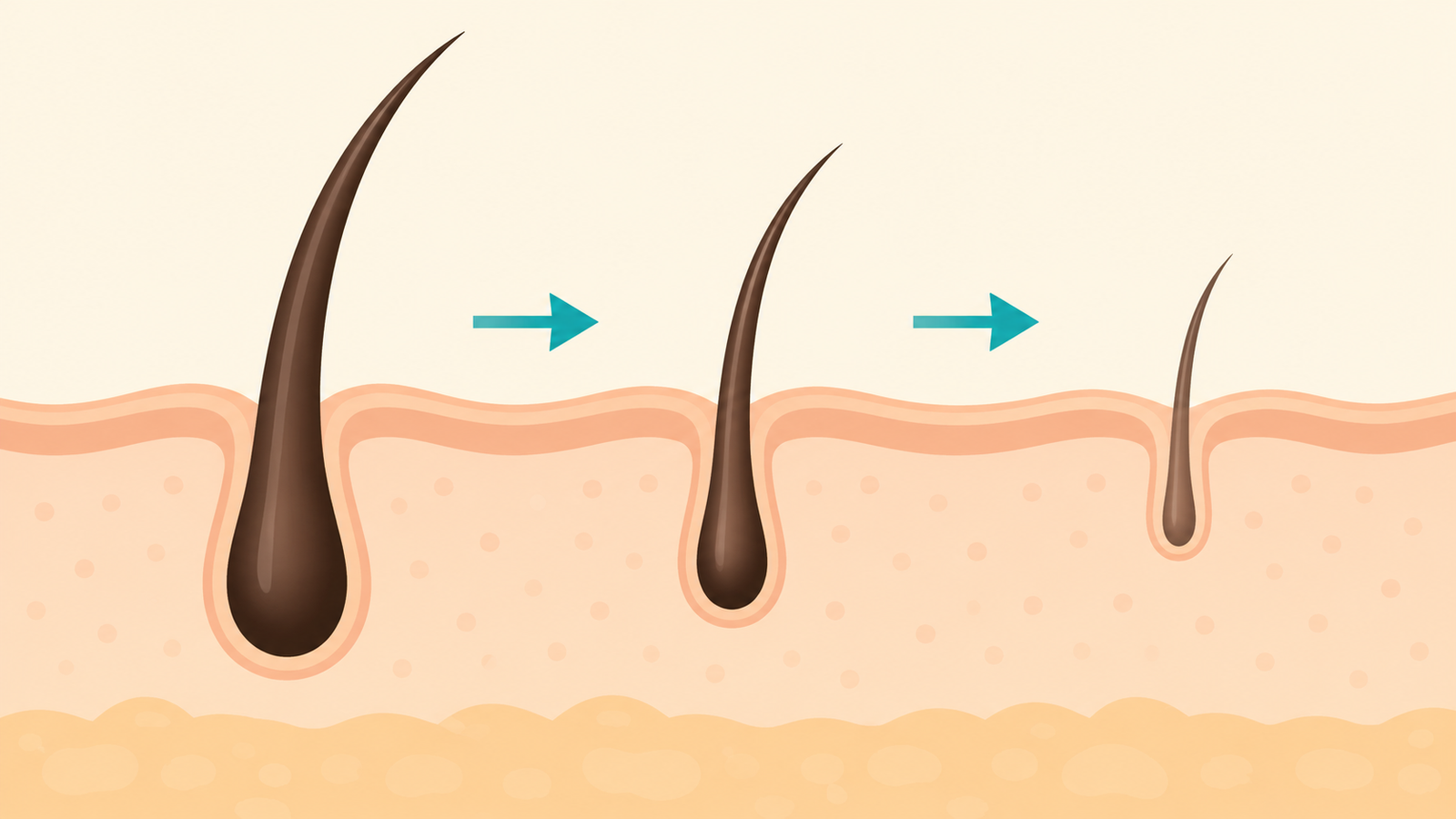
Pattern baldness is a long-term condition in which scalp hair gradually becomes thinner in a typical pattern. It happens because certain follicles are sensitive to DHT, a hormone made from testosterone. Under its influence, a healthy follicle shrinks with every hair cycle. The growth phase gets shorter, the hair gets finer and lighter, and in time the follicle makes only a faint, short fibre or nothing at all.
This process is called miniaturisation. It affects a large share of men and a large share of women over a lifetime. The condition is not caused by wearing caps, washing hair often or using oil, and it is not a sign of poor health on its own.
Why Hair Loss Runs in Families
Pattern baldness is one of the most strongly inherited traits in dermatology. Studies of twins suggest that around 80 in 100 men’s risk comes from genes, and large family studies put the figure at roughly 60 in 100. The rest comes from lifestyle, hormones and chance.
The mother’s father myth. Some of this belief has a real basis. A key gene that controls how the scalp reacts to male hormones sits on the X chromosome, which a son gets from his mother. It is one of the strongest single genetic factors for early baldness in men. But it is only one piece. A review of the genetic landscape of androgenetic alopecia describes hundreds of other places in the genome, spread across chromosomes that come equally from both parents, that affect hair growth and follicle sensitivity. This is why a father’s hair loss matters as much as a mother’s father’s, and why doctors look at both sides of the family.
Why a family history is not a guarantee. Because so many genes are involved, each adds only a small amount of risk. You can inherit many of them or few, and brothers in the same family often differ. Studies of identical twins, who share the same genes, show that one twin can lose hair earlier or more heavily than the other. A study of identical twins found that higher stress, heavier smoking and other health factors were linked to more hair thinning. So your genes set the tendency, and your life and health influence the timing.
Other kinds of hair loss can run in families too. Patchy autoimmune hair loss, some scarring hair loss around the hairline and rare conditions present from childhood can also cluster in families. They behave very differently from pattern baldness and need different care, which is why a doctor must confirm what you have.
Early Signs in Men and Women
Hair loss is easy to miss at first. Clinical estimates suggest that a large share of scalp density can be lost before thinning is clearly visible, so noticing early signs matters.
In men:
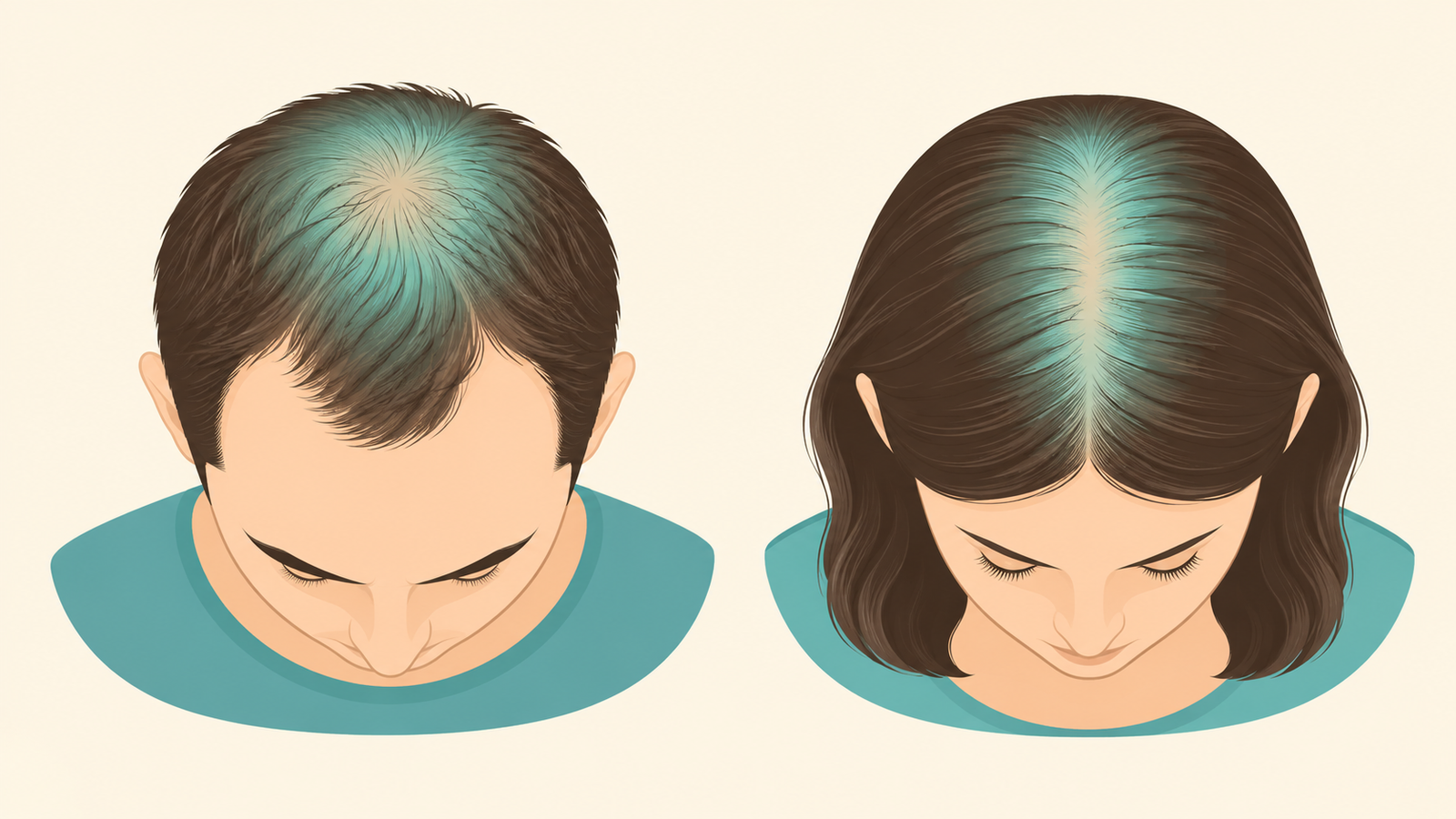
- Hairline recession at the temples, often forming an “M” shape
- Thinning at the crown, sometimes seen first in photos or a mirror from behind
- Hair that feels finer and shorter than before
- Over time, the areas can join, leaving hair around the sides and back
In women:
- A wider centre parting
- Thinning across the top and crown, while the front hairline is usually kept
- A smaller ponytail than before
- More scalp visible under bright light
Signs that suggest a different cause and need prompt review:
- Sudden shedding of large amounts of hair
- Round, smooth bald patches
- A scalp that is red, scaly, sore, burning or itchy
- Hair loss with weight change, tiredness, irregular periods or other body symptoms
What the Research Shows
- Pattern baldness is very common: Studies suggest that most men have some degree of it by old age, and about half of women are affected over a lifetime. It often begins in the late teens or twenties in men and is more common after menopause in women.
- It is polygenic: Large genetic studies have found hundreds of regions linked to baldness, so there is no single “baldness gene” and no simple test that can predict who will lose hair.
- Genes are not the whole story: Twin research shows that stress, smoking and general health are linked to more hair thinning, even when genes are shared.
- Early follicles can still respond: Balding scalps seem to keep dormant cells in the follicle before it is badly shrunken. This is why treatment started early can protect and thicken hair, while follicles that have fully gone cannot be revived by medicine.
- Treatment needs to continue: Medical treatment keeps follicles in a healthier state only while it is used. If it is stopped, the gains are usually lost over about a year as shrinking resumes.
- Newer options are still being tested: Several new treatments are in late-stage trials, but none should be assumed available or proven until they are fully reviewed and approved. Be careful with products sold online that claim to be a new breakthrough.
- Family risk can overlap with other health patterns: In both men and women, early or heavy pattern hair loss has been linked in studies with some metabolic and hormone conditions, so a doctor may check for these.
How Doctors Diagnose the Cause
Diagnosis comes before treatment, because medicines that suit pattern baldness do not help scarring or autoimmune hair loss, and some hair loss is caused by a fixable health problem. A thorough check usually includes:
- History: When the thinning began, how fast it is moving, family history on both sides, recent illness, weight loss, stress, new medicines, diet, hair care habits and, in women, periods and pregnancies.
- Scalp and hair examination: The pattern of thinning is noted and graded using standard scales, so changes can be tracked over time.
- Magnified scalp examination: A handheld scope shows whether hairs vary in thickness, which points to miniaturisation, and whether there are signs of inflammation, scarring or patchy autoimmune loss.
- Blood tests when needed: These may include thyroid function, iron stores, vitamin D and other nutrients, and in women, hormone checks if there are signs such as irregular periods or excess facial hair.
- Scalp biopsy, in some cases: A tiny skin sample is taken when the diagnosis is unclear, especially if scarring is suspected.
The result tells you whether you have pattern baldness, another type of hair loss or more than one type together. Many people have a mixed picture, for example pattern thinning along with low iron.
Doctor Review Block
This article has been medically reviewed by Dr. Tejansu Dalal, MD (Dermatology), for clinical accuracy. In my experience, the biggest regret patients share is waiting. Many come when the hair loss is already advanced, after trying products that were never matched to the cause. If hair loss runs in your family, a baseline scalp check in your twenties or at the first sign of thinning gives you a record to compare against and the most hair to protect.
Baldness Treatment by Stage
The right plan depends on your diagnosis, your stage and your goals. In broad terms:
Early thinning, many follicles still active. This is the best time to act. Medical care aims to slow the shrinking and thicken fine hairs. Doctors may use medicines that reduce the effect of DHT on follicles, medicines applied to the scalp that support growth, or a combination. Treatments such as scalp micro-injury and growth-factor treatments may be added to help the response. Which of these suits you depends on your sex, age, health and plans for children, since some medicines are not safe in pregnancy and some have side effects that need to be discussed.
Moderate thinning. Medical treatment is still useful, though the change is usually a thickening and slowing of loss rather than a full return of the original density. Results build slowly, typically over several months, and a period of increased shedding early on can happen.
Advanced loss, with bare areas. Where follicles have disappeared, medicine cannot rebuild them. Hair transplant surgery, which moves hair from the back and sides of the scalp to thinning areas, is the option for lasting coverage. It does not stop the hair that remains from thinning, so medical care usually continues alongside it. Donor hair is also limited, and it is not always as stable as people assume, so it should be assessed carefully before surgery.
Timelines to expect. Most medical treatments need at least three to six months before change is visible and a year or more to judge properly. It is a long-term commitment, and stopping usually means the benefit fades.
A planned baldness treatment starts with a scalp assessment and a clear diagnosis, then matches options to your stage, health and goals, with follow-up photographs to check progress. A consultation with the best dermatologist in Ahmedabad includes a check for other causes, an honest talk about what to expect and a plan you can stay with over time. If you are comparing clinics, look for the best hair treatment in ahmedabad that explains the diagnosis first and sets realistic expectations.
Treatment Options at a Glance
| Stage or Situation | Main Aim | Typical Approach | Realistic Expectation |
|---|---|---|---|
| Early thinning in men | Slow loss, thicken fine hair | Hormone-blocking and growth-supporting medical care, with add-on procedures if needed | Slower loss for most, some thickening, needs continued use |
| Thinning at the parting in women | Thicken and hold density | Growth-supporting medical care, with hormone checks and sometimes other medicines | Gradual improvement over many months |
| Moderate thinning | Protect what remains | Combined medical plan with regular review | Better density than doing nothing, not the original density |
| Bare areas with no follicles | Restore coverage | Hair transplant by a qualified doctor, plus ongoing medical care | Lasting coverage in treated areas, remaining hair still needs protecting |
| Hair loss from low iron, thyroid or stress | Fix the trigger | Treat the cause, then recheck | Often improves once the cause is corrected |
| Scarring or autoimmune hair loss | Stop damage early | Different treatment plan from pattern baldness | Needs a specific diagnosis |
This is a general guide. Your own plan should come from an in-person assessment.
References & Citations
This article draws on published research on the genetics of pattern baldness, including a review of the genetic landscape of androgenetic alopecia available through the National Institutes of Health, and a study of identical twins on the contribution of inherited and environmental factors to hair thinning, indexed by the National Library of Medicine. Figures reflect published studies and general clinical practice.