
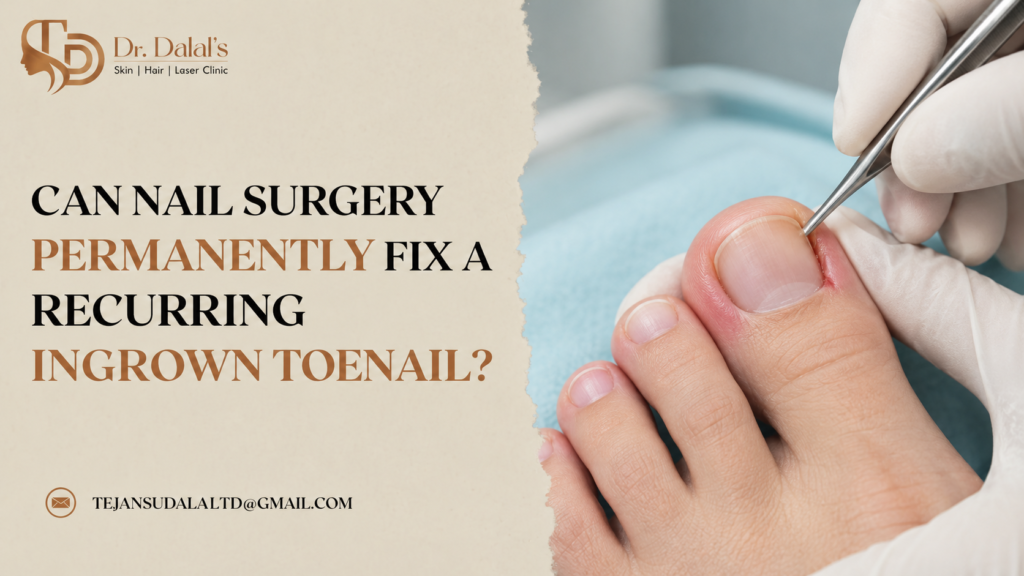
If an ingrown toenail has come back more than once, you have probably already tried soaking, trimming and careful footwear. When those stop working, the question becomes whether it can ever be fixed for good. The honest answer is yes, in the large majority of cases, but only if the operation matches the real reason the nail keeps growing into the skin.
Yes. Nail surgery can permanently fix a recurring ingrown toenail in roughly 90% to 100% of people when the right technique is chosen. Simply removing the nail without treating the root that grows it fails often, with the nail returning in a large share of cases. Permanent success usually comes from one of two approaches: destroying the small edge of the nail root that causes the problem, or reducing the overgrown skin fold that keeps pressing on the nail. Which one is right depends on how the nail and the surrounding skin look and how severe the infection is.
Key Takeaways
- Early ingrown toenails often settle with soaks, gentle care and better footwear, but chronic or recurring ones usually need a procedure.
- Taking out the nail edge alone, without treating the nail root, fails often. The nail grows back along the same path and digs in again.
- Treating the edge of the nail root with a chemical agent brings recurrence down to a few percent in most studies.
- In some people the nail is normal and the real problem is an overgrown skin fold. For them, reducing the skin fold works better than narrowing the nail.
- Teenagers and young adults have a higher risk of recurrence, so a thorough technique matters even more for them.
Introduction
An ingrown toenail happens when the edge of the nail pierces the skin beside it, causing pain, redness, swelling and sometimes infection with pus and a fleshy, bleeding overgrowth. It most often affects the big toe. When it keeps returning, daily life suffers: shoes hurt, walking is painful, sports stop and infections repeat. This article explains why ingrown nails come back, how nail surgery works, which techniques give the best chance of a permanent result and what influences recovery.
Why Ingrown Toenails Keep Coming Back?
A nail grows from a small area of tissue at its base, called the nail root or matrix. If a procedure removes part of the nail but leaves this root intact, the root keeps producing nail in the same direction. The new nail grows forward along the same groove and meets the same skin, and the cycle repeats. Studies show that simply removing the nail edge without treating the root leads to recurrence in anywhere from about 30% to over 80% of people.
There are two main reasons for failure even after a proper operation. The first is that a tiny piece of nail root is left behind, and it produces a thin sharp strip of nail that pierces the skin again. The second is that the real problem was never the nail. In many chronic cases the nail shape is normal, but the skin fold beside it is swollen and overgrown, pressing against the nail edge with every step. If that skin is not dealt with, narrowing the nail only makes the pressure worse.
Clinical Overview: Stages of an Ingrown Toenail
Doctors use staging systems to decide what to do. In simple terms:
- Stage 1: mild redness, slight swelling and pain on pressure. The skin fold is normal. Soaks, careful nail care and sometimes a small splint under the nail edge are enough.
- Stage 2: more pain, active infection and pus in the nail groove. Stage 2 may be treated by removing the problem edge of the nail and treating the root. When the skin fold has started to swell, a skin reduction step may be added.
- Stage 3: long-standing infection, fleshy overgrown tissue and a thick, scarred skin fold covering the nail edge. This stage usually needs the overgrown skin to be removed.
Early care can help in the first stage, but once an ingrown toenail has returned several times, or has reached the later stages, home care rarely gives a lasting result.
Diagnosis: Choosing the Right Operation
Deciding which surgery to do starts with an examination. The clinician looks at the shape of the nail, the depth and swelling of the skin fold, whether there is infection or fleshy overgrowth and how many times the problem has returned. The main questions are:
- Is the nail itself the problem? If the nail edge is curved or thick, treating the nail root edge is likely to work.
- Is the skin fold the problem? If the nail looks normal but the skin beside it is swollen and thick, the skin needs to be treated.
- Has a previous operation failed? After a failed nail root treatment, the cause is often an overgrown skin fold.
- How old is the patient? Younger people recover and regrow tissue more actively, so a more thorough approach is chosen.
- Is there infection right now? Active infection may be treated first, or the procedure may be adapted around it.
Matching the operation to the cause is the single biggest factor in whether the problem is fixed for good.
Treatment: What Nail Surgery Involves
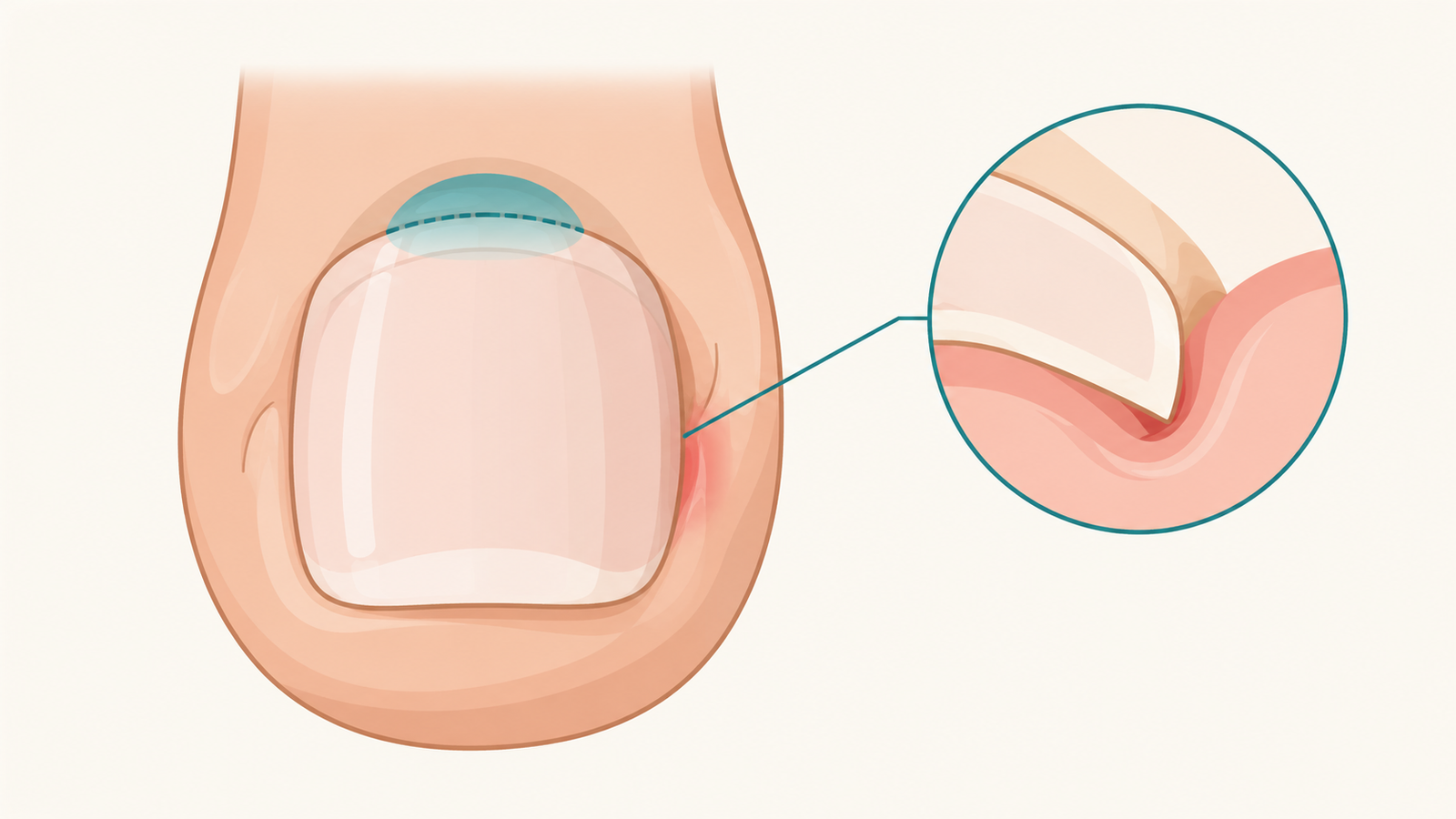
Nail surgery for a recurring ingrown toenail is done under local anaesthesia, with the toe numbed so the procedure is painless. The commonest approach removes the narrow strip of nail that is digging in and then destroys the matching section of nail root underneath it, so that the edge cannot grow back. The root is usually treated with a chemical agent applied for a short, carefully controlled time. Studies show that adding this step to a simple nail removal cuts recurrence from a high rate to only a few percent. The chemical methods differ a little. The most commonly used agent leaves a wet wound that can drain for two to four weeks, while others dry up faster, in around ten days. Because the nail root is only treated at one edge, the nail stays but becomes slightly narrower.
A second approach removes a thin wedge of nail, nail root and skin together and closes the wound with stitches. It heals quickly, but it demands more skill, and any leftover nail root can cause regrowth. A third approach is reserved for people whose real problem is the overgrown skin fold. The surgeon removes a strip of the swollen skin beside the nail and leaves the nail and its root completely untouched, as described in the next section. Complete removal of the whole nail with its root is now rarely chosen for a simple ingrown nail, because it has a higher failure rate and a poorer cosmetic result. Surgery usually takes under an hour, and most people walk home the same day.
Surgical Options Guide: Success Rates and Recovery
| Approach | What Is Done | Typical Recurrence | Typical Recovery | Key Point |
|---|---|---|---|---|
| Nail edge removal alone | Removes the problem edge, root is not treated | Roughly 30% to over 80% | A few weeks | Often fails because the root keeps growing |
| Nail edge removal with chemical root treatment | Removes the edge and destroys that section of root | About 1% to 5% | About 10 days to 4 weeks, depending on the agent | Most widely used, high success |
| Wedge removal with stitches | Removes a wedge of nail, root and skin, then stitches | About 7% to 10% | About 1 to 2 weeks | Faster healing, but needs more skill |
| Skin fold reduction | Removes overgrown skin beside the nail, nail untouched | Close to 0% to 2% | About 4 to 6 weeks | Best when the skin fold is the problem; keeps the full nail |
| Full nail and root removal | Removes the whole nail and root | About 16% to 28% | Several weeks | Rarely chosen now; poorer results |
The right choice depends on nail shape, skin fold, infection, previous attempts and age. It is decided after an examination, not from a description alone.
When the Skin Fold Is the Real Problem?
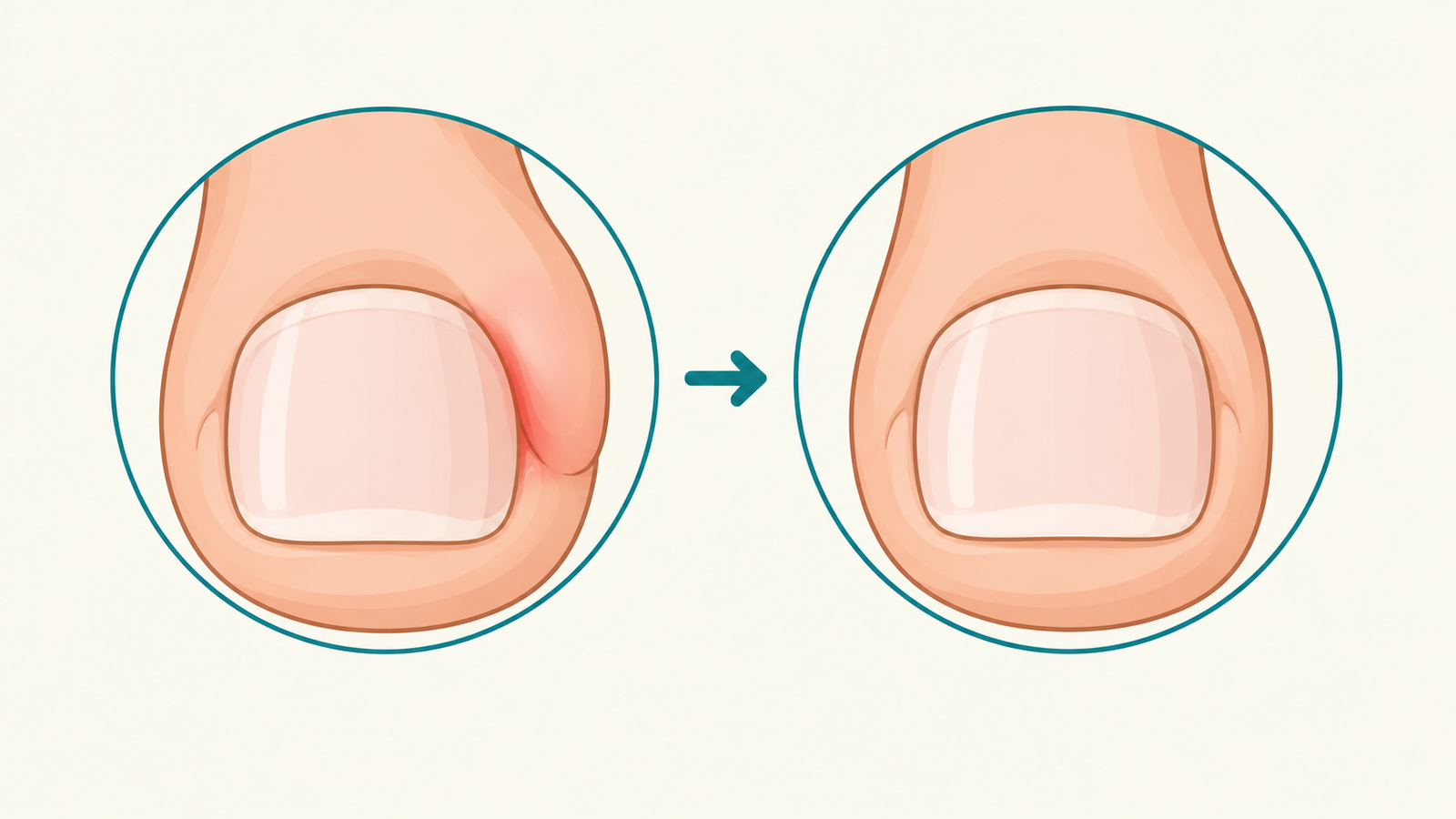
Some people have had one or more nail operations and the toenail keeps coming back. In many of these people, the nail was never abnormal. The real cause is an overgrown skin fold that keeps pressing on the nail edge. For them, the better operation is to remove a strip of the swollen skin and let the wound heal from the bottom up over about four to six weeks. As the tissue heals and contracts, the skin edge is gradually pulled below the edge of the nail, and the contact that caused the problem is gone for good. The nail keeps its full width.
This approach is especially useful for people who have failed previous nail root treatments, those with very thick skin folds and those who want to keep a natural nail width. Studies, including a large group of children and teenagers, report almost no recurrence and a return to school or work in about a week, even though the wound takes longer to fully close.
What the Research Shows?
Published research on ingrown toenail surgery supports several points:
- Removing the nail alone often fails: Studies report recurrence in roughly 30% to over 80% of people when only the nail edge is removed and the root is not treated.
- Treating the root works: Adding a chemical root treatment to nail edge removal lowers recurrence to around 1% to 5%, and studies of different agents show similarly low rates.
- Technique details matter: Short, controlled contact times give a better balance between preventing regrowth and limiting wound drainage than longer exposure.
- Skin fold surgery gives very low recurrence: Studies of removing the swollen skin fold, including in children and teenagers, report close to zero recurrence and a quick return to school or work.
These findings reflect published research; individual results depend on the person, the cause and the clinician’s technique.
Doctor Review Block
This article has been medically reviewed by Dr. Tejansu Dalal, MD (Dermatology), for clinical accuracy. The most important point for patients is that a recurring ingrown toenail is not a failure of care. It usually means the cause was not fully addressed. When the operation is matched to the real cause, whether the nail root or the skin fold, the problem can be solved for good.
References & Citations
This article draws on research on ingrown toenail surgery, including a review published by the National Center for Biotechnology Information on chemical treatment of the nail root, and a comparison of two surgical approaches indexed by the National Institutes of Health on skin fold removal versus wedge removal. Recurrence and recovery figures reflect published clinical research.